1.2.9 Indirect taxes and subsidies
What are indirect taxes?
Imposed by the government and they increase production costs for producers. Therefore, producers supply less. This increases market price and demand contracts
What are subsidies?
A payment from the government to a producer to lower their costs of production and encourage them to produce more
What are the two types of indirect taxes? Ad valorem and specific taxes
Ad valorem: A tax that is a percentage of the purchase price: such as VAT which adds 20% of the unit price. Main indirect tax in the UK
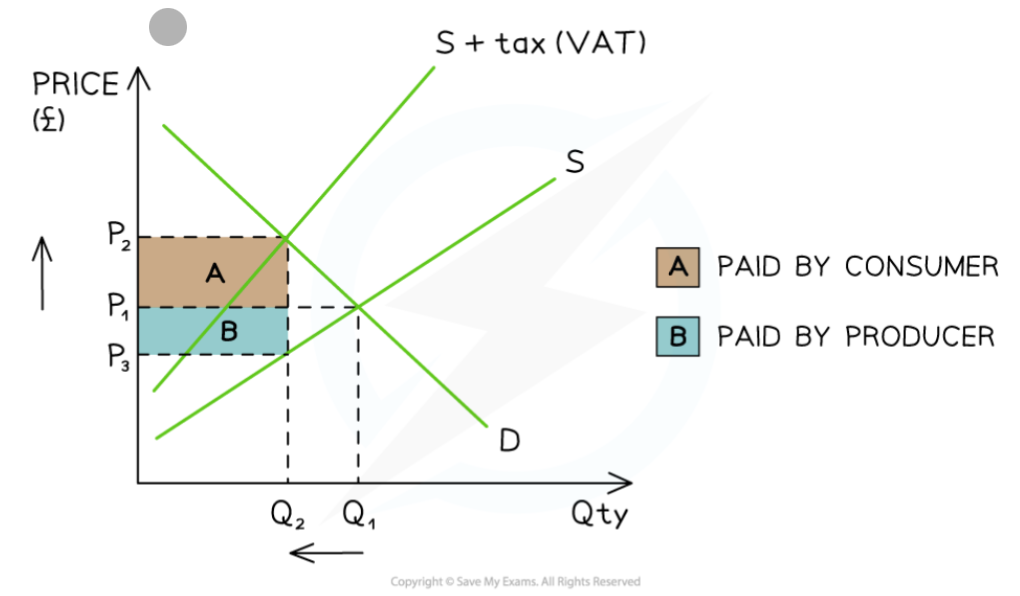
Initial equilibrium is at P1Q1
The government places an ad valorem tax to raise government revenue
Supply shifts left due to the tax from S → S + tax
The two supply curves diverge as a percentage tax means more tax is paid at higher prices
The price the consumer pays has increased from P1before the tax, to P2 after the tax
The price the producer receives has decreased from P1before the tax to P3 after the tax
The government receives tax revenue = (P2-P3) x Q2
Producers and consumers each pay a share (incidence) of the tax
The consumer incidence (share) of the tax is equal to area A: (P2-P1) x Q2
The producer incidence (share) of the tax is equal to area B: (P1-P3) x Q2
New equilibrium is at P2Q2
Final price of goods/service is higher (P2) and QD is lower (Q2)
Specific taxes: A set tax per unit, such as 58p per litre fuel duty on unleaded petrol
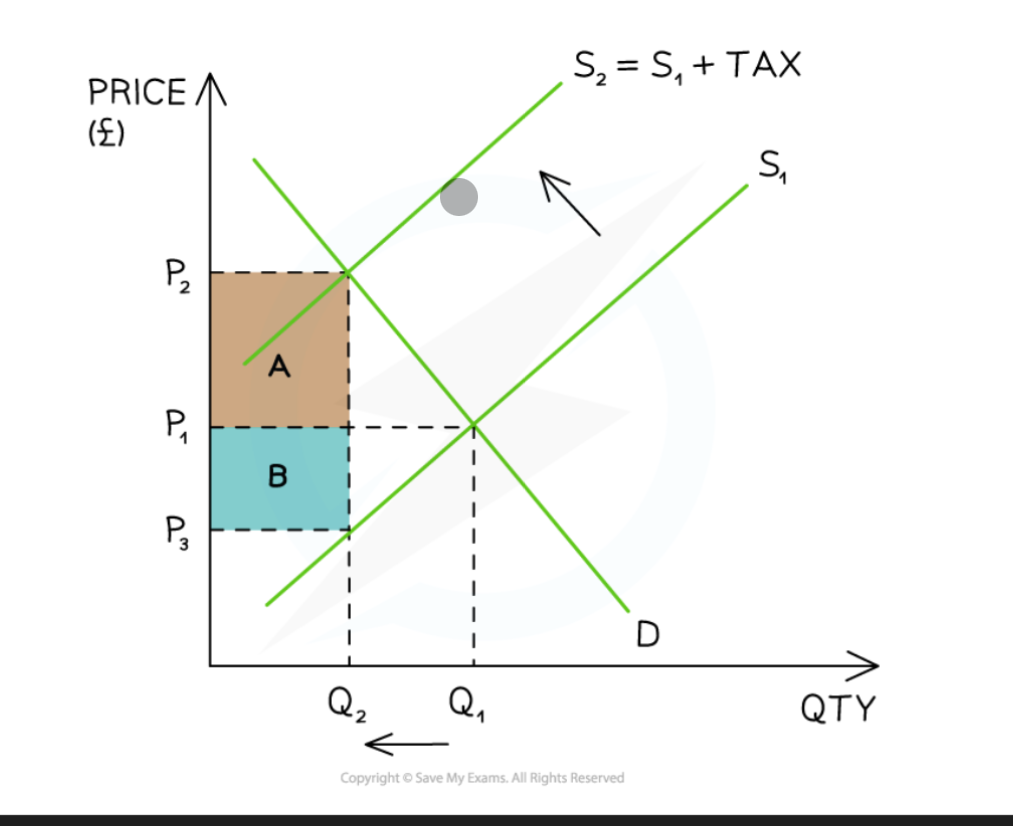
Initial equilibrium is at P1Q1
Government places a specific tax on a demerit good and curve shifts left from S1-S2 by the amount of tax
Price the consumer pays has increased from P1( before the tax) to P2 after the tax
Price the producer receives has decreased from P1 (before the tax) to P3 (after the tax)
Gov receives tax revenue (P2-P3) x Q2
Producers and consumers each pay a share (incidence) of the tax
-Consumer incidence (share) of the tax is equal to area A: (P2-P1) x Q2
-The producer incidence of the tax is equal to area B: (P1-P3) x Q2
New equilibrium at P2Q2
Final price is higher and quantity demanded is lower (Q2)
Subsidies
A producer subsidy is a per unit amount of money given to a firm by the government
To increase production
To increase provision of a merit good
The incidence (share) of the subsidy is determined by the PED of the product
If governments subsidise goods/services with high PED, the increase in QD will be more than proportional to the decrease in price
Producers keep some of the subsidy and pass the rest on to the consumers
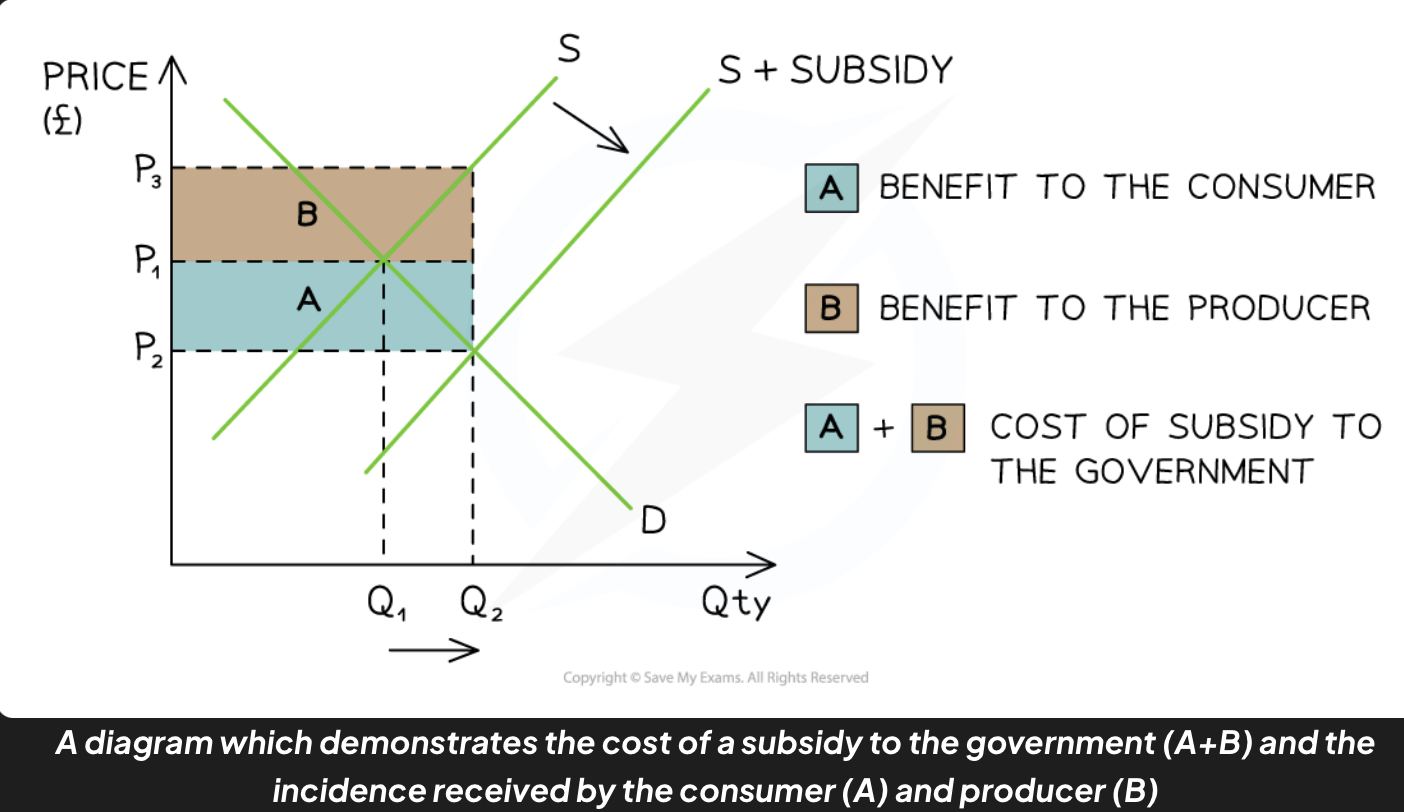
The original equilibrium is at P1Q1
The subsidy shifts the supply curve from S → S + subsidy:
This increases the QD in the market from Q1→Q2
The new market equilibrium is P2Q2
This is a lower price and higher QD in the market
Producers receive P2 from the consumer PLUS the subsidy per unit from the government
Producer revenue is therefore P3 x Q2
Producer incidence of the subsidy is marked B in the diagram
The subsidy decreases the price that consumers pay from P1 → P2
Consumer incidence of the subsidy is marked A in the diagram
The total cost to the government of the subsidy is (P3 - P2) x Q2 represented by area A+B