The Eye
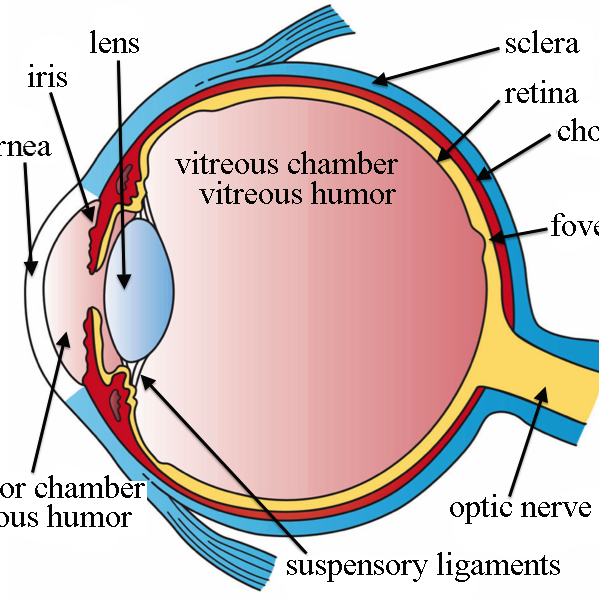
The human eye is a complex optical system that functions similarly to a camera. It consists of various parts that work together to focus light and create images.
Anatomy of the Human Eye
Cornea: Transparent front part that refracts light.
Lens: Flexible structure behind the iris that adjusts shape to focus light on the retina.
Pupil: Opening that allows light to enter the eye; size is controlled by the iris.
Retina: Layer of light-sensitive cells at the back of the eye that detects light and sends signals to the brain.
Optic Nerve: Transmits visual information from the retina to the brain.
Reflections:
Reflection occurs when light bounces off surfaces.
Law of Reflection: The angle of incidence equals the angle of reflection.
Most reflections can be categorized into two types:
Specular Reflection: Reflection from smooth surfaces, leading to clear images (e.g., mirrors).
Diffuse Reflection: Reflection from rough surfaces, resulting in scattered light and unclear images.
Lenses:
Lenses are transparent optical devices that refract light to converge or diverge it.
Types of Lenses:
Convex Lenses (Converging Lenses): Thicker at the center than at the edges; bring light rays together to a focal point.
Concave Lenses (Diverging Lenses): Thinner at the center than at the edges; spread light rays apart.
Focal length: (f) the distance from the optical centre of thee les to the focal point.
Optical centre: The central point of the lens, where light rays pass through undeviated.
Lens Formula:
The relationship between the object distance (u), image distance (v), and focal length (f) is described by the equation:
Magnification (m): Ratio of the height of the image to the height of the object:
Myopia and Hypermyopia:
Conditions related to improper focusing of light on the retina due to the shape of the eye.
Myopia (Nearsightedness):
Occurs when the eye is too long or the cornea is too curved.
Distant objects appear blurry because light focuses before reaching the retina.
Corrected using concave lenses that spread light rays.
Hypermyopia (Farsightedness):
Occurs when the eye is too short or the cornea is too flat.
Close objects appear blurry because light focuses behind the retina.
Corrected using convex lenses that converge light rays.
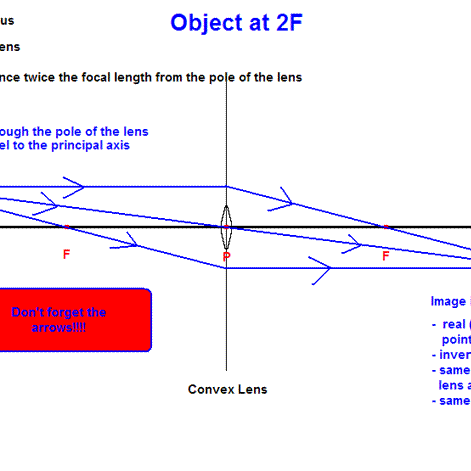
Ray diagrams are essential tools for understanding how lenses and mirrors form images. There are three key rules to follow when drawing ray diagrams for convex lenses.
1. A ray parallel to the principal axis passes through the focal point after refraction.
2. A ray that passes through the focal point before reaching the lens emerges parallel to the principal axis after refraction.
3. A ray that strikes the center of the lens continues in a straight line without bending.
These rules facilitate the accurate positioning of the image, which can be analyzed using the lens formula:
where f is the focal length, u is the object distance, and v is the image distance.