The Nervous System
the rest of the body bows down before the nervous system
the nervous system works by Sensory Input → Integration → Motor output
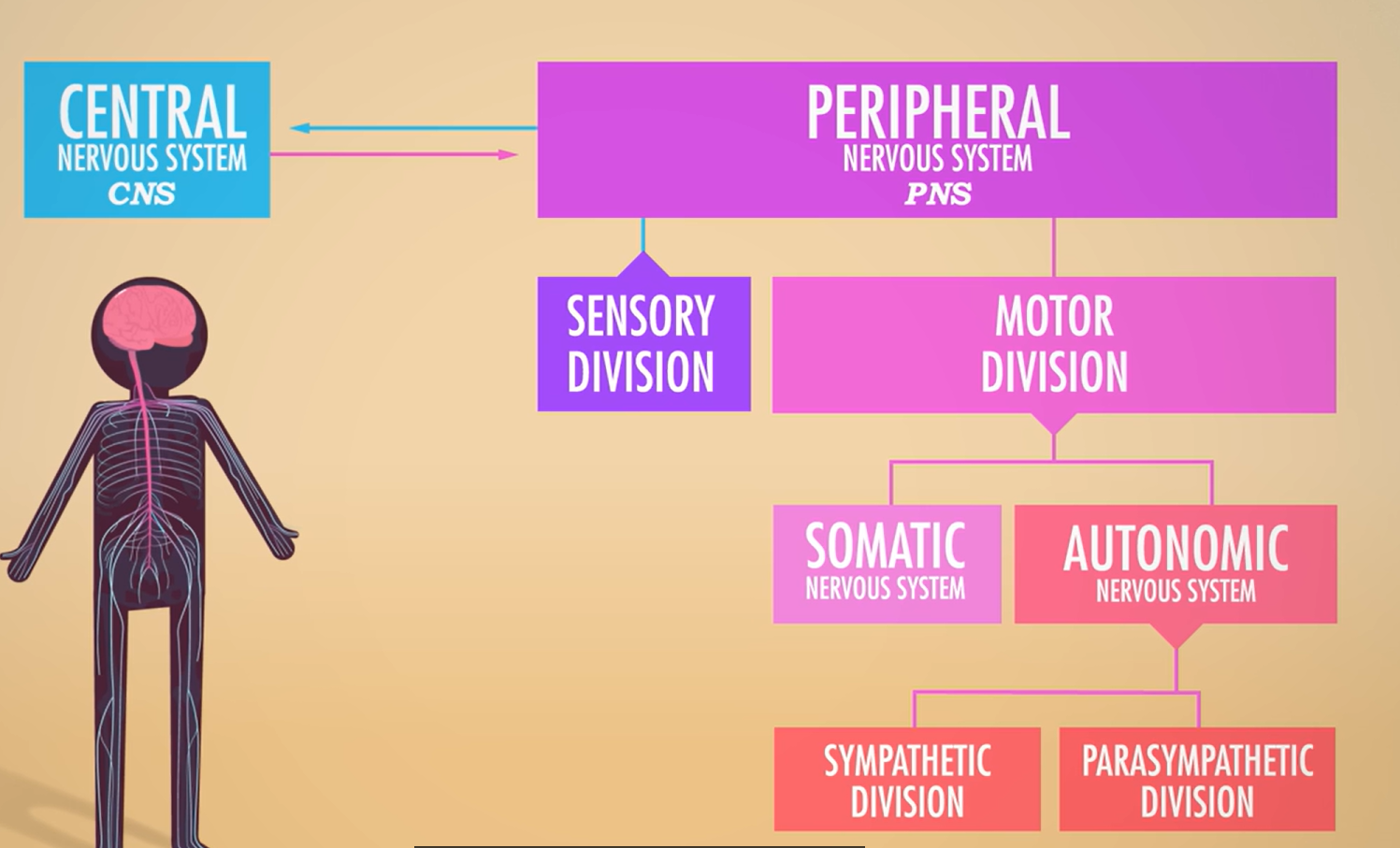
Here is a chart of how the nervous system is organized
All of the nervous system is mainly made up of nervous tissue
Neurons
Glial cells
Astrocytes are the most abundant glial cells, found in the central nervous system
Microglial cells are kind of thorny and also found in the CNS are your main defense against any invaders
Ependymal cells line the barriers of the brain and spinal cord and are what make and manage cerebrospinal fluid(CSF)
Oligodendrocytes… insulation
Peripheral nervous system glial cells
Satellite cells(like astrocytes.. “pit crew”)
Schwann cells (like oligodendrocytes.. insulation)
Types of neurons
Multipolar neurons - multiple dendrites
Bipolar - one dendrite
Unipolar - one process
Sensory carry info to the CNS, most are unipolar
Motor carries info away from the CNS to the rest of the body, most are multipolar
Interneurons carry info around the CNS; mostly multipolar
Part 2 - Sack of Batteries
neurons use real electricity, they are like small batteries
A polarized neuron is at rest
high potassium inside, high sodium outside
the resting rate is -70mV
IONS are just electrically charged cells
ION CHANNELS are what allow sodium and potassium to pass through the membrane, they are what opens at action potential
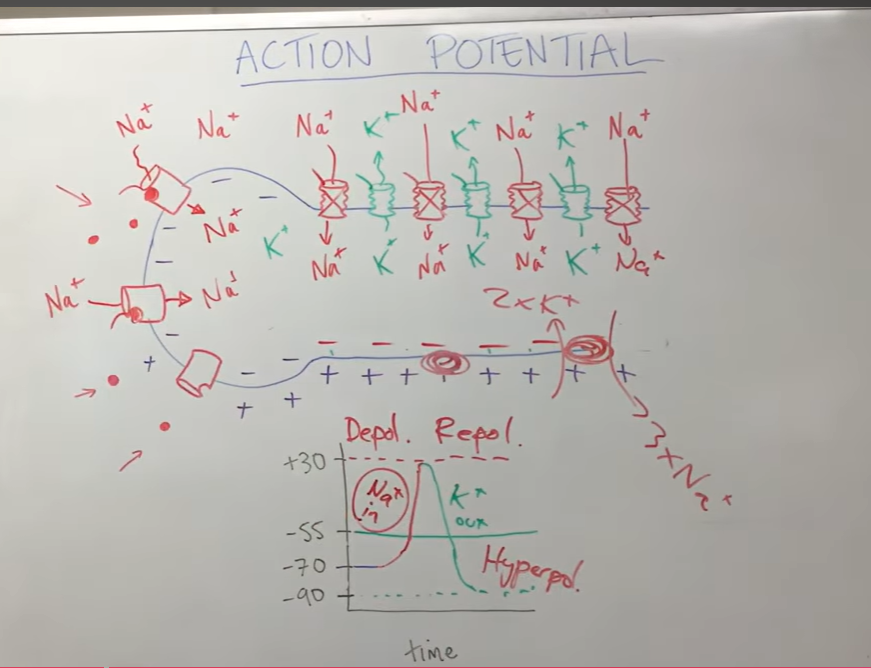
An action potential happens when the positively charged sodium ions enter the neuron and create a charge that goes above -55mV.
This causes the voltage gated sodium channels to all open in a chain like reaction down the neuron into the axon, which creates depolarization with all of the positively charged sodium ions coming into the neuron
When the inside of the neuron hits +30mV, all of the sodium gates close and potassium starts getting pumped out, this is repolarization.
the sodium-potassium pump is actively moving 3 sodium out and 2 potassium in after this happens in order to re balance the neuron
Axons that are coated with MYELIN have higher conduction velocities
Part 3 - Synapses
The synapse is the meeting point between two neurons
Chemical synapses are much slower, more abundant, precise, and selective
An electrical synapse is a type of connection between two neurons where electrical signals pass directly from one cell to another through gap junctions. These junctions allow ions and small molecules to flow freely between cells, enabling very fast and synchronized communication
The presynaptic terminal is the end of an axon that sends the message. it connects an axon to a dendrite
Holds synaptic vesicles which are plasma membranes holding packets of neurotransmitters
the synaptic cleft is the tiny gap between the terminal and the receiving neuron
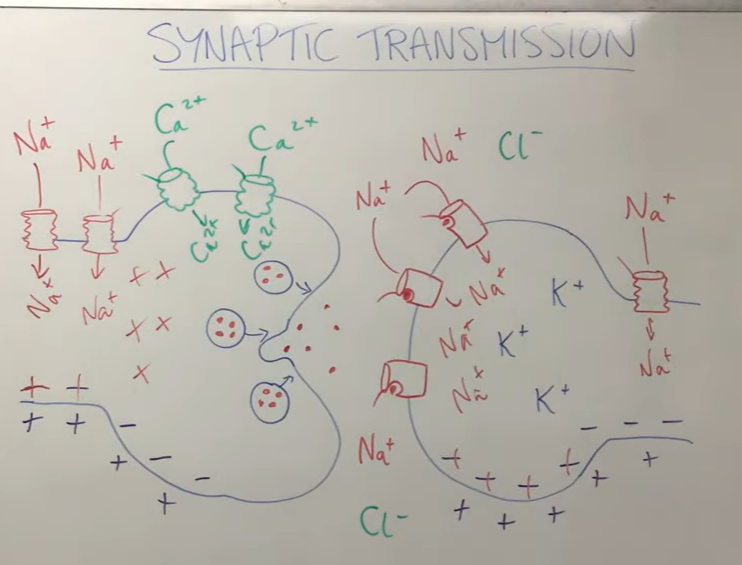
the synaptic terminal has voltage gated calcium channels instead of sodium
calcium stimulates the synaptic vesicles(plasma membranes which hold neurotransmitters inside)
the synaptic vesicles then move and fuse with the plasma membrane that walls the synaptic terminal and release the neurotransmitters inside of them
they then move across the synaptic cleft and bind to receptors on the dendrite of the other neuron
they can either be excitatory or inhibitory
An excitatory neurotransmitter polarizes the postsynaptic neuron
An inhibitory neurotransmitter hyperpolarizes the postsynaptic neuron
Part 4 - Central Nervous System
the brain is directly connected to the spinal cord, and the spinal cord governs basic muscle reflexes and patterns, while the brain is responsible for thinking, feeling, and remembering.
Cerebellum - Coordinates muscular activity
Brain Stem - Relays information between the body and the higher regions of the brain.
The three main regions of the brain stem regulate many of the key involuntary functions of the body
Midbrain - receives and processes sensory information to make u react without thinking
Pons
Medulla Oblongata
Diencephalon(Reptilian/Caveman brain)
Thalamus
Hypothalamus - regulates homeostasis, alertness, and reproductive activity
Epithalamus
Mamillary body
Limbic System - center for strong emotions, like fear
Telencephalon(Cerebrum) - made up of grey(outside) and white matter(inside)
Frontal lobe - governs muscle movement, motor skills, and cognitive functions that require conscious thinking
Occipital lobe - processes bright visual cues
Parietal lobe - processes sensations of touch, pain, and pressure
temporal lobe - helps sort out auditory information
The limbic system is also here
Amygdala - social and sexual behavior
Hippocampus - short term memory
DEVELOPMENT
Neural Tube
Prosencephalon
Telencephalon
Diencephalon
Mesencephalon
Rhombencephalon
Metencephalon
Myelencephalon
Part 5 - Peripheral Nervous system
the peripheral nervous system outs your brain in touch with your outside environment. It has different types of sensory nerve receptors.
thermoreceptors - temperature
photoreceptors - light
chemoreceptors - chemicals
mechanoreceptors - pressure, touch, vibration
nociceptors - PAIN
The MOTOR DIVISION is responsible for carrying signals from the CNS to the body
Reflex ARC
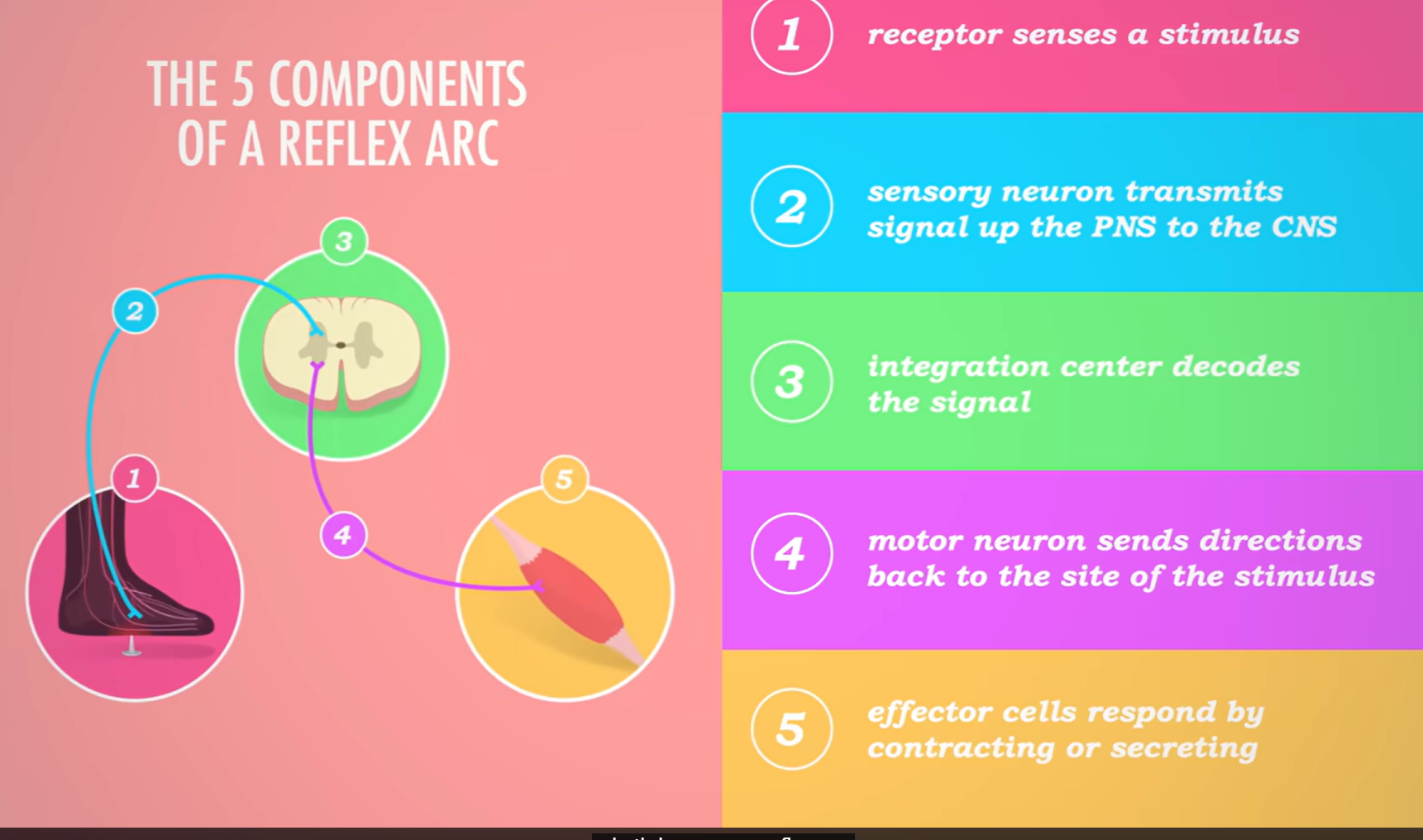
Innate/Intrinsic Reaction - a super fast motor response to a starting stimulus
Learned/Acquired reflexes - come from experience
Muscle and tendon spindles are what keep them from over stretching
Part 6 - Autonomic Nervous system intro
the autonomic nervous system regulates your organs, smooth and cardiac muscles, and glands… it does all of this automatically and is inconsistent
Sympathetic nervous system is the “lively” part of it and controls the fight or flight response… it is responsible for stress
Is located throughout the thoracic spine
ganglia is found in the spine, short
The parasympathetic nervous system is the “chill” part. Its what makes us feel at peace
is located at base of the brain(upper neck) and the tailbone.
ganglia is found way outside of the spine, very long
A Ganglia is a cluster of neuron synapses all located in the same place
both parts of the autonomic nervous system require at least two neurons in order to work, unlike the PNS being able to have just one long axon
The sympathetic nervous system is set up in such a way that even a small stress signal sent down one path could trigger a response in many effectors at once. Which is one reason why your reaction to a sudden, stressful event can feel so all-encompassing.
By the same token, the resting and digesting that’s overseen by the parasympathetic system doesn’t require urgent, all-hands-on deck communication. If you need to process a burrito or take a nap or maybe a trip to the bathroom, it can communicate with the organs involved, one on one.
Part 7 - Sympathetic nervous system(aka the stress system)
Our sympathetic nervous systems response to non immediate stresses is largely the same as the response to fighting for survival
The stress response involves two kinds of chemicals:
Neurotransmitters(what neurons use to communicate with one another)
Hormones - chemical messengers secreted by glands into the bloodstream that regulate vital functions(mood, thirst metabolism, homeostasis, etc.)
THE STRESS RESPONSE (for neurotransmitters)
Your brain sends action potentials down your spinal cord and preganglionic neuronal axons which flow all the way to their ganglia.
When the signals reach the synapses inside the ganglia, the nerve fibers then release a neurotransmitter -- called acetylcholine, aka ACh - a key neurotransmitter used for various functions
So, that acetylcholine crosses the synapse and, if there’s enough of it, it can stimulate action potentials in several neurons on the other end -- in the postganglionic fibers.
And at the end of that second, postganglionic neuron, the fiber releases a different neurotransmitter called norepinephrine which helps carry out the action
preganglionic - ACh
postganglionic - norepinephrine
A substance is a neurotransmitter or a hormone based off of where its at in your body.
Norepinephrine can help increase or decrease bloodflow to certain parts of the body at the same time depending on what’s most important at the moment
^^^weather something restricts or opens more depends on the receptor. norepinephrine receptors are in smooth muscle(organs or blood vessels)
alpha receptors cause it to contract - vasoconstriction
beta receptors cause it to relax - vasodilation
Part 8 - parasympathetic nervous system(the rest system)
in the parasympathetic nervous system, the postganglionic cell continues to release more ACh rather than norepinephrine
remember that the nerves of the parasympathetic are craniosacral - right under the brain and also in the tailbone. they run right from the brain almost all the way to their effectors, there are 12 of them… they all are sensory, motor, or both
1. Olfactory nerve S
2. Optic nerve S
3. Oculomotor nerve - controls 4 of 6 eye muscles M
4. Trochlear nerve - controls a single eye muscle(looking down) M
5. Trigeminal nerve - Largest, control face and jaw muscles B
6. Abducens - controls eye muscle looking side to side M
7. Facial nerve - makes facial expressions possible B
8. Auditory nerve S
9. Glossopharyngeal nerve - tongue B
10. Vagus nerve - heart and digestive tract B
11. Spinal accessory nerve - head and shoulder movement M
12. Hypoglossal - swallow and talk M