MS111
Week 1: Evolution and Biodiversity
Key Words
marine biodiversity: the variety of life in our ocean
biodiversity hotspots: areas of high biodiversity that support processes such as nurseries, spawning, or feeding
functioning ecosystem: the natural processes are working effectively
Key Concepts
The earth formed 4.5 billion years ago.
Photosynthesis began more than 2.5 million years ago with the Great Oxidation Event.
Marine biodiversity allows our oceans to be productive, resilient, and adaptable.
Fishing has had the greatest impact on marine biodiversity in the last 50 years.
Major risks to biodiversity are bycatch, invasive species, pollution, overfishing, and climate change (BIPOC).
Week 2: Oceanography & Bathymetry
Key Words
oceanography: the study of the physical, biological, geological, and chemical properties of the sea
continental margin: stretches out as far as the eye can see and has 3 aspects; the shelf, slope, and rise
shelf: an underwater landmass that extends from a continent, resulting in an area of relatively shallow water known as shelf sea
slope: the area between the shelf and rise that has a steep grade and irregular erosion by currents, forming valleys and canyons
rise: found between the slope and the abyssal plain
volcanic islands: form when a volcanic eruption rises above the surface and forms an island
seamounts: undersea mountains formed by volcanic activity that do not reach the water’s surface
Deep sea trenches: deep, V-shaped trenches
mid-ocean ridges: mountain chains in the middle of the oceans
atolls: a ring-shaped coral reef including a coral rim that encircles a lagoon partially or completely formed when an extinct volcano or seamount has eroded partially beneath the water
abyssal plain: the ocean-basin floor, made up of abyssal hills
abyssal hills: a small hill that rises from the floor or an abyssal plain
Key Concepts
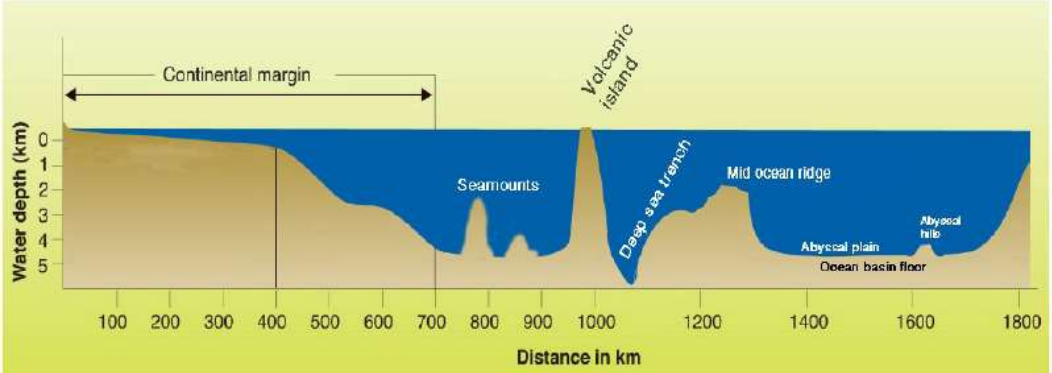
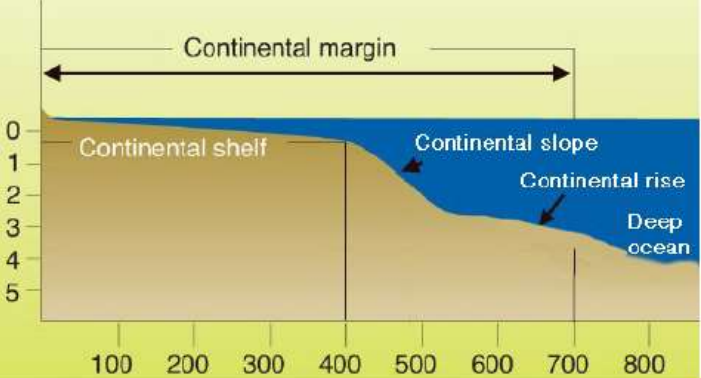
The continental margin is made up of the continental shelf, slope, and rise.
The continental rise can be shared between two countries: In the Timor Sea Oil and Gas Treaty, both Australia and Timor-Leste have legitimate sovereign rights over the gas fields in their continental rise. They share the benefits.
Abyssal hills are the most abundant geomorphic structure on earth
Week 2: Ocean Currents and Heat Distribution
Key Words
Coriolis effect: the deflection of moving objects (to the right in the northern hemisphere and left in the southern hemisphere) caused by the rotation of the earth tilted on its axis
convection currents: a cycle of movement in fluids (liquids or gases) caused by the uneven heating of the fluid
gyres: a large system of rotating ocean currents, driven by wind patterns and the earth's rotation, typically found in the major ocean basins
thermohaline circulation: a global ocean circulation pattern driven by differences in water temperature and salinity, which affects the density of seawater and influences deep ocean currents
flood current: tide coming in
ebb current: tide going out
spring tides: occur when the gravitational pull of the sun and the moon are combined and the tides are at their highest
neap tides: occur during a first quarter moon and again at a last quarter moon phase, the sun is at right angles to the moon
Antarctic circumpolar current: the powerhouse for global climate, connecting the Atlantic, Pacific, and Indian oceans in an eastward flow and features a region of high nutrient production south of Australia
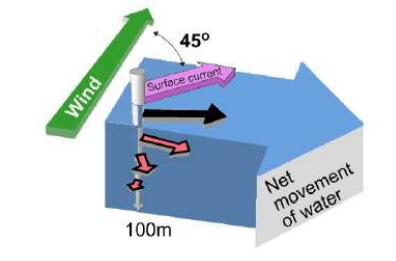
Ekman transport: the net movement of water at an angle to the direction of the wind due to the Coriolis effect, resulting in a spiral pattern of water movement
Ekman spiral: the gradual change in direction and speed of ocean water layers with depth, where each successive layer moves at a greater angle to the wind, creating a spiral effect in the water column
upwelling: ekman transport moves surface waters away from the coast and they are replaced by the water that wells up from below
downwelling: ekman transport moves surface waters toward the coast where it piles up and sinks down
el nino: the trade winds’ push on the ocean surface falls and warm water that was once driven westward now runs back towards the central pacific, causing hot air to rise and split the trade wind circulation pattern. Stops upwelling in Peru
la nina: easterly trade winds push large amounts of warm water across the pacific causing upwellings in Peru and a monsoon in Australia
Key Concepts
Unequal heating of the earth happens because the sun’s rays hit the earth at a perpendicular angle at the equator, causing warmer temperatures as less heat is dispersed. The sun’s rays hit earth parallel to the poles, causing more heat to be dispersed making cooler temperatures.
Heat distribution: heat is distributed around the earth by currents pushing warmer waters from the equator toward the poles and back.
Heating at the equator causes air to rise which creates areas of low pressure. That hot air moves towards the poles where it cools and sinks, creating areas of high pressure.
Surface currents are driven by wind and deep water currents are driven by differences in density.
Gyres are located in the Indian Ocean, North Pacific, South Pacific, North Atlantic, and South Atlantic.
Thermohaline circulation: The sun heats water north of the equator in the Atlantic and drives it from the Gulf Stream towards northern latitudes, distributing heat into the atmosphere in the poles. This loss of heat to the atmosphere causes the water to cool and sink as it is more dense. More warm water is transported north and pushes this cooler water down along the ocean floor to Antarctica. Eventually, the cold bottom waters return to the surface through mixing and wind-driven upwelling, continuing the conveyor belt around the globe.
Tutorial Questions
Discuss the factors that affect ocean currents:
Heat from the sun on the ocean alters the density of the surface water by changing its temperature
Coriolis effect modifies the course of ocean currents by deflection to the right in the northern hemisphere and to the left in the southern hemisphere
Wind drives surface currents
Density drives deep currents
Why are ocean currents important?
Nutrient distribution through upwelling and downwelling
Currents help regulate the earth’s temperature by distributing heat to the poles
Water turbines get energy generation from the currents
Characteristics of gyres:
large, circular ocean currents formed by the Coriolis effect and global wind patterns
Week 3: Marine Geology
*different setup because this unit was not focused on by Prasad*
Tutorial Questions
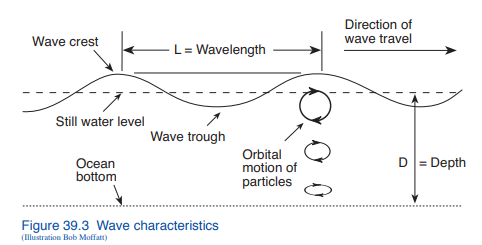
Describe, with the aid of diagrams, the basic characteristics of a wave
crest: the highest point of a wave
trough: the lowest point of a wave
wave height (H): the vertical distance between the crest and the trough
wavelength (L): the distance between two successive crests
Explain longshore drift:
Longshore drift is when the currents hit the beach at an angle and carry sand and sediments down the beach, creating things like sandbars.
Briefly explain the difference between an eroding beach and an accreting beach:
eroding beach: during storms, the sandbar from the longshore drift moves further out to sea fed by sand from the dunes
accreting beach: when calm weather moves sand onto the beach by wave bores and they deposit layers in micro ridges
Describe the different types of plate boundaries:
Divergent plate boundaries are when plates move away from each other, causing earthquakes and mid-ocean ridges. Convergent plate boundaries are when plates come together, causing mountain ranges or seafloor trenches. Transform plate boundaries are when the plates slide past each other and create fault zones.
Provide evidence for plate movements:
most earthquakes originate in areas where plates collide
the ocean floor near ocean ridges has very little sediment buildup because this is where the ocean floor is spreading and the new crust is being formed
continents have been measured to be moving apart at 3 cm/year
volcanic island chains in the Pacific show movement of the ocean floor
Why are biogeochemical cycles important?
Biogeochemical cycles such as the water or carbon cycle are crucial for maintaining the balance of ecosystems, supporting life by recycling nutrients, and regulating climate. They help ensure that living organisms have access to the necessary resources for growth, reproduction, and survival.
Give an example of a biogeochemical cycle and describe how it works:
The water cycle is the continuous process through which water moves between the Earth's surface and the atmosphere. It begins with evaporation, where water from oceans, rivers, and lakes turns into vapor and rises into the air. As the vapor cools, it condenses to form clouds through condensation. Eventually, the water falls back to the surface as precipitation, such as rain or snow. This water then flows into bodies of water, infiltrates the ground, or is taken up by plants, and the cycle repeats.
List the major plates of the world:
African
Antarctic
Eurasian
Indo-Australian
Pacific
South American
Provide examples of the three plate boundary interactions:
Divergent: mid-Atlantic ridge
Convergent: Pacific Ring of Fire
Transform: San Andreas Fault Line
Week 4: Classification & Marine Biodiversity
Key Words
taxonomic key: uses a choice of characteristics to differentiate a species or other taxonomic ranks (present or absent, round or square)
pelagic habitat: water column
benthic habitat: reefs, seagrass beds, mangroves, sediment
primary production: organisms, such as phytoplankton and seaweed, that convert sunlight or inorganic compounds into organic matter through photosynthesis or chemosynthesis, forming the base of the marine food web
Key Concepts
The order of the taxonomic ranks is: Kingdom, Phylum, Class, Order, Family, Genus, Species.
Defining biodiversity is important for ocean understanding, utilization (e.g. fisheries), conservation (e.g. of endangered species), and management (e.g. human influences and assets).
Tutorial Questions
What is classification and why is classifying organisms important?
Classification is grouping organisms according to their likeness and special traits and it is important for keeping track of organisms that have been discovered and identifying possible new species that are discovered.
Why does each organism need to have an acceptable scientific name?
Each organism needs an acceptable scientific name so it can be recognized worldwide, no matter what language is being spoken in that area. The scientific names are worldwide standardization.
Describe the binomial nomenclature:
Binomial nomenclature is identifying organisms by their genus and species. Genus comes first and has a capitalized first letter. Species come second and is all lowercase. Both words are italicized.
Describe the three levels of biodiversity:
Genetic diversity: the variety of genes within a species
Species diversity: the number of different species and the abundance of each species within a given area
Ecosystem diversity: the variety of ecosystems in a particular region, including the different habitats, communities, and ecological processes that support various forms of life
Describe one ecosystem function of any ecosystem (asking how an ecosystem can benefit humans):
Mangroves root themselves in coastlines and are the first line of defense when it comes to tsunamis. They protect the inland land and help prevent erosion.
Week 4: Plankton
Key Words
plankton: a diverse collection of organisms that live in the water column and are unable to actively propel themselves against currents
phytoplankton: plant-like plankton
zooplankton: animal-like plankton
diatoms: unicellular phytoplankton encased in a siliceous cell wall, often live in aggregations
dinoflagellates: unicellular phytoplankton with flagella that help them move
meroplankton: organisms that spend only part of their lives in the plankton
holoplankton: organisms that spend all their lives as planktonic
Key Concepts
Phytoplankton are primary producers and directly influence the trophic levels above them, known as bottom-up control.
Factors contributing to phytoplankton success:
Photosynthesis: efficient conversion of light energy into chemical energy
Growth: rapid reproduction rates that enhance population dynamics
Resource acquisition: effective strategies for obtaining nutrients and light
Grazer avoidance: adaptations to minimize predation and infection
Organisms like copepods and most shrimps are holoplankton, whereas barnacles, lobsters, and crabs are meroplankton.
Copepods are the most abundant animal in the ocean.
Diurnal vertical migration of copepods is when copepods spend daytime in colder, deeper waters to avoid predators and conserve energy…and they spend nighttime at the surface where they are less likely to be eaten.
Week 5: Seawater, Seawater Chemistry & Seawater Conditions
Key Words
solute: the salt dissolved in water
concentration: grams per liter of the solute
conductivity: how well electricity travels through water
refractometer: a handheld device that measures the change of direction or bending of light as it passes from air to water
isohaline: lines on a figure that join places of the same salinity
thermocline: changes in temperature with depth
pycnocline: changes in density with depth
halocline: changes in salinity with depth
pH: potential of hydrogen is a measure of the acidity of a substance
ocean acidification: worldwide reduction in the pH of seawater as a consequence of the absorption of large amounts of carbon dioxide by the oceans
polar covalent water molecule: two electrons shared but not shared equally in the asymmetrical molecule
hydrogen bond: bond between hydrogen and some electronegative atom
surface tension: when air meets upper layers of liquid water the hydrogen bonds are strong and make a type of tense skin on the water
viscosity: the resistance of a liquid flowing through or passing an object
density: the number of grams of a substance found in a given volume
heat capacity: the ability of water to resist temperature change
salinity: how much of dissolved salts are present in a body of water
diffusion: the process where particles move from an area of higher concentration to an area of lower concentration until they are evenly distributed
latent heat of vaporization: the amount of heat needed to convert liquid to gas at a constant temperature
latent heat of melting: energy needed to turn solid to liquid
ionization: process of breaking apart ions (electrical charges)
Key Concepts
Seawater’s unique characteristics are that it is an excellent solvent, has a high heat capacity, has variable density, and can absorb light.
Dissolved gases enter the ocean from the atmosphere by a process called diffusion, or are released from animals and plants that live in the ocean.
Concentrations of oxygen and carbon dioxide vary according to the biological processes such as photosynthesis and respiration. Nitrogen values remain fairly constant.
Aerobic organisms need oxygen to extract energy from organic molecules and dissolved carbon dioxide is necessary for autotrophic nutrition.
Temperature gradients within the ocean determine where most animals and plants will live. The temperature controls the metabolic rate of all cold-blooded animals and controls distributions of warm-blooded animals who are poorly adapted to change in temperature.
Light entering the ocean is absorbed and converted to heat.
Red light is absorbed by the ocean first with blue and violet light penetrating the furthest.
Marine plants that photosynthesize are limited to live only in the photic zone.
A covalent bond in a water molecule links one H to the O.
A hydrogen bond in water molecules links one H from one water molecule to an O in a separate water molecule.
A water molecule is polar because the negatively charged electrons are not shared equally in the asymmetrical molecule.
Water that has dissolved salt in it will conduct electricity better than water with no dissolved salt.
The more salt in the water, the slower light moves.
The biological significance of temperature:
animal migrations occur due to temperature
whales migrate to warmer waters to calf
corals spawn at certain temperatures and the composition and texture of marine animals and plants are governed by temperature
animals that live on the rocky shores also develop protective coverings to compensate for temperature changes
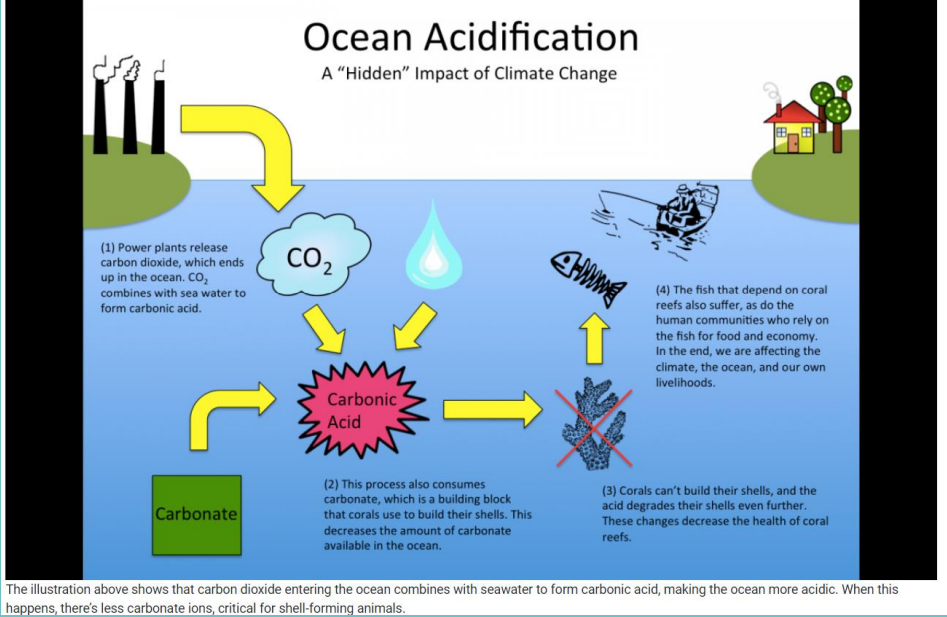
Basics of ocean acidification:
the worldwide reduction in the pH of seawater as a consequence of the absorption of large amounts of carbon dioxide by the oceans
largely the result of vehicles, industries, and agricultural practices loading the atmosphere with CO2
the pH declines, making the ocean more acidic
increased acidity reduces the concentration of carbonate ions and the availability of aragonite (a significant source of calcium carbonate). Organisms that use carbonates (coral, shellfish, and other marine calcifiers) will have less available materials to maintain their skeletons and shells
Tutorial Questions
What special properties does polar covalent bonding give water?
enormous ability to dissolve substances
high heat capacity
multiple physical states (gas, liquid, solid)
high latent heat of vaporization
viscosity
surface tension
State the salts in seawater and their origin:
NaCl, MgCl2, (NaSO2)4, KCl, and CaCl2 come from runoff from land rocks or coming up through cracks in the seafloor.
Explain why icebergs float in seawater:
Ice is less dense than water because salt is excluded when ice forms. Less salt equals lesser density. Less dense water will float while more dense water will sink.
State what an Oxygen Minimum Zone is and explain how it is formed:
Persistent layers in the water column that have low oxygen concentration due to biological, chemical, and physical processes. Stratification allows these layers to persist over large stretches of geological time. This zone forms where the oxygen is consumed by the decomposition of sinking organic matter faster than it can be replenished due to limited mixing. Also called dead zones.
Week 6: Marine Plants
Key Words
infauna: species that spend most or all of their adult life within the substrate, boring into hard substrates or burrowing in soft sediments
epifauna: animals that may move over, or are attached to, hard or soft substrates
primary production: rate of photosynthesis or chemosynthesis
seagrass roots: anchor the seagrass and absorb nutrients
seagrass rhizomes: part of seagrass that spreads beneath the sediment to store nutrients and help the seagrass propogate
epiphytes: organisms like algae, bacteria, and small invertebrates that grow on seagrass leaves, competing for light and nutrients
epifauna: animals such as crustaceans, molluscs, and worms that live on seagrass leaves and sediments, grazing on epiphytes to prevent overgrowth and promote nutrient cycling
mariculture: the farming of seaweeds
phycocolloids: gelatinous chemicals produced by seaweeds that are used in food production and product manufacturing
Key Concepts
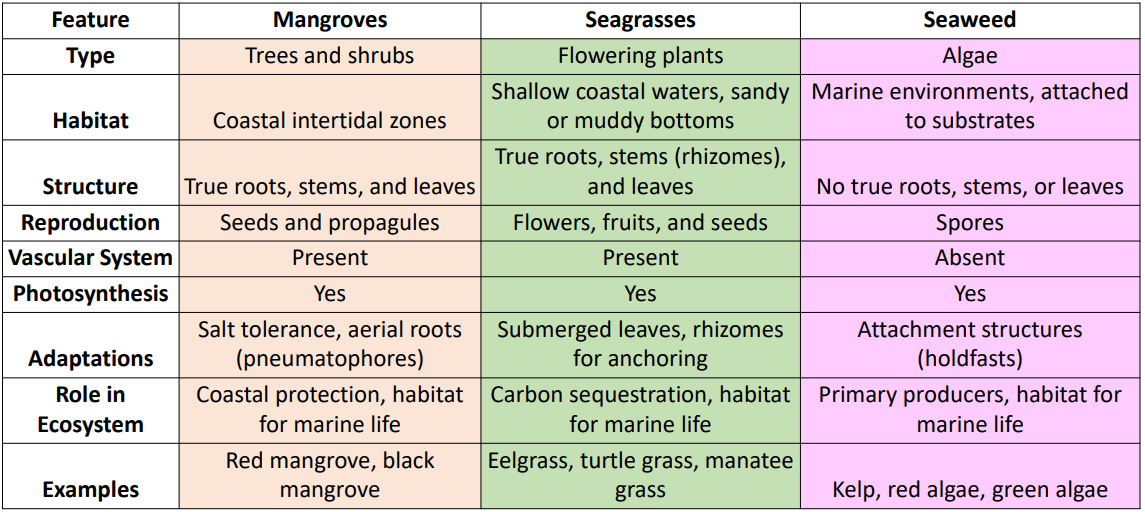
Mangrove distribution is controlled by climate, salinity, tidal fluctuation, sedimentation, wave energy.
Mangrove ecological functions:
transitional zones: mangroves thrive in areas that are neither terrestrial or aquatic
provide shelter
serve as nursery spots
sink many contaminants before reaching the ocean
highly productive area
sites for accumulation of carbon, nutrients, and sediments
Mangrove anthropogenic services:
provide wood
protect inland areas from tides and hurricanes
host many species of fish
provide food and medicine resources
Mangroves trap contaminants (including heavy metals) from land before they reach the marine environment. This is why they are called “sinks”.
Challenges that mangroves face include:
construction
deforestation
overfishing
sea level rise
temperature rise
salinity rise
Seagrasses are primary producers. They utilize sunlight or chemical nutrients as a source of energy to produce organic matter from CO2 usually by photosynthesis.
Factors affecting primary productivity:
light: essential for photosynthesis (aka productivity)
nutrients: essential for the growth of seagrass, which makes them stronger and able to do more photosynthesis
hydrographic conditions: conditions like temperature and salinity can promote or hinder growth
currents: transport producers to different areas
upwelling: increase in nutrients increases productivity
vertical mixing: distribution of oxygen and nutrients throughout the water column supports growth and overall productivity
Week 7: Phylums Protozoa and Porifera
Key Words
open circulatory blood system: moving blood flows from the vessels and into the sinuses, bathing the internal organs and eventually seeping back to the heart
closed circulatory blood system: the blood remains in the vessels following a specific path- heart to arteries to capillaries to veins to heart (hacvh- heart apple cider vinegar heart)
radial symmetry: can be divided into similar halves by multiple planes that pass through a central axis (a starfish looks the same when cut in any direction)
bilateral symmetry: can be divided into two mirror-image halves along a single plane, usually with a distinct left and right side (like a crab)
Key Concepts for Protozoa
Domain: Eukarya. Kingdom: Protista. Phylum: Protozoa
- Class Rhizopoda (Amoeba):
Amoeboids are characterized by pseudopodia or cytoplasmic extensions
They have holes called foramina
Amoeboids are constantly moving so pseudopodia are not fixed, they can recede back into the main body and then extend when needed
Consume prey by phagocytizing: pseudopodia take in prey and then direct it to the cell’s food vacuoles
Consume algae, bacteria, or other protozoans
Marine amoebas include foraminiferans and radiolarians
They have pores in their outer membrane through which the pseudopodia passes through to extract food
They have a chalky carbonate shell (or test) that sinks to the bottom after the animal dies forming a fine sediment known as “ooze”. Ooze forms chalk and silicon beds. Fossilized ooze can be used to measure climate from long ago because the shell changes with water temperature
-Class Ciliate and Flagella
CILIATE
cilia: special hairs used for movement and feeding
gullet: specialized opening that is a channel/funnel for feeding
digestion occurs in vacuoles
nutrients absorbed into cells and residue goes out through the anal pore
FLAGELLATA
flagellum: whip-like hairs called flagella used for locomotion
lifestyles include autotrophic, heterotrophic, parasitic, and symbiotic
may be solitary, colonial, free-living, or parasitic (parasites live in the bloodstream of the host, and many others live as plankton)
a comparison of a ciliate and a flagellate:
Euglena | Paramecium |
flagellate | ciliate |
animal and plant characteristics | animal characteristics |
has chloroplasts | does not have chloroplasts |
both heterotroph and autotroph | heterotroph |
can survive droughts without water or light | cannot survive droughts without water or light |
has flexibility due to pellicle | no pellicle, no flexibility |
Key Concepts for Porifera
Domain: Eukarya. Kingdom: Protista. Phylum: Porifera
Phylum Porifera only has sponges
-Sponges:
have many pores and cells but no organs
filter food particles from water
skeletal structure consists of limestone or silica spines
attached to seafloor on rocks, sea plants, shells of animals, and artificial structures
found at all depths
brightly colored
Tutorial Questions
Differences in structural characteristics between Porifera and Protozoa:
Characteristic | Protozoa | Porifera |
cell structure | unicellular | multicellular |
tissue organization | no true tissues | true tissues (simple) |
body plan | simple, single-celled | asymmetrical, porous body |
cell wall | absent (some have pellicles) | present (made of silica or calcium carbonate) |
movement | motile (using cilia, flagella, or pseudopodia) | mostly sessile |
reproduction | asexual (binary fission) and sexual (conjugation) | asexual (budding) and sexual (via gametes) |
feeding mechanism | heterotrophic (phagocytosis, absorption) | filter feeders |
specialized structures | organelles (vacuoles) | |
nervous system | no nervous system (some have simple responses) | no nervous system (response through cell signaling) |
habitat | fresh and salt water | salt water |
Week 7: Cnidaria
Key Words
medusa: basic cnidaria body form that is umbrella-shaped with the mouth/anus opening pointing down
polyp: basic cnidaria body form that is cylindrical and has the mouth/anus opening at the top
nematocysts: stinging cells
fission: intratentacular reproduction; the mouth forms new polyp within the original ring of the parent tentacles, division of existing polyps
budding: extratentacular reproduction; new polyp is formed outside the original ring or parental tentacles from tissue between existing polyps
brooding: asexual production of planula larvae genetically identical to parent colony
fragmentation: breakage of smaller sections of a coral colony, new polyps can grow over the substrate they land on creating a new colony
mass spawning: when many coral colonies release their eggs and sperm into the water at the same time, usually synchronized with environmental cues like lunar phases or water temperature
Key Concepts
Phylum Cnidaria includes corals, jellyfish, gorgonians, soft corals, anemones, and sea pens.
Cnidaria are sac-like animals with body plans arranged in a circle and a sac at one end with two cell layers and stinging cells.
Cnidarians are radially symmetrical. They may be attached by means of a basal disc to form a polyp like corals or may drift in the water as a free-swimming medusa, like a jelly.
Three tissue types are outer epidermis, middle mesoglea, and inner gastrodermis.
Corals reproduce asexually by budding and sexually by mass spawning events.
-Class Anthozoa (sea anemones)
the tentacles are connected to a mouth which leads down to a hollow gut which is where food is digested
wastes are ejected out of the mouth
sea anemones can move by sliding on their basal disc or by somersaulting from place
reproduce by growing small buds on their sides or by producing eggs and sperm from inside their gut
anemones can retract during low tide or to eat their prey using strong retractor muscles located in the body wall
-Class Anthozoa (corals)
corals secrete a calcium carbonate base when they grow, leaving it behind when they die for new coral polyps to grow on. so, reefs are made of dead coral with a thin layer of living corals and animals on the outside
four main requirements for corals:
clear water to get light
low nutrients
stable salinity
a hard surface to grow on
soft corals lack a hard skeleton and protect themselves by secreting chemicals called terpenes. soft corals have eight fringing tentacles with each tentacle having side branches giving it a feathery appearance.
sea fans are like soft corals but the polyps are supported by a substance called gorgonium. They often protrude out from coral mounds
hard corals are classified by their appearance (boulder, branching, table, etc)
polyps extend from coral to feed at night when zooplankton are most active. they use their tentacles armed with nematocysts to catch prey. nutrients are passed between polyps after feeding and the limestone base is added slowly as a result of the polyp absorbing calcium carbonate from seawater
algae (zooxanthellae) help coral promote calcium materials and growth while the corals provide them a place to live and some nutrition from polyp waste.
planula larvae are ciliated larvae which are fertilized during mass spawning and then drift for days or weeks until settling down to root and grow
-Subclass Octocorallia, Order Pennatulacea (sea pens)
sessile plankton feeders
colonial organisms
polyps have specialized functions: stalk, water intake, feeding, reproduction
-Subclass Octocorallia, Order Helioporacea (blue corals)
massive lobed calcium carbonate skeleton
only octocoral to produce massive skeleton
blue skeleton, brown polyps
-Subclass Octocorallia, Order Gorgonacea (gorgonians)
sessile colonial polyps with horny skeleton
some with zooxanthellae
-Class Scyphozoa (jellyfish)
symbiotic zooxanthellae
medusa stage occupies main part of the life cycle but they still develop from a polyp
-Class Hydrozoa
medusa and polyp stages
solitary and colonial (multiple connected polyps)
polyps connected by chitinous stalk
feathered polyps
-Class Hydrozoa (bluebottle)
form colonies of specialized individual cells; each has function like feeding, reproduction, digestion, floating
trailing tentacles over 10 m long
severe sting
-Class Hydrozoa (Portugese Man O War)
Order Siphonophora
colonial organism made up of 4 types of polyps/medusa
sail, defense, reproduction, feeding
severe sting
-Class Hydrozoa (Hydroids)
colonial with multiple polyps connected by chitinous tube-like structures
feather of fern-like appearance
a significant portion of life stage in both polyploid and medusoid stage
severe sting
-Class Hydrozoa (fire corals)
not true coral
colonies with calcareous exoskeleton
symbiotic zooxanthellae
severe sting
-Class Hydrozoa (lace corals)
not true coral
colonies with delicately branched skeleton
polyps differentiated for specific functions like predation and defense
-Class Cubozoa (box jellies)
medusa form is cuboidal with groups of tentacles from each edge
some deadly
large, transparent, bell-shaped bodies up to 30 cm across, each with a large, trailing clump of tentacles up to 4 m long, containing millions of nematocysts
-Class Staurozoa (stalked jellies)
no alteration between medusa/polyp forms…they are in a medusa stage that is attached by a stalk
common in cold water
Tutorial Questions
Structural characteristics for Cnidaria:
characteristic | Cnidarians |
cell structure | multicellular |
tissue organization | true tissues, but diploblastic: have two germ layers (ectoderm and endoderm) |
body plan | radially symmetrical. medusa and polyp forms. sac-like body plan arranged in a circle with a sac at one end |
cell wall | absent (have gelatinous layer) |
movement | polyps are sessile, medusa |
reproduction | sexual through medusa stage and asexual through budding in polyps stage |
feeding mechanism | use tentacles with nematocysts to catch prey |
specialized structures | nematocysts (stinging cells) |
nervous system | simple network of interconnected nerve cells called diffuse net |
habitat | salt water |
Week 8: Ctenophore, Annelida, and Mollusca
Key Words
chemosynthesis: chemical-based food-making process for marine worms
anterior: front
posterior: back
dorsal: top
bottom: ventral
ctenidia: gills
radula: modified mouth piece that scrapes food off rocks
veliger: planktonic stage of Mollusca
Key Concepts (Ctenophore)
Characteristics:
radial symmetry
rows of cilia that beat in a comb-like manner
free-swimming and part of the plankton family
tentacles
Key Concepts (Annelida)
Characteristics:
worm shape
segments with bristle appendages
head with eyes and tentacles that are reduced in tube-dwelling form
Marine Worms:
survival depends on symbiotic relationship with billions of bacteria that live inside them, converting chemicals into food for the worm
no mouth or digestive tubes, they absorb food thru skin
Class Polychaeta:
includes free-swimming, tube-dwelling, and burrowing
marine worms that live in and under rocks, corals, shells, or on the backs of other animals
leg-like bristles along their length
4 distinct part: anterior, posterior, dorsal, and ventral
anterior has mouth and sensory parts
middle regions have digestive and reproductive parts
posterior is for excretion
pharynx can be everted to catch prey and teeth can be seen
importance: process dead and decaying matter, aerate mud, and filter food
source of food for mud flat birds
can be gonochoric (separate sexes) or be hermaphroditic (both male and female reproductive organs)
once fertilized, eggs change into free-swimming larvae and drift in the plankton until they grow into adults and settle on sea floor
Key Concepts (Mollusca)
Characteristics:
head and foot
mantle": tissue membrane that either lines the shell or covers the soft body
bilateral symmetry
ctenidia (gills)
no segmentation
soft body covered with shell
foot can fix body to rock for protection
radula is a modified mouth piece that scrapes food off rocks. in carnivorous molluscs, radula can bore into other animals like oysters. other molluscs filter feed by drawing water into their bodies through siphons
food goes from mouth to digestive tract to anus
molluscs breathe through gills located in the mantle on top of the foot. muscular contractions suck in water and drawn over gills’ surfaces where oxygen is extracted
two-chambered heart pumps oxygen-rich blood from the gills to a single aorta which branches into smaller blood vessels then leaks out into body. it’s returned to gills then back to heart (open blood system)
cellular waste is removed by a kidney that excretes them into the mantle cavity
a nerve ring with two pairs of nerve cords that operate the foot and the organs
mainly male and female molluscs, some are hermaphroditic though
sperm and eggs are produced by gonads. a planktonic stage called veliger emerges from the eggs. they feed by rows of cilia which move food to a food groove by mucus
Class Amphineura:
Chitons
8 sections to shell
cling to rocks in surf zone
slow moving herbivores, graze on algae
only male and female chitons
sperm and eggs are released into water where they fertilize and drift with the plankton
Class Gastropoda:
largest class
spiral shell
Torsion: a developmental process where the body twists 180 degrees, moving the anus and mantle cavity to the front, affecting their internal organ arrangement.
includes whelks, limpets, nudibranchs, periwinkle
Class Gastropoda (mud whelks):
live in muddy areas like mangrove swamps
feed on plankton and debris from dead organisms
mouth is ventral with outer and inner lip that can be closer with a cap called an operculum to stop predators or to stop drying out
Class Gastropoda (cone shells):
Dangerous to humans
venom gland inside shell
prior to stinging, the radula teeth are released into the pharynx and from there into the proboscis which has a venomous tooth. venom is then forced down the venom duct and into the pharynx to kill prey
Class Gastropoda (nudibranch):
“naked gills”
tail end has gills that allow oxygen exchange
front end has pair of tentacles called rhinopores and sensitive chemical receptors for prey
covered in papillae that secrete noxious chemicals for protection from predators
feed on hydroids which contain nematocysts. nudibranch can separate stinging cells from the hydroid in their digestive tract then move them to their own skin for protection
Class Bivalvia (bivalves):
oyster, clam, scallop
pearls from genus Pinctada
two shells are hinged and open/close with muscles
giant clam has a unique relationship with zooxanthellae which make the food for the clam as they photosynthesize
some bivalves attach themselves to rock or burrow in the sand
commercial importance (human food)
suspension feeders: filter water for edible particles with its cilia on the gills
Class Cephalopoda:
octopus, squid, cuttlefish, nautilus
group of tentacles around the mouth
highly developed eyes and large brain
Class Cephalopoda (octopus):
8 arms
live in rock pools
can flatten body
can squirt ink and use jet propulsion to escape predators
eat crabs which they break up with their beaks inside their mouths
suction discs on arms
camouflage
Class Cephalopoda (squid):
largest invertebrate is giant squid
live on continental shelf
have a long, elongated body with triangular fins extending along a quarter of the body
common Pacific squid will congregate and mate in large groups
males approach a female with arms and tentacles ablaze with red and white markings changing to solid maroon when copulation occurs
male picks up sperm packet (spermatophore) with its tentacle and transfers it to the female’s mantle cavity where the eggs are fertilized
female produces long cases containing eggs where they develop and emerge as juveniles
Class Cephalopoda (pearly nautilus):
active at night and rests during the day
gas-filled chambers keep the shell upright
can dive to 600 m
swims by ejecting water through a siphon by the contraction of muscles in the mantle
only cephalopod that can contract itself into its shell and seal itself with its hood
eat crabs and fish
Tutorial Questions
What is the biological importance of marine worms?
Marine worms process dead and decaying matter, aerate mud, and filter food
What structural characteristics do cephalopods have that make them adaptable to any environment?
tentacles and arms: grab prey
no skeleton: gives them flexibility
siphon/funnel: pumps water and allows for jet propulsion
chromatophores: used for camouflage
beak: consuming and ripping apart prey
Week 8: Arthropoda and Echinodermata
Key Words
vertical migration: when copepods spend the day in deep, dark waters and move towards the surface at night
chitin: the substance that makes up the arthropod exoskeleton
Artemia: brine shrimp used for feed in aquaculture
water vascular system: a unique system of water-filled tubes found in echinoderms that assists with locomotion and feeding
Aristotle’s Lantern: sea urchin jaw that consists of five plates of calcium carbonate that is moved by sets of muscles
Cuvier’s organ: this organ in a sea cucumber shoots sticky tubules out of the sea cucumber’s anus to confuse or trap predators while the cucumber escapes
lamellar epipodites: fibrous, feather-like plates on the legs of Artemia that allow for respiration
cirri: a barnacle’s modified legs that it uses for feeding
nauplius: the first larval stage of a prawn
zoea: the second larval stage of a prawn
mysis: the final larval stage of the prawn
ossicles: plates of calcium carbonate on the exoskeleton of echinoderms
Key Concepts
Crustaceans scavenge for dead and decaying matter, cleaning up the sea floor and keeping bacteria and algae growth to a minimum.
Trait | Phylum Arthropoda | Phylum Echinodermata |
body symmetry | bilateral symmetry | radial symmetry |
circulatory system | open circulatory system | water vascular system |
nervous system | ventral nerve chord | nerve ring in the body with extending radial nerves |
skeleton | chitinous exoskeleton | calcareous endoskeleton |
locomotion | jointed legs | tube feet (using the water vascular system) |
reproduction | sexual | mostly sexual (mass spawning). some asexual through regeneration |
examples | crabs, prawns, barnacles | sea stars, sea urchins, sea cucumbers |
Phylum Arthropoda
Subclass Copepoda (copepods):
body is divided into cephalothorax, abdomen, and telson
swim by beating antennae or thoracic appendages
are considered plankton
participate in vertical migration
Artemia- brine shrimp:
head, thorax, and abdomen
are known for ability to tolerate high salinity levels up to 250%
can produce dormant eggs known as cysts which are used in aquaculture for convenient feed
Subclass Cirripedia (barnacles):
their shell has a protective coating allowing them to latch on to hard surfaces
uses cirri to wash food into its mouth as plankton passes by
no heart, arteries, or gills
a blood pump behind the oesophagus helps blood flow
gas exchange in the cirri
excretion of wastes by the maxillary glands located behind the stomach
barnacle is a hermaphrodite and creates both sperm and egg. but, they do not fertilize themselves but their neighbor
fertilized eggs are released from ovaries and float to surface to become plankton
Subclass Malacostraca (prawns, crabs, shrimps, and lobsters):
Prawns (order Decapoda):
19 body segments with appendages on each segment
separate females and males with either oviduct and ovaries or testis and vas deferens
fertilized egg floats to the surface and starts life as plankton. goes through three larval stages; nauplius, zoea, and mysis. then, they become bottom dwellers in the mangroves. lastly, the adult life is spent in the open ocean.
Coral shrimp (Decapoda):
uses its feeding appendages to clean mucous and parasites off fish
Alpheid shrimp (Decapoda):
shares a common burrow with the Gobie fish, exchanging cleaning services for protection
Rock lobsters (Decapoda):
camouflage and impressive defense
females hold fertilized eggs on the abdomen until they hatch
Crabs (Decapoda):
male crabs have small abdomen flaps tucked away
female crabs have large abdomens for carrying eggs
mating occurs after females moult and don’t have an exoskeleton in the way
females hold fertilized eggs on the abdomen until they hatch
Mantis Shrimp (order Stomatopoda):
powerful and speedy claws can crush and pierce prey
feed on other crustaceans and small fish
Krill (Stomatopoda):
colder waters
whale food staple
high in protein because they consume plankton
Phylum Echinodermata
Water vascular system:
water enters through a madreporite and passes down a stone canal to a ring of tissue
the radial canal delivers water to the ampulla and the ampulla delivers to tubed feet
the expanded tube foot is moved by muscles which control the arm movements
Echinoderms can regenerate. If an arm falls off, they can replace it.
Feather stars (class Crinoidea):
attach themselves using their legs to reefs or rocks
filter feed
a specialized shrimp can live on their legs and steal their food
Sea stars (starfish) (class Stelleroidea):
normally have 5 arms centered around the central body section
eat bivalve molluscs by wrapping their arms around them and pulling them apart
Crown of Thorns starfish:
cause massive destruction to coral
high spawning rates
Brittle stars (subclass Ophiuroidea):
similar to starfish but thinner arms
Sea urchins (class Echinoidea):
spherical with no arms
long, brittle spines attached to the test (the shell made up of fused-together body plates)
some feed on algae and seaweeds, or dead and decaying matter
Aristotle’s Lantern: 5 plates of calcium carbonate that are moved by sets of muscles for feeding
Sea cucumbers (class Holothuroidea):
tubed feet at the mouth
sad grit goes in and fine sand come out (vacuum cleaners)
can throw up organs to distract predators and then regenerate the organs
can shoot out sticky tubules from Cuvier’s organ in the anus to entrap predators then escape
can secrete toxins
the pearlfish lives inside their anus during the day and leaves at night to feed
Tutorial Questions
What reproductive advantage does the Artemia species have that makes it a very important organism for aquaculture?
Artemia can produce dormant cysts which can be stored and hatched at will for feeding in aquaculture
How can you differentiate between female and male crabs?
Male crabs have a small abdominal flap whereas females have a large abdomen built for carrying eggs
What is the biological importance of sea cucumbers?
They are the vacuum cleaners of the ocean. They clean up dead and decaying matter that would otherwise take up oxygen. They poop out clean sand that forms the ocean floor
Week 9: Marine Vertebrates Part 1
Key Words
Class Chondrichthyes: cartilaginous fish
Superclass Osteichthyes: bony fish
notochord: a stiff but elastic rod of glycoprotein that serves as a backbone
hollow dorsal nerve chord: develops into the spinal chord, aids the central nervous system
pharyngeal slits: form gills
spiracle: draws oxygenated water over the gills on sharks
ampullae of Lorenzini: pores over the head and snout that allow sharks to pick up the faintest of electrical fields from prey
neuromasts: sensory cells that run along the lateral line to pick up changes in water pressure
myotomes: muscles in V-shaped blocks that contract and expand to produce a smooth body wave
epaxial: muscles above the lateral line
hypaxial: muscles below the lateral line
oily liver: a liver filled with low-density oil such as squalene to help animals like sharks maintain neutral buoyancy
viviparity: live birth
ovoviviparity: fetus develops and is fed inside egg inside mother then egg hatches within mother and live birth occurs
claspers: a male shark’s and ray’s reproductive part that is inserted into the female cloaca during reproduction
pylorus: a constriction between the stomach and intestines in bony fish that opens and closes to let food pass into the intestine for digestion
Key Concepts
Trait | Chondrichthyes (cartilaginous fish) | Osteichthyes (bony fish) |
habitat | mainly marine | marine and freshwater |
shape | dorso-ventrally flattened | bilaterally flattened |
exoskeleton | separate dermal placoid scales | overlapping dermal cosmoid, ganoid, cycloid, or ctenoid scales |
endoskeleton | cartilaginous | bony |
caudal fin | heterocercal | heterocercal or diphycercal |
pelvic fins | posterior | mostly anterior, occasionally posterior |
intromittent organ | males use pelvic fins as claspers for transferring sperm to a female | do not use claspers, though some species use their anal fins as gonopodium for the same purpose |
mouth | large, crescent-shaped on the ventral side of the head | variable shape and size at the tip or terminal part of the head |
gill openings | usually 5 pairs of gill slits which are not protected by an operculum | 5 pairs of gill slits protected by an operculum (a lateral flap of skin) |
spiracles | the first gill slit usually becomes spiracles opening behind the eyes | no spiracles |
cloaca | present | absent |
stomach | typically J-shaped | shape varies, absent in some |
intestine | short with spiral valve in lumen | long with no spiral valve in lumen |
rectal gland (excretes salt) | present | absent |
liver | 2 lobes | 3 lobes |
swim bladder | absent (oily liver instead) | usually present |
brain | large olfactory lobes and cerebrum with small optic lobes and cerebellum | small olfactory lobes and cerebrum and large optic lobes and cerebellum |
ampullae of Lorenzini | present | absent |
male genital duct | connects to the anterior part of the genital kidney | no connection to kidney |
oviducts | not connected to ovaries | connected to ovaries |
urinary and genital apertures | lead into common cloaca | separate and open independently to exterior |
eggs | small number of large eggs with plenty of yolk | large number of small eggs with little yolk |
fertilization | internal | usually external |
development | ovoviviparous develop internally. oviparous develop externally in egg case | develop externally without an egg case |
The skeletal and muscular systems of fish are designed primarily to provide locomotion as the surrounding water provides support.
Saltwater fish actively maintain osmotic balance by drinking seawater and excreting excess salts.
Organisms like sea squirts and lancelets link invertebrates to vertebrates because of their appearance of a backbone.
Fish with short intestines are usually carnivores.
Many fish perform courtship displays, changing color, size, or shape, or building nests or performing dances.
Tutorial Questions
What common characteristics do all Chordates have?
a stiff rod or notochord
gill slits in the pharynx at some stage in life
bilateral symmetry
hollow dorsal nerve chord
post-anal tail
Week 9: Marine Vertebrates Part 2
Key Words
endothermic vertebrate: a vertebrate that can regulate its body temperature internally, like seabirds
preen: a special gland that secretes oils that birds rub through their feathers to repel water and trap air, keeping them dry and afloat
temperature-dependent sex determination: incubation temperature determines what sex an embryo develops into
Seabird Feeding Patterns | definition |
surface plunging | dive into the water from the air to grab prey near the surface |
pursuit diving | diving into the water from the air and then chasing prey underwater |
aerial pursuit | stealing prey from another bird in the air |
surface seizing | sitting atop the water and catching fish at the surface |
bottom feed | dive into water, swim to bottom, and feed at bottom |
dipping | gliding over the water and dipping their beak in to grab fish at the surface |
skimming | gliding over the water with their beak skimming the water the whole time |
scavenging | opportunistic feeders who hunt for dead fish, waste, etc |
Key Concepts
Superclass Tetrapoda includes birds, turtles, snakes, crocodiles…
Class Sauropsida (reptilia):
lay eggs
reptiles have 3—chambered hearts & crocodiles are the only one with 4-chambered hearts
lungs
scales with salt glands to remove excess salt
bask in sun for body temperature
Turtles (order Testudines):
All turtles are from the same family (Cheloniidae) except for Leatherbacks (family Dermochelyidae).
herbivores or omnivores based on species
front limbs for propulsion in water
hold breath for ½ hour
excrete excess salt through glands next to their eyes
light bones and fatty deposits to stay buoyant
migrate from feeding ground to breeding ground in two separate places
females will lay multiple clutches of eggs in one season and then return to feeding grounds
baby frenzy: turtles hatch and swim in the sea for several days without stopping or feeding
warmer temps cause female eggs and lower temps cause male eggs
Sea snakes
tropical waters
can spend long periods underwater because they have an elongated right lung that spans the length of their body
lay eggs on land
Sea birds
feathers, toothless beaked jaws, laying of hard-shelled eggs, high metabolic rate, 4-chambered heart, and a strong yet lightweight skeleton
warm-blooded unlike their reptile relatives
excrete excess salt through nostrils
waste is called Uric acid
some birds adapted for swimming over flying
huge migrations each year
plastic is a huge problem for them
Tutorial Questions
What is the homing mechanism in turtles?:
The homing mechanism in turtles allows them to navigate back to their nesting sites after foraging or migration. They use a combination of environmental cues, such as the Earth's magnetic field, visual landmarks, and olfactory signals, to find their way. Sea turtles, for instance, can detect the magnetic fields of their home beaches and use them to guide their journey. This ability is crucial for returning to the same location to lay eggs.
What do the turtle and the sea snake have in common?:
They both return to land to lay eggs
They both can hold their breath but eventually still need to surface
Week 10: Marine Vertebrates Part 3
Key Words
“lawn mowers” of the ocean: dugongs and manatees
echolocation: underwater sonar capability
Key Concepts
Mammals (class Synapsida):
4-chambered hearts
endotherms (warm-blooded, regulate own body temp internally)
majority give birth to live young
fur/hair at some stage in life
three orders of marine mammals are Sirenia, Carnivora, and Cetacea
Order Sirenia:
manatees, dugongs, sea cows
tropical waters
feed on sea grass (have special lip and tooth adaptations. upper lip is split with each side moving independently. the lower lip and jaw have horny pads that allow them to grasp plants)
give birth to one calf every 3 to 5 years
Order Carnivora:
seals, sea lions, walruses
leave water for breeding
“pinnipeds”= fin foot
well adapted to the cold with numerous oil glands and a thick layer of blubber
all 3 in separate families
seals: no external ear flap, cannot walk on all fours
sea lion: external ear flap, can walk on all fours
Infraorder Cetacea:
whales, dolphins, and porpoises
fully aquatic and carnivorous
found in all oceans on earth, and some brackish bodies of water
two parvorders: toothed whales and baleen whales
extensively hunted
a Baleen Whales
bristles made of keratin instead of teeth to filter krill
only travel to tropics to calf, live southern or northern during other parts of year
b Toothed Whales
sperm whales, beak whales, orcas, dolphins, porpoises, Narwhal
teeth to catch and hold food…then swallow prey whole
eyesight and hearing is adapted for water and air
advanced echolocation
Echolocation:
emit calls and listen for echoes that return
used for navigation, hunting, foraging, communication
moving air between head and sinuses to create different sounds
echoes are detected by an oil-filled channel in the lower jaw that travels to the middle ear
Week 10: Marine Ecology
Key Words
ecology: the study of the relationships between marine organisms and their environment
population ecology: the study of how one species interacts with each other and its environment
community ecology: interactions among multiple species’ populations
ecosystem ecology: the study of how multiple species and their environment interact
biosphere: the entire planet’s interactions
competition: two or more organisms fighting to obtain a limiting resource
consumption: when one organism eats another
cooperation: when two or more organisms interact in a way that benefits all parties involved
transformation: organisms change matter from one form to another
flux: organisms move matter and energy within and between species
eutrophication: an overabundance of nutrients that causes an ecological imbalance
euphotic zone: the 1% of the ocean that receives maximum sunlight
habitat: the physical environment where an organism lives, including abiotic and biotic factors that the organism interacts with
estuaries: where the tides meet rivers and an area that traps runoff sediments
halophytes: trees and shrubs that live in intertidal zones that have adaptations that allow them to survive in saltwater
nursery hypothesis: the idea that young larvae are born in the coral reefs, migrate to mangroves where they live as juveniles, migrate to the seagrass beds as sub-adults, and then finally back to the coral reef as adults
niche: an organism’s role in its habitat including its interactions with the biotic and abiotic factors of its environment
niche specialization: helps reduce competition between species by allowing them to coexist while utilizing different resources or strategies
ecological function: the specific tasks or roles an organism performs within its ecosystem
functional diversity: the range of things that organisms do in communities and ecosystems
functional redundancy: different species perform the same functional role in ecosystems
Key Concepts
Ecology is the study of how living organisms interact with each other and their environment. It encompasses three main branches: population ecology, which examines the dynamics of species populations and factors affecting their size and growth; community ecology, which focuses on the interactions between different species within a particular area and how these relationships shape community structure; and ecosystem ecology, which looks at how living organisms interact with their physical environment, including the flow of energy and the cycling of nutrients within ecosystems.
Transformation is when an organism turns one matter form into another, like nitrogen fixation.
Flux is when organisms move matter and energy within and between species, like when seabirds forage offshore and return to their island and defecate, fueling productivity with new nutrients.
Energy transfers up through the food web but only 10% goes from one trophic level to the next.
Higher amounts of primary production create the potential for more tropic levels because there is more energy to be shared.
Upwelling brings nutrients from deeper water to shallow waters and in these zones, there is very high productivity because there are so many nutrients.
Eutrophication is an overabundance of nutrients which can be cause by runoff my agricultural practices. It causes excessive algae growth which takes up oxygen and cuts off sunlight, making it hard for corals to grow.
Nutrient cycles of carbon, nitrogen, and phosphorous have high ecological significance because they support primary production by phytoplankton which are at the bottom of the food web. Everything depends on them.
Tropical ecosystems usually have the least nutrients (besides coral reefs).
The neuston consists of the plankton at the very top of the ocean who provide photosynthetic processes and are crucial for energy transfer.
Estuaries act as a dumping ground, filter, and absorber of nutrients and pollutants. Nutrient-rich sediments limit benthic organisms. They are excellent nurseries.
Mangroves are halophytes and have adaptations that allow them to survive in saltwater. They have little competition in these intertidal zones. They trap nutrients that protect nearby reefs, provide habitats for juvenile fish, and prevent coastal erosion.
Seagrass beds stabilize sediments and provide shelter and habitat. They are rooted and live entirely underwater. They extract oxygen from the water to breathe. They release pollen into the current to reproduce. They are heavily grazed by microbes, invertebrates, turtles, fish, and manatees & dugongs.
Niche=how a species uses resources, behavior, interaction with other species, etc
Ecological function= contribution a species makes to the ecosystem such as pollination, predation, parasitism, decomposition, nutrient cycling, etc.
The niche of the parrotfish is living on coral reefs and eating algae off the rocks and coral. The ecological function is eating algae to prevent overgrowth so the reef can succeed.
Human impacts:
overfishing: fishing too much of one species, or fishing over the allowed quota
eutrophication: too many nutrients causing harmful algal blooms
pollution: specifically plastic
habitat destruction: causing coral, mangrove, and other organisms to perish
carbon dioxide emissions: causes ocean acidification
Tutorial Questions
What do you mean by high productivity regions? Give examples:
High productivity regions are areas where life thrives due to great environmental conditions like high concentrations of nutrients.
Upwelling areas & estuaries
What is the difference between a niche and a habitat?
A habitat is the physical environment where an organism resides and a niche is that organisms lifestyle in that environment.
Week 11: Coral Reef Ecology
Key Words
corals: marine animals in the Class Anthozoa of Phylum Cnidaria, typically living in compact sessile colonies of many identical individual polyps
zooxanthellae: symbiotic algae that lives on corals, exchanging energy for protection
cnidocytes: specialized stinging cells
nematocysts: the stinging organelle/ structure
coral reefs: massive deposits of calcium carbonate (CaCO3) produced by corals, calcareous algae, and CaCO3-secreting organisms like mollusks and sponges
coral bleaching: occurs when corals expel zooxanthellae living in their tissues, causing them to turn white, due to increased sea surface temperatures
Key Concepts
Taxonomy of Scleractinian corals:
Phylum: Cnidaria
Class: Anthozoa
Subclass: hexacorals
Order: Scleractinia
Zooxanthellae and corals:
Zooxanthellae gets protection, nutrients, and carbon dioxide
Coral gets sugars, which are used for skeletal formation, growth, reproduction, and secretion of dissolved organic carbon (mucus)
Coral also gets UV protection and oxygen (from photosynthesis)
Parrotfish:
Niche: algae-grazing herbivore and bioeroder
Herbivory function: control algal growth on coral surfaces, maintaining coral health and ecosystem balance
Importance of functional redundancy of herbivorous fish: high functional redundancy ensures that if one herbivorous species is lost due to overfishing or disease, another species can take its place and the ecosystem will stay balanced
Major impacts on coral reefs:
emissions: causes ocean acidification
ocean acidification: increase in seawater acidity when there’s too much carbon dioxide. Causes descrease in avaialable CaCO3 which corals use to make their skeletons. Skeletons weaken and dissassociate. Acidity slows growth, and can also make them stressed and expel zooxanthellae, causing bleaching.
runoff: excess nutrients from things like fertilizers and sewage can cause eutrophication which blocks zooxanthellae on corals from photosynthesizing
high temperatures: causes coral to expel zooxanthellae and bleach themselves
overfishing: removes key species which deestablishes food webs. loss of herbivorous fish leads to algal growth which outcompetes corals
Hermatypic corals | Ahermatypic corals |
reef builders | not reef builders |
have zooxanthellae | may not have zooxanthellae |
restricted in distribution by water temp | distribution not restricted by water temp |
Coral reefs grow in low nutrient, clear, shallow, tropical water.
Coral bleaching:
occurs when coral expels zooxanthellae and coral turns white
caused by stress, usually high temperature
What can be done about threats to coral reefs?:
global initiatives to reduce greenhouse gas emissions
set up marine protected areas for fish communities
management of key species
fishing restriction
programs to improve coastal water quality
coral restoration
Tutorial Questions
Describe the types of effects that coral bleaching has on corals:
reduced energy: zooxanthellae gives them energy. they expel zooxanthellae and don’t have that major source of energy
reduced growth
decline in health
loss of reef structure
mortality: being bleached for too long causes death
Week 11: Aquaculture
Key Words
aquaculture: the farming of aquatic organisms such as fish, shellfish, and plants in a controlled or semi-controlled environment
wetland filters: mangrove and wetland communities could be utilized as bio-flilters
bio-filtering: use of seaweed and bivalves in outlet channels can be used for marine aquaculture wastewater
effluent: wastewater from aquaculture facilities
Key Concepts
Aquaculture can be done almost anywhere; on land, lakes, rivers, or the open ocean.
Asia dominates the aquaculture industry, producing 91.6% of the total.
Natural and Capture Fisheries:
harder to catch stock
depletion of wild stocks due to overfishing
disregard for sustainability of resources
degradation of the environment by human activities
future issues: climate change, human population increase
Why is the Pacific a good place for aquaculture?:
close proximity to markets in Asia
aquarium trade
pharmaceutical trade
pristine habitats
cheap labor
tradition of working with marine resources
Aquaculture benefits:
food production & food security
reduction of fishing pressure on natural stocks
biodiversity preserved
income generation & employment
Aquaculture disadvantages:
environmental problems: wastewater, excess nutrients, introduced species, biosecurity
use of land and aquatic system: habitat destruction
Aquaculture constraints:
lack of juveniles and post-larvae
lack of feeds from a local supply: imported = $$$
not enough trained personnel
government: laws, policies, fees
water: availability, quality, ownership
land and sea: ownership, land laws
climate: floods, droughts, cyclones, climate change
Future Development of Aquaculture Requires:
more scientific info on native species, the feeds, technology
trained personnel (locals!)
sustainable practices
financial investors
government support
Important Aspects of Aquaculture:
species and where to farm
water quality
availability of juveniles
appropriate feeds
animal management
stocking density
sustainability
To Minimize Effects of Effluent:
settlement ponds or beds: wastewater flows into a separate pond/bed and since it moves so slow the particles can settle there
filters: mangroves, seaweed, bivalves, etc
bacteria: bacterial cultures can eat excess nutrients in water
management: feed management and good farming techniques to help reduce waste
getting disease-free fish from trusted sources
optimum stocking density, don’t overcrowd
control use of chemicals and hormones and antibiotics
Tutorial Questions
What is the importance of aquaculture in the current fisheries scenario?
capture fisheries are declining so aquaculture is needed
the supply is low and the demand is high
aquaculture can help capture fisheries meet demand
Week 12: Marine Pollution
Key Words
marine pollution: any material discharges into the sea by humans that causes some negative change in the environment
marine contamination: the presence of elevated concentrations of substances in the environment above the natural background level for the area and for the organism
point source pollution: direct input into oceans like sewage and mines
non-point source pollution: indirect input into oceans like runoff and atmospheric deposition
classical contaminants: previously established containants. Data on their effects and toxicity to the aquatic ecosystem is known and thus regulations exist
emerging contaminants: “new” contaminants. Have been detected in the environment and pose threats to the ecosystem but a lack of data exists to properly regulate these
toxicology: a multidisciplinary field concerned wit the adverse effects of chemical, biological, and physical agents on living organisms
ecotoxicology: the study of harmful effects of chemicals upon ecosystems and includes effects upon individuals as well as consequent effects at the levels of populations and above
biological oxygen demand (BOD): the measure of the amount of oxygen that will be consumed when organic matter decomposes
oxygen sag curve: shows the relationship between dissoled oxygen and biological oxygen demand
blackwater sewage: wastewater from toilets
graywater sewage: wastewater from all domestic sources except toilets like sinks, showers, dishwashers, etc
conservative pollutants: they are not degraded, or are degraded very slowly, by chemical or bacterial action so are “permanent” additions to the environment, like persistent organic pollutants (POP’s)
non-conservative pollutants: easily broken down and dissipate within a “short” time span
essential elements: elements that are required for proper metabolic functions generally not toxic under normal conditions
essential metals: Most of the light metals and some of the transitional metals. Most are toxic at high concentrations
non-essential elements: These are elements not required for metabolic function. Most can be tolerated at low concentrations, but all are toxic at higher levels
black list metals: metals that cannot be dumpes into the environment like cadmium and mercury
grey list metals: less harmful but still bad metals. A permit is required for usage/dumping
radioactive pollution: the presence or deposition of radioactive material where it presents environmental threat
half life: the time required to lose half of the activity when breaking down
greenhouse gas: any gas that absorbs radiant energy within the thermal infrared range
primary microplastics: are manufactured and are a direct result of human material and product use
secondary microplastics: are microscopic plastic fragments derived from the breakdown of larger plastic debris like the macroscopic parts
Key Concepts
Marine pollution is when material is discharged into the sea by humans and it has a negative effect. Marine contamination is when there are higher levels of a substance than there normally are and it has a negative effect. Pollution is introducing new things to the environment while contamination is increasing substances that are already there. Both can have negative effects.
Effects of pollution on different levels:
individual: biological changes are measured in regards to health condition
population: dynamics are measured, including survivor and mortality rate, male to female ratio, etc
communities: dynamics are measured, including presence or absence of key species and relationships between populations
Ecotoxicology is the study of harmful effects of chemicals upon ecosystems and includes effects upon individuals as well as consequent effects at the levels of populations and above. An ecotoxicologist could do many assessments, including conducting toxicity tests on fish to determine lethal dosage amounts, or studying how agriculture runoff affects species diversity in estuaries.
Pollutants are driven by atmospheric circulation and water currents.
Classical pollutants:
human waste (oxygen-demanding pollutant)
oil
heavy metals
greenhouse gas
Emerging pollutants:
pharmaceuticals
nanoparticles
microplastics
Marine Pollutants:
Type | Ex/Source | Ex/Source | Ex/Source | Impact |
Nutrients | sewage | ag. fertilizers | aquaculture | eutrophication |
Pathogens | sewage | livestock + animal waste | . | disease outbreak (for wildlife and humans) |
Chemicals | oil | heavy metals | persistent organic pollutants (POP’s) | habitat degradation |
Trash | land trash | ship trash | . | wildlife ingestion and entanglement |
Oxygen Sag Curve:
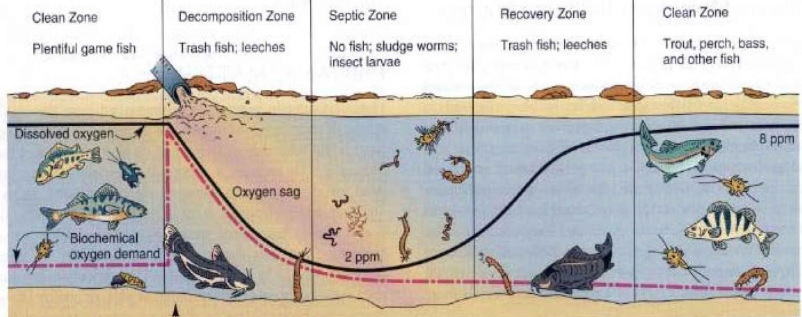
A higher BOD leads to more and more oxygen being consumed, possibly to the point where there is almost none left and the area becomes anoxic.
One of the most important pollution challenge facing the inshore areas of the world oceans, especially Pacific Island Countries, is sewage and eutrophication.
Persistent organic pollutants (POP’s) like pesticides and PCB’s are concerning due to their ability to accumulate and biomagnify, and their persistence.
Oil can cause a range of direct and indirect effects on marine life (ingestion, smothering, death, human food shortages, etc), and it is difficult to clean up despite having properties that prevent it from dissolving in water.
Due to human sources, the composition and ratio of gases in the atmosphere changes and thus the greenhouse effect is enhanced, leading to global warming.
Mitigating pollution:
address the problem, locate the source, fix the problem, educate communities
mitigation on an individual level: practice recycling, proper disposal, sustainable methods
“ national level: national laws regulate use and disposal of many common pollutants, but enforcement is difficult
'“ global level: international treaties, conventions, and protocols to adress global issues and particularly harmful things
Tutorial Questions
What are oxygen demanding wastes and give examples?:
Oxygen demanding wastes are those wastes which, as a result of aerobic breakdown of organic matter, result in a decrease in oxygen in the water
*they break down in the water and steal all the oxygen*
examples include sewage, household garbage, and food processing waste
can cause eutrophication
Explain the oxygen sag curve and what it represents:
The oxygen sag curve illustrates the relationship between dissolved oxygen and the biological oxygen demand
When organic matter is introduced into the water, microorganisms decompose it, consuming oxygen in the process. As a result, the oxygen levels initially drop, creating a "sag" in the curve. After the organic matter is broken down and the microorganisms' activity decreases, oxygen levels may gradually recover.
There are 5 sections/zones: clean zone, decomposition zone, septic zone, recovery zone, clean zone
oxygen levels are critically low in the septic zone
Discuss “the dose makes the poison”:
The amount or concentration of a substance determines its toxicity. Even beneficial or just neutral substances can be toxic in large amounts
Discuss POP’s and which convention regulates its use:
Persistent organic pollutants, or POPs, are concerning because they easily accumulate and biomagnify, and are very persistent
They are conservative pollutants, meaning that they are not degraded or degrade very slowly by chemical or bacterial action, so they are seen as “permanent” additions to the environment
The Stockholm Convention regulates their use
Week 13: Marine Conservation and Management
Key Words
marine conservation: the protection and preservation of ecosystems in oceans and seas through planned management in order to prevent the over-exploitation of marine resources
marine management: a political process to conserve ecosystem that includes creating marine protected areas, regulating gear use, regulating species harvested, and enforcing fish catch limits
Key Concepts
The natural marine ecosystem is fragile and vulnerable because it relies on an unstable balance of various living organisms and a changing environment
Week 13: Fisheries Issues
Key Words
bycatch: the part of the capture that is discarded at sea, dead or injured to an extent that death is the result
catch: portion of fish retained because it has economic value
selective fishing: catching the desirable sizes of the target species
trawl efficiency device: a trawling net where the smaller target species can pass through the grid, whereas larger organisms such as turtles and skates are deflected out of the net through an escape opening
pelagic longline: using specific bait to target specific catch and avoid bycatch
discard: the unwanted fish that are thrown overboard, usually dead, when they need to make room on the boat
IUU fishing: illegal, unreported, and unregulated fishing
ghost fishing: abandoned, lost, or othwise discarded fishing gear that continues to entrap fish
high grading: when marketable fish are discarded to make space for bigger, more valuable fish
Key Concepts
IUU fishing impacts:
economic: loss of revenue from licensing
ecological: damage to sensitive ecosystems
social: undermines the law
Impacts of ghost fishing:
continued catch of target and non-target species
harm to threatened and endangered species
physical impacts on the benthos: nets damage coral, invertebrates, and bottom dwelling organisms by getting entangled in their habitat
introduction of synthetic material into the food web
How to adress ghost fishing:
prevent: avoid letting ghost fishing occur, like marking gear and creating soaking times
mitigate: reduce the impact of fishing gear in the environment, like developing better materials
cure: remove fishing gear from the environment, like tracking lost gear with technology or creating gear recovery programs