Lesson 12
Lesson 12: Closing Volume and Capacity
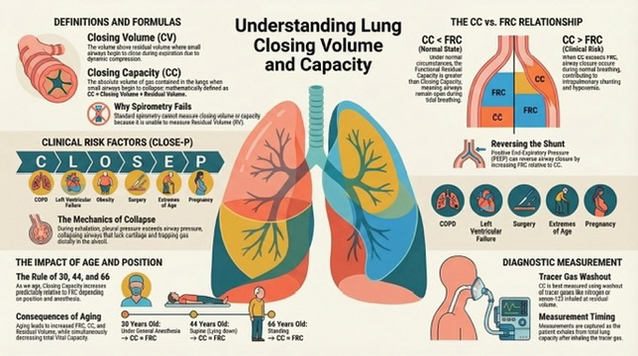
Closing Volume: Volume above residual volume where small airways begin to close during expiration.
Closing Capacity (CC): Sum of closing volume and residual volume (CC = Closing Volume + Residual Volume).
Factors Increasing Closing Volume
Conditions (CLOSE-P):
COPD
Left ventricular (LV) failure
Obesity
Surgery
Extremes of age
Pregnancy
Implications of Closing Capacity
Airway closure occurs during tidal breathing when CC > FRC, leading to intrapulmonary shunting and hypoxemia.
CC increases with age:
Age 30: CC ~ FRC under general anesthesia.
Age 44: CC ~ FRC in supine position.
Age 66: CC ~ FRC in standing position.
Age-Related Changes in Lung Volumes
As age increases:
FRC increases
Closing capacity increases
Residual volume increases
Vital capacity decreases
Impact of Anesthesia
Age and anesthesia affect closing capacity:
Age 30: CC ~ FRC under anesthesia.
Age 44: CC ~ FRC in supine.
Age 66: CC ~ FRC in standing.
Measurement of Closing Volume and Capacity
Limitations of Spirometry: Cannot measure closing volume or capacity as it does not assess residual volume.
Best Measurement Technique: Washout of tracer gas (e.g., nitrogen or xenon-133) inhaled at residual volume and measured as exhaled from total lung capacity.