Level 3 Music Theory
Intervals
As studied in level two an interval is the distance of pitch between two given notes. Each distance is assigned a name such as Unison, second, third, fourth, fifth, sixth, seventh, and octave.
Notice that the unison, fourth, fifth, and octave are called perfect but the second, third, sixth, and seventh, can be called major or minor. All intervals are named for the lowest note, the tonic.
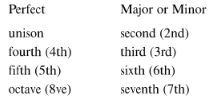

To determine the nature of an interval, we use the major scale as a reference point. All intervals are perfect or major depending on the type of interval
Augmented intervals are when a perfect or major interval is made larger by a semitone
Diminished intervals are when a perfect or major interval is made smaller by a semitone

Simplifying these terms can be done in two ways, but it’s recommended to pick one and stick with it.
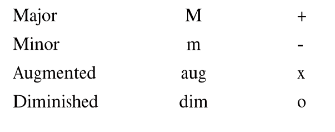
Perfect intervals
Perfect intervals are composed of unison, 4th, 5th, and the octave
Unison
Two or more notes with the same sound

Fourth
In a perfect 4th all notes with the same accidentals (# to #) are perfect, except for F and B and their derivatives (F# B# Bb etc…)
To have a perfect 4th between these two notes the interval has to have an F# and a B, or an F and a Bb.
As mentioned earlier if an interval has a note a semitone larger, it becomes augmented while if it has a semitone smaller it becomes diminished
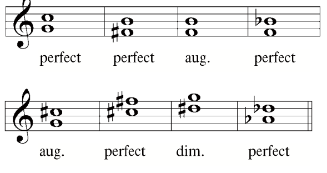
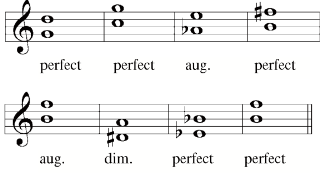
This same rule applies with the perfect fifth
Three-Note Chords
A chord is given to any three or more notes that sound simultaneously. The most basic chord is a Triad, that is, three sounds build up in thirds
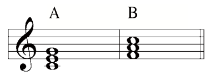
Triads can be built on every degree of a major and minor scale. The lowest note they are built on is called the root of the triad. The following note is the diatonic, the third above the root and named the third, and the third note is a diatonic fifth above the same root called the fifth.
(In simpler terms a chord is build off the first, third, and fifth degrees starting on the root, each note a third higher than the previous.)
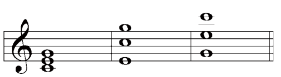
No matter how the notes are placed on the staff, the chord does not change.
Major Chord or Minor Triads
A major perfect chord is made up of the root, a major third, and a perfect fifth
A minor chord is made up of the root, a minor third, and a perfect fifth
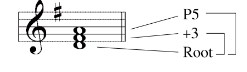
Using this you can say the nature (major or minor) of a chord is