Framing Your Research Question
Topics in this Talk
Project allocation and meeting your supervisor
Clarity and SMART objectives
Dependent and independent variables, and hypothesis direction
Project traction
Project Allocation and Meeting Your Supervisor
After Project Allocation Details
A list of project allocations will be provided.
If you do not have a project, you are encouraged to email Gordon Allison (goa) for assistance.
For those registering on the Welsh dissertation module (BG36440), ensure your registration is captured by contacting the lecturer via email if not already done.
It is essential to align the selected project with your degree scheme for RSB accreditation.
For desk-bound studies, confirm this option is applicable for your degree scheme.
Responsibilities of Students
Students must arrange a meeting with their supervisor to discuss project details.
Project titles and topics can often be discussed and negotiated.
If students find themselves deeply unhappy with their project and supervisor, they should contact Gordon Allison for potential resolutions.
Generally, once assigned a supervisor, it may not be easy to swap supervisors.
Agenda for Meeting with the Project Supervisor
Objectives of the Meeting
A key goal is to gather sufficient information to complete the project plan assignment.
Build rapport with your future supervisor to receive advice.
Gain an understanding of the field and the specific problem you
How will tackle.
What the Meeting Should Not Be Used For
It should not be an opportunity for the supervisor to correct or partially write your assignment.
The initial meeting should not aim to set the project plan in stone.
Do not seek exhaustive details on experimental methodology during this meeting.
It cannot substitute for the extensive literature review that you need to conduct.
Preparation for the Meeting
Necessary Research Before the Meeting
Investigate your project topic in detail, read relevant papers, and generate your ideas.
How they navigate structuring and handling data
Identify the nature of your project: Experimental, Observational, Literature Survey, or Data Reanalysis.
After meeting the supervisor, aim to summarize the project succinctly.
Consider the expected data outputs and potential analytical approaches.
Important Research Steps
Look for relevant reviews and papers, particularly some authored by your supervisor.
Develop a preliminary outline for your introduction, sketching out key points.
Determine any key questions that need answering to finalize your introduction.
Use notes made from any previous project fairs or meetings.
Hypothesis Development
Formulating Your Hypothesis
It is crucial to ensure your alternative hypothesis (HA) is a prediction with only two possible outcomes.
Your HA must include both a dependent and independent variable.
Avoid using terms that imply causation in your hypothesis, opting for results independence (e.g., using "affects" rather than "increases/decreases").
Be clear on how your experiments will test this hypothesis.
During the Meeting
Engaging with the Supervisor
If the supervisor wants to provide their summary, allow them to do so while listening attentively; make notes during this exchange.
Confirm your understanding of the work's aim and the broad outline of the proposed methods.
Discuss the ideal outcomes and interpretations of these results during the meeting.
Discussion Points
Talk about contingency plans if the project does not proceed as planned.
Projects often start vague and must be refined to ensure tractability.
Ensure you grasp the excitement and expectations involved in your research project.
Guidance on Literature Use
Supervisor's Role in Literature
Some supervisors may provide guidance on essential papers, especially if the student has already identified recent reviews and relevant studies.
Students should ask for good references suitable for specific purposes, such as methodologies or studies resembling their own.
General Advice for Meetings
Interacting with Supervisors
Avoid treating your supervisor like an interrogator; instead, seek clarification on vague points.
Listen to the supervisor’s project ideas first before presenting your own.
Prepare to clarify any misunderstandings or unclear points during your discussions.
It is your responsibility to prepare for establishing a work plan.
Follow-Up Meetings
Consider scheduling additional meetings after reflection on earlier discussions.
Always remember that supervisors typically handle multiple UG and MBiol students, with many possibly based at the Gogerddan campus.
Be aware of transportation options to ensure effective communication and meetings.
Clarity and SMART in Research Questions
The Importance of Clear Research Questions
It is essential that the research question is presented clearly.
Vague questions limit control over outcomes.
Example of Vague Questioning
An example provided involved asking "What do you want for dinner?"
Responses may vary from specific (Lasagne) to vague (Not fussed—anything). This lack of clarity can lead to unintended outcomes in research.
SMART Objectives
Defining SMART Objectives
Your project goals must be:
Specific: The objectives should be clearly outlined and defined.
Measured: Define how much or how many to quantify the success.
Achievable: Objectives must be realistic within the constraints of time and funding.
Relevant: The project should have meaningful significance—otherwise, it begs the question of its necessity.
Time-Bound: Establish when you will start and stop the project.
Example of Lack of Clarity
The question "Do different dog breeds have different personalities?" lacks specificity.
The Fédération Cynologique Internationale (FCI) recognizes 360 dog breeds, raising uncertainty on whether it relates to any two, some, or all breeds.
The concept of personality also requires precise definition, further complicating clarity.
Intractability Example
A proposal to compare personality recall across many dog breeds is deemed impractical.
The KISS Principle
Explanation of KISS
Elegant and effective research questions should adhere to the KISS principle (Keep It Simple Stupid) or (Keep It Short and Simple).
This principle, linked with US Navy aircraft design in the 1960s, emphasizes the importance of simplicity.
Notably, simplicity does not equate to a lack of sophistication in formulating research questions.
Transforming Research Questions into Hypotheses
Requirements for a Good Hypothesis
It is essential to translate your research question into a precise experimental hypothesis.
An experimental hypothesis is a clear, testable statement predicting the outcome of a research experiment.
It illustrates the relationship between two or more variables and forecasts how manipulating the independent variable will impact dependent variables.
Research questions that are straightforward lend themselves more readily to well-formed hypotheses.
Dependent and Independent Variables
Understanding Variables in Research
An example illustrates this using the outcome of cyanobacteria in drinking holes:
Dependent Variable: Mortality of African Elephants (what is measured).
Independent Variable: The presence of toxin-producing cyanobacteria (what is manipulated).
Another example shifts to poaching as the independent variable:
High levels of poaching in Botswana may further increase mortality in elephants.
Mortality is critical to understanding population decline, with dependent and independent variables reflecting this causal relationship.
Directionality in Hypothesis
Types of Hypotheses
Your hypothesis can be directional or non-directional:
Directional (One-tailed): Predicts a change in one direction only, establishing a clearer statistical power to detect a single directional change.
Non-directional (Two-tailed): Detects change regardless of direction and makes fewer assumptions, although it typically has lower power.
Examples explore both types of hypotheses in various biological contexts, demonstrating application across differing variables and potential outcomes.
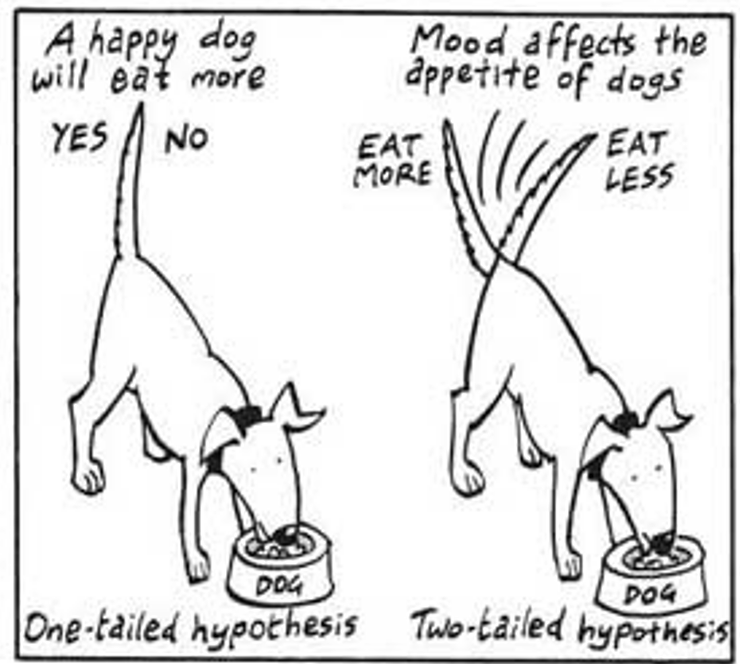
Recommended to use a bi-directional hypothesis
Project Traction
Assessing Project Feasibility
Tractability assesses if a research topic is testable. An example demonstrated uses the question of whether nest box colour influences blue tit egg clutch size, indicating seasonal dependencies.
Project discussions may prompt refinement of questions. An improved version highlights the influence of bird feeder color on feeding behavior in blue tits, showcasing evolving clarity.
Another example critiques the question of organic food nutrition versus conventional farming, identifying it as too broad given the variability in defining “nutritional.”
To refine project traction, consider limiting the scope, as seen in studies evaluating glyphosate's effect on faba bean protein content—specificity enhances testability.
Conclusion and Next Lecture
Preview of Upcoming Content
The next lecture will include discussions on systems biology, research questions for critical review studies, and concepts encompassing data hierarchy.