Healthy Body Weight
Calculating Body Mass Index
Body mass index (BMI) is a number calculated using your height and weight to estimate how much body fat your body is composed of. Too much body fat can present issues to your health, leading to illness or disease. Too little body fat can present nutrition deficiencies and other forms of illness.

There are four categories within the BMI scale:
Less than the 5th percentile is underweight
Greater than or equal to the 5th percentile—but under the 85th percentile—is a normal weight range
Greater than or equal to the 85th percentile—but under the 95th percentile—is overweight
Greater than or equal to the 95th percentile is obese
For example, a child who has a BMI around the 50th percentile is close to average on the BMI chart. A child who is between the 85th and 94th percentiles is overweight according to the BMI chart. If a child is at or above the 95th percentile, that child is considered obese. Obese is a term doctors use to indicate that someone is very overweight.
When adults are evaluated on the BMI chart, it is interpreted differently. Men and women have different charts that they use, and they use ranges instead of percentiles. The ranges include underweight, normal weight, overweight, and obese. Age is not considered an important factor with adults because they have stopped growing. Children are continuing to grow and therefore age is a factor when evaluating them. Puberty can cause an increase in weight gain in children, and that needs to be factored in when evaluating them. The charts for children take growth spurts into account.
It is important to know that BMI is not the full scope of a child's health. A child who has more muscle will have a higher BMI even though he or she is healthy and doesn't have high body fat. A child who is smaller could measure well on the BMI chart but could have higher body fat and not enough muscle weight.
As mentioned, puberty can also cause an issue with the BMI chart as a child gains more weight during puberty. It is important to talk to your doctor about your BMI results as well as what an ideal weight is for you.
If you calculate your BMI and find out that it is high, don't be upset about it before talking to your doctor. Talk to your doctor about your BMI and ask if your doctor thinks you should lower it; if so, your doctor can offer tips to help you. Young people should not usually be on diets as it is unhealthy for them both physically and emotionally. However, it is important to eat healthier and get more exercise in order to try and improve your BMI if recommended by a doctor.
If you do have a high BMI and your doctor recommends eating healthier and getting more exercise, doing so while you are young is crucial. If you are able to control your weight when you are younger, it can help you avoid health issues (including diabetes and heart disease) when you are older. With a little effort, your BMI will be just where it ought to be.
Take a moment to utilize the formula below or use the link to the following resource to calculate your own BMI.
BMI = (weight in pounds x 703) / ((height in inches) x (height in inches))
Centers for Disease Control and Prevention (CDC): Healthy Weight - Body Mass Index (BMI)
Click this link for more information on BMI.
Interpreting BMI
Your BMI will tell you if you are a healthy weight, underweight, overweight, or obese. Although these terms are determined differently for children and teens than they are for adults, the health consequences or benefits are similar.
If an adult is twenty years old or older, that adult's BMI is interpreted using weight categories. All of these categories are the same for both males and females. The table below shows the BMI chart for adults:
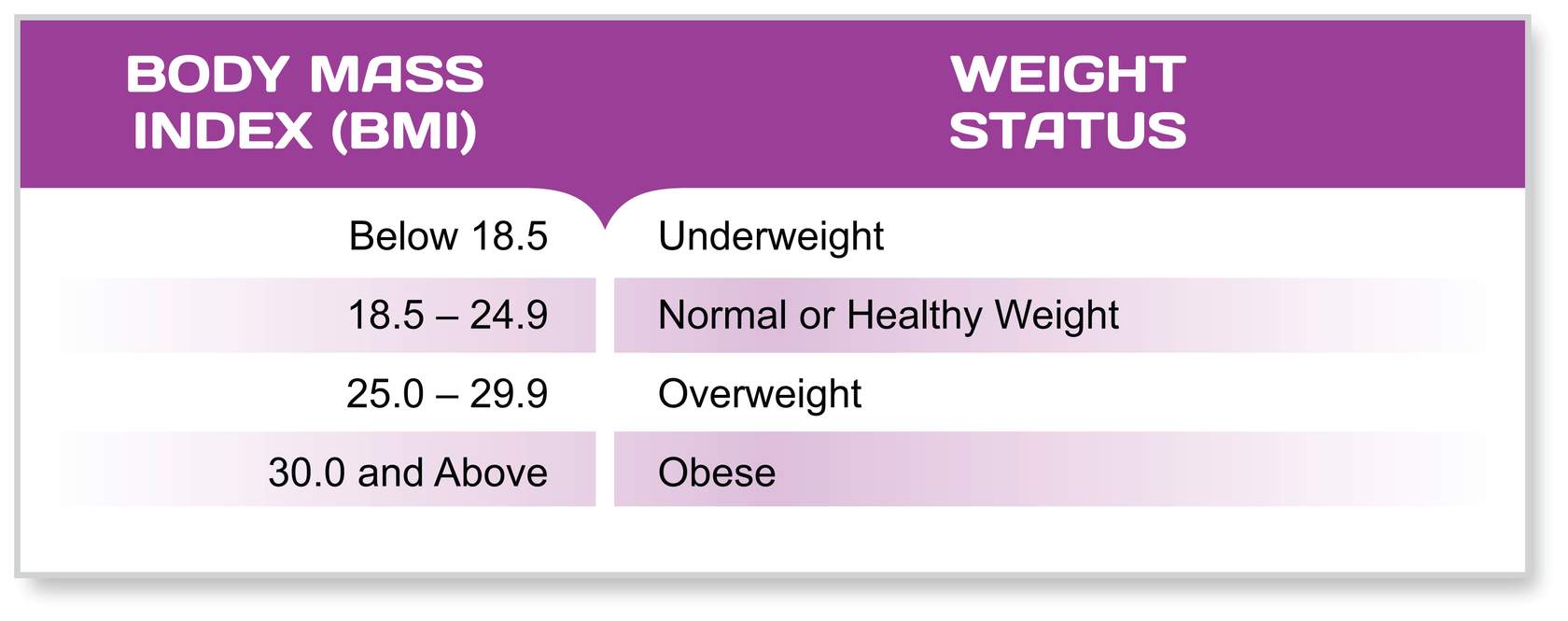
©LUPC Body Mass Index (BMI) Table
The means for determining healthy weight is slightly different for children and teens than it is for adults. Why is this the case? According to the CDC, it is difficult to provide healthy weight ranges for children and teens because the interpretation of BMI depends on weight, height, age, and sex. Normal or healthy weight status for children and teens is based on having a BMI between the 5th percentile and just under the 85th percentile on the CDC BMI chart. BMI-for-age weight status categories and the corresponding percentiles were created based on expert committee recommendations and are shown in the following table:
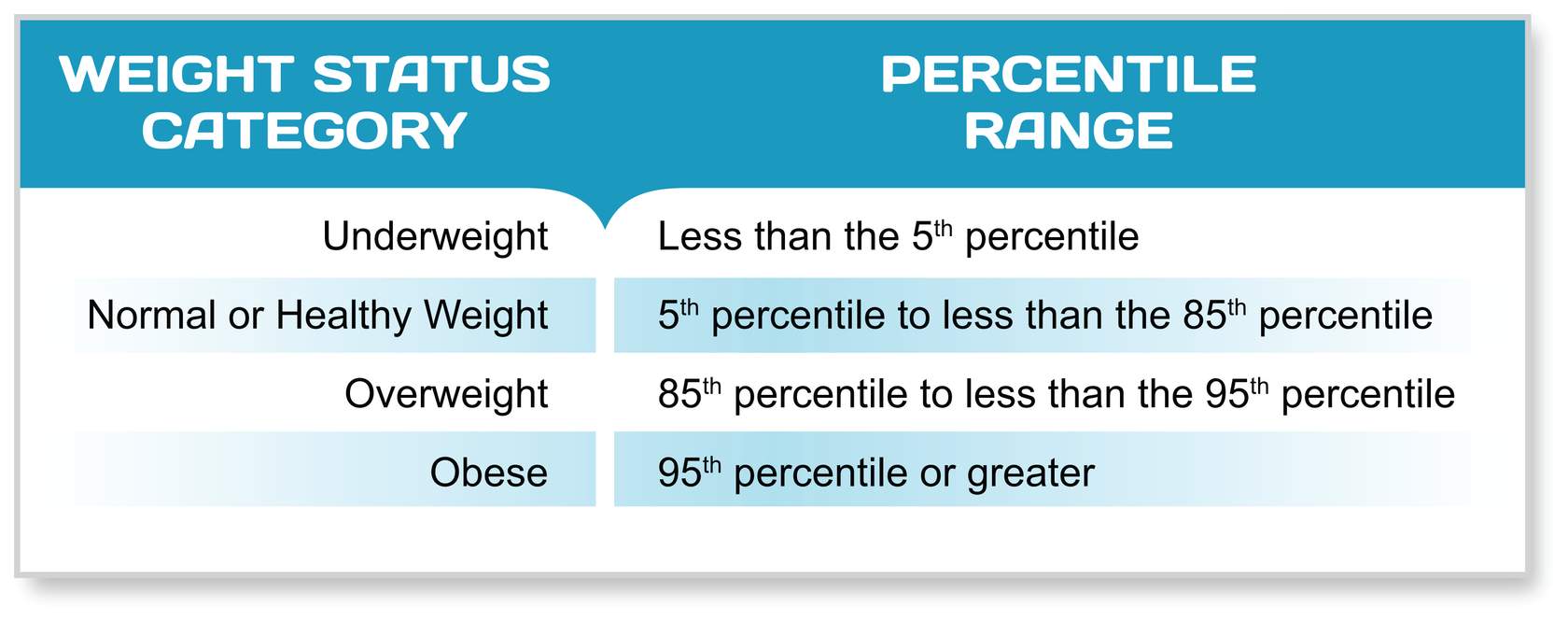
©LUPC Percentile Table
A healthy body weight is a weight (or BMI) that does not increase your risk of developing weight-related health problems or diseases. Having too much or too little body fat can negatively impact bodily functions and health. The same is true of body weight because body weight is tied to total body fat along with other factors (muscle mass, height, bone density, etc.); both weighing too much or weighing too little can be harmful to health. Therefore, it is important to maintain a healthy BMI. You will have other lessons on body weight, eating disorders, diseases associated with body weight, etc. later in the course, but this lesson will touch briefly on some of the health problems related to being underweight or overweight.
A healthy body weight is a weight (or BMI) that does not increase your risk of developing weight-related health problems or diseases.
BEING UNDERWEIGHT
Some people are "naturally" slender and healthy. On the other hand, low body weight can indicate the presence of certain diseases or conditions such as malnutrition, substance abuse, disease, and/or eating disorders. Also, having a low BMI is associated with an increased risk of anemia, bone disorders/diseases, bone fractures, heart irregularities, lack of menstruation, anxiety, and depression.
BEING OVERWEIGHT OR OBESE
Having a BMI that places you in the overweight or obese categories will put you at risk for several health problems and diseases. Being overweight or obese increases your risk of heart disease, type 2 diabetes, cancer, reproductive disorders, gallstones, and several other diseases.
WEIGHT MANAGEMENT
It is important to start managing your weight now. The earlier you start a weight management program, the easier it will be to maintain a healthy weight into and throughout adulthood. In a few weeks, you will learn some of the basics of important nutrients, making healthy choices, and nutrition planning. Those lessons will help prepare you for reaching and maintaining a healthy weight.
What is the BMI of a person who weighs 165 pounds and is 5 feet 4 inches tall?
28
(165 pounds x 703) / ((64 inches) x (64 inches)) = 28