Language-Families
Language Families:
Definition:
Language Families: Groups of languages that share a common ancestral language, known as a proto-language. These languages evolve over time, developing distinct characteristics but retaining traces of their shared origin.
Historical Linguistics:
The study of language families falls under historical linguistics, which examines how languages change and diverge over time.
By comparing similarities in vocabulary, grammar, and phonology, linguists can reconstruct aspects of the proto-language and trace the development of its descendant languages.
Major Language Families:
Indo-European: Includes languages like English, Spanish, Hindi, Russian, and German. Originated from Proto-Indo-European.
Sino-Tibetan: Includes Mandarin, Cantonese, and Tibetan. Originated from Proto-Sino-Tibetan.
Afro-Asiatic: Includes Arabic, Hebrew, and Amharic. Originated from Proto-Afro-Asiatic.
Niger-Congo: Includes Swahili, Yoruba, and Zulu. One of the largest language families in terms of the number of languages.
Austronesian: Includes Malay, Tagalog, and Hawaiian. Originated from Proto-Austronesian.
Subgroups and Branches:
Language families are often divided into subgroups or branches based on closer relationships. For example, the Romance languages (e.g., French, Spanish, Italian) are a branch of the Indo-European family.
Importance:
Understanding language families helps linguists trace the historical movements and interactions of human populations.
It provides insights into cultural and historical connections between different groups.
Proto-Indo-European Culture and Vocabulary Reconstruction:
Reconstruction of Proto-Indo-European (PIE) Vocabulary:
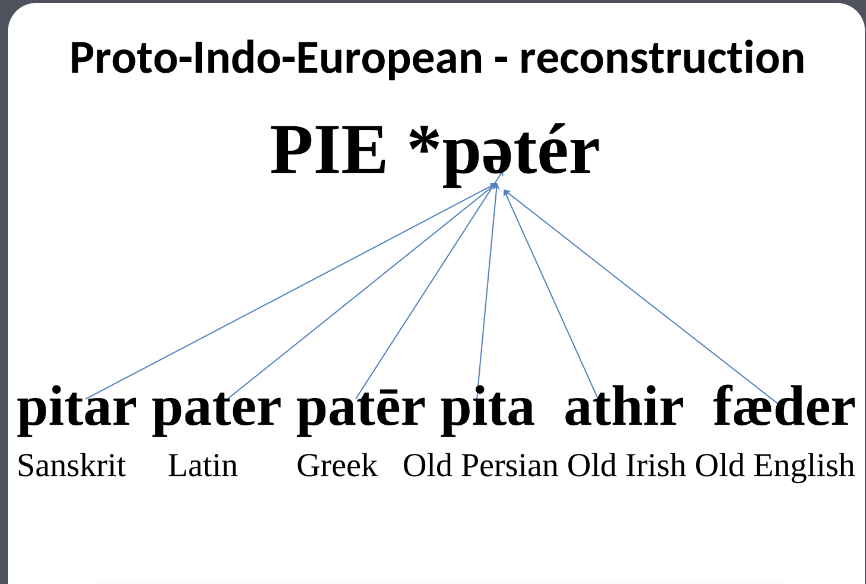
The culture of the earliest Indo-Europeans is primarily understood through the reconstruction of PIE vocabulary. By comparing cognate words across descendant languages, linguists can infer aspects of their material culture, environment, economy, and social practices.
Example: The word for "sheep" (ówis) is reconstructed from cognates in Old Irish (ói), Latin (ovis), Old High German (ouwi), Old Church Slavonic (ovĭca), Lithuanian (avìs), Greek (ó(w)is), Luvian (haw-), and Sanskrit (ávi-). This suggests that sheep were known to PIE speakers.
Natural Environment and Flora:
Lexical evidence indicates that PIE speakers were familiar with trees such as the birch, oak, willow, ash, yew, and pine.
This suggests they lived in a temperate forested environment.
Fauna:
Wild mammals known to PIE speakers included the otter, beaver, wolf, fox, bear, lynx, elk, red deer, hare, hedgehog, and mouse.
Fish and bird names are less common, but the salmon, duck, goose, and other birds were known.
Domesticated Animals and Agriculture:
PIE speakers domesticated animals such as cattle, horses, sheep, goats, pigs, and dogs.
They cultivated grains and had terms for various cereals, indicating an agricultural economy.
Agricultural technology included tools like the plow, sickle, and grinding stone.
Technology and Material Culture:
Technological items included knives, spears, axes, bows and arrows, and beads.
Metals such as copper were known, and possibly gold and silver.
The existence of terms for wheeled vehicles suggests advanced technological knowledge.
Social and Religious Practices:
The reconstructed vocabulary provides indirect evidence of social structures and religious practices, though these are less explicitly detailed.
Kurgan Culture Hypothesis:
Origin of the Kurgan Hypothesis:
Proposed by archaeologist Marija Gimbutas, the Kurgan hypothesis suggests that the Kurgan people, who lived northwest of the Caucasus and north of the Caspian Sea as early as the fifth millennium B.C., were the original Proto-Indo-European (PIE) speakers.
Kurgan Culture:
Economy: Domesticated cattle and horses, practiced farming and herding.
Technology: Used four-wheeled wagons, indicating mobility and advanced engineering.
Settlements: Built hilltop forts and burial mounds (kurgans), reflecting complex social organization.
Social Structure: Had a complex sense of family relationships and organization, and developed counting skills.
Material Culture: Used gold and silver, and consumed mead, a honey-based alcoholic beverage.
Religion: Worshiped multiple gods, including deities associated with the sky/thunder, sun, horse, boar, and snake. Believed in life after death, evidenced by elaborate burial practices.
Lexical Evidence:
Descendants of PIE words for trees (ash, apple, oak, linden, aspen, pine), animals (bear, wolf, salmon), and other terms (honey, snow, cold, winter, father, mother) provide insights into their environment and culture, supporting the hypothesis about their homeland.
Migration:
Beginning around 3000 B.C., the Indo-European people migrated in various directions:
Reached Greece by 2000 B.C.
Arrived in northern India by 1500 B.C.
These migrations spread the Indo-European languages and cultural practices across Europe and Asia.
Survival and Endangerment of Celtic Languages:
Current Status of Celtic Languages:
Irish Gaelic (Irish): Spoken in the west of the Republic of Ireland (Éire), with approximately 20,000 native speakers. It has died out in Northern Ireland.
Scottish Gaelic (Gaelic): Spoken in the Western Isles of Scotland, especially the Outer Hebrides. There were 57,375 speakers recorded in 2011.
Welsh: Spoken in Wales, particularly in the north and west, with around 550,000 speakers. It is also found in parts of England, though rarely.
Breton: Spoken in Brittany, northwest France. A 2004 survey found around 200,000 speakers, most of whom were aged 60 or over. The number has significantly declined from over a million in 1950.
Extinct Celtic Languages:
Manx Gaelic: Spoken on the Isle of Man, officially extinct as of 1974.
Cornish: Spoken in Cornwall, England, extinct since around 1777.
Cumbrian: Spoken in the Cumbria region (northern England and southern Scotland), extinct since approximately the 10th century.
Gaulish: Spoken in Gaul (modern France) and other parts of continental Europe, extinct since the early medieval period.
Endangerment:
All surviving Celtic languages (Irish, Scottish Gaelic, Welsh, and Breton) are considered endangered. Factors contributing to their decline include language shift to dominant languages like English and French, urbanization, and lack of intergenerational transmission.