Interrupts And Data Transfers In Input-Output Systems For Operating Systems
Interrupts and Data Transfers in Input-Output Systems
Interrupts
Interrupts are signals sent by hardware devices to the CPU to request attention or to notify about an event.
They allow devices to asynchronously communicate with the CPU, reducing the need for constant polling.
Types of interrupts:
Hardware Interrupts: Generated by external devices, such as keyboard, mouse, or disk drives.
Software Interrupts: Generated by software instructions, like system calls or exceptions.
Interrupts have priority levels, allowing the CPU to handle higher priority interrupts first.
When an interrupt occurs, the CPU suspends its current task, saves its state, and jumps to the interrupt handler routine.
After handling the interrupt, the CPU resumes the suspended task.
Data Transfers
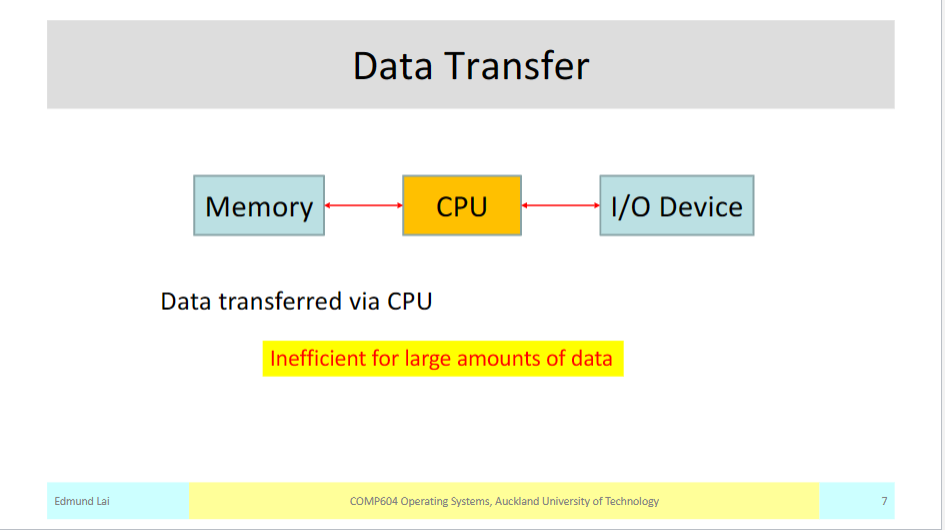
Input-Output (I/O) devices transfer data between themselves and the CPU or memory.
Data transfers can occur in two modes:
Programmed I/O: CPU directly controls the data transfer by polling or busy-waiting.
CPU repeatedly checks the device status until it is ready for data transfer.
Suitable for slow devices but wastes CPU cycles.
Interrupt-driven I/O: Devices use interrupts to notify the CPU when they are ready for data transfer.
CPU initiates the transfer and then continues executing other tasks.
When the device is ready, it generates an interrupt to signal completion.
DMA (Direct Memory Access) is an alternative to programmed I/O and allows devices to transfer data directly to/from memory without CPU intervention.
DMA controller takes control of the bus and performs the data transfer.
CPU is only involved in setting up the transfer and is freed to perform other tasks.
Input-Output Systems
Operating systems provide an abstraction layer for managing I/O devices and their data transfers.
Device drivers are software components that interface between the OS and the hardware devices.
OS provides system calls and APIs for applications to interact with I/O devices.
OS manages I/O buffers to store data temporarily during transfers.
I/O scheduling algorithms determine the order in which I/O requests are serviced to optimize performance.
OS handles error handling and recovery for I/O operations.
Interrupt handlers are responsible for handling interrupts and coordinating data transfers between devices and the CPU.
DMA controllers are managed by the OS to facilitate efficient data transfers without CPU intervention.
→Long detailed notes below:
Interrupts and Data Transfers in Input-Output Systems
Interrupts
Interrupts play a crucial role in input-output (I/O) systems by allowing hardware devices to communicate asynchronously with the CPU. These signals are sent by devices to request attention or to notify the CPU about an event. By using interrupts, the need for constant polling is reduced, enabling the CPU to focus on other tasks.
There are two types of interrupts: hardware interrupts and software interrupts. Hardware interrupts are generated by external devices, such as keyboards, mice, or disk drives. On the other hand, software interrupts are generated by software instructions, like system calls or exceptions. Each interrupt has a priority level, which allows the CPU to handle higher priority interrupts first.
When an interrupt occurs, the CPU suspends its current task, saves its state, and jumps to the interrupt handler routine. The interrupt handler is responsible for handling the interrupt and performing any necessary actions. Once the interrupt is handled, the CPU resumes the suspended task, ensuring the uninterrupted flow of execution.
Data Transfers
Data transfers between I/O devices and the CPU or memory are essential for efficient communication. There are two modes of data transfer: programmed I/O and interrupt-driven I/O.
In programmed I/O, the CPU directly controls the data transfer by repeatedly checking the device status until it is ready for data transfer. This method is suitable for slow devices but can waste CPU cycles due to constant polling or busy-waiting.
On the other hand, interrupt-driven I/O allows devices to use interrupts to notify the CPU when they are ready for data transfer. The CPU initiates the transfer and then continues executing other tasks while waiting for the device to signal completion through an interrupt. This approach maximizes CPU utilization and minimizes wasted cycles.
Another method for data transfer is Direct Memory Access (DMA). DMA is an alternative to programmed I/O and enables devices to transfer data directly to or from memory without CPU intervention. A DMA controller takes control of the bus and performs the data transfer, freeing the CPU to perform other tasks. The CPU is only involved in setting up the transfer, and the DMA controller handles the actual data movement.
Key Information:
Interrupts are signals that interrupt the normal execution of a program.
They are used to handle events that require immediate attention.
Interrupts can be generated by hardware devices or software.
Data transfers in input-output systems involve moving data between devices and memory.
Input-output devices communicate with the CPU through input-output controllers.
DMA (Direct Memory Access) allows devices to transfer data directly to and from memory without CPU intervention.
Polling and interrupt-driven I/O are two common techniques for handling data transfers.
Polling involves the CPU continuously checking the status of the device.
Interrupt-driven I/O allows the CPU to perform other tasks while waiting for the device to signal completion.
Interrupt handlers are routines that handle interrupts and perform necessary actions.