BIOC D NOTE
1. Brief Review of naming fatty acids
- Greek letters = used for talking about sites of chemical reactivity
- Numbering carbons are used for locations of features, i.e. double bonds
- C1 is at the position of the COO group
2. Triacylglycerols and mobilization of fatty acids
Functions of triacylglycerol = energy storage
Mobilization of Triacylglycerols
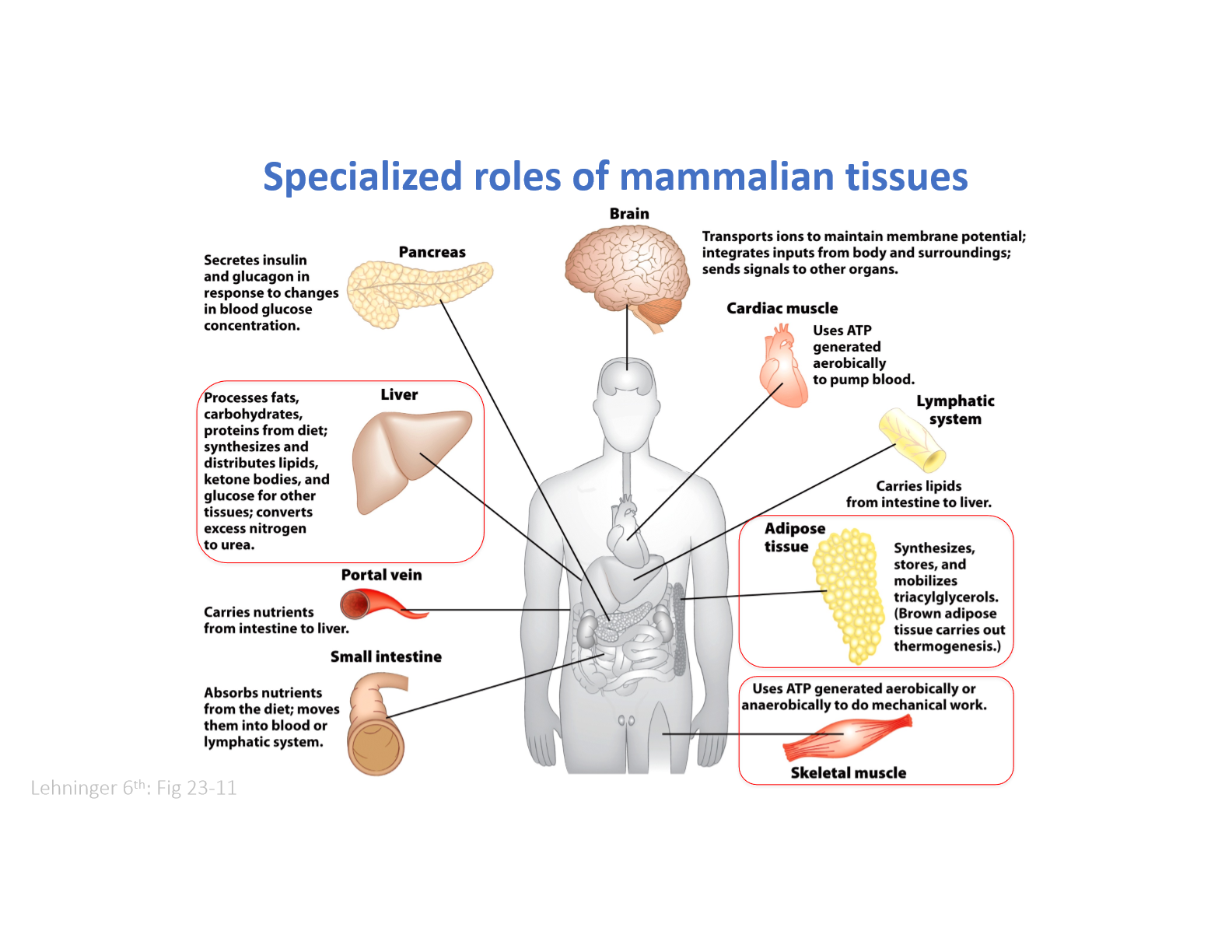
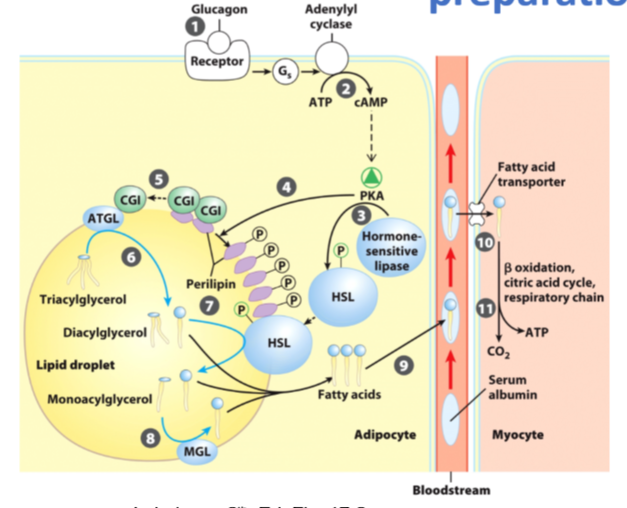
- Stored in adipocytes and coated by Perilipin to form globules
- Degradation occurs in the mitochondria of other cells
- How do we move these to other cells?
10 Steps
- Hormone binds g coupled receptor (AC/cAMP pathway)
- Receptor sends signal, kinase is activated
- PKA phosphorylates a ^^hormone-sensitive lipase^^
- PKA phosphorylates perilipin
- Phosphorylated Perilipin releases CGI protein
- CGI activates ^^Adipocyte triacyl glycerol lipase (ATGL)^^ which releases the first Fatty Acid
- ^^HSL (Hormone Sensitive Lipase)^^ releases a second fatty acid from diacylglycerol
- ^^(MGL) Monoacylglycerol lipase^^ cleaves a THIRD fatty acid from monoacyl glycerol
- Released fatty acids enter the bloodstream where they bind SERUM ALBUMIN
- FA transporter in the muscle cell takes up the fatty acids
- FA is oxidized in the muscle cell by Beta Oxidation
3. Fatty acid oxidation (degradation)
- Occurs in the Cytoplasm and Mitochondria
Shuttle
- FA shorter than 12 C do not need a transporter
- FA longer than 14 C require a carnitine shuttle
- Cytoplasmic fatty acids → Fatty acyl CoA (acyl CoA synthetase)
- Fatty acyl is transferred to carnitine ^^(Carnitine acyltransferase I)^^
- Fatty acylcarnitine enters mitochondria (VIA acyl-carnitine/carnitine transporter)
- Fatty acyl-CoA is regenerated within the mitochondrion by ^^carnitine acyltransferase II^^
Shuttle
- fatty acylcarnitine is formed at the outer membrane/intermembrane space of mitochondria (carnitine acyltransferase II)
- moves by facilitated diffusion into matrix
- Acyl group is transferred to mitochondrial CoA (carnitine acyltransferase II)
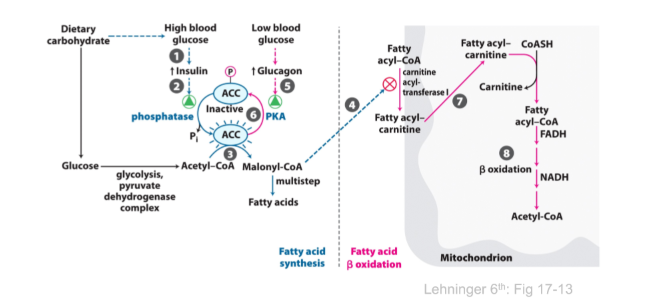
- Carnitine Acyl transferase I is INHIBITED by malonyl CoA
- prevents simultaneous synthesis and degradation of fatty acids
1. B-Oxidation produces Acetyl CoA
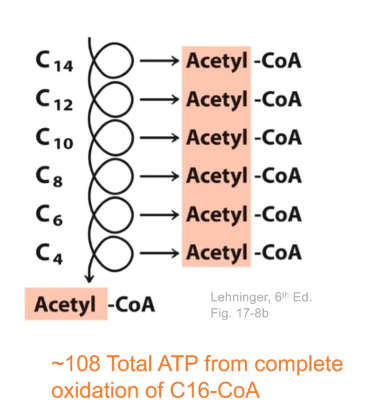
- Results in one acetyl coA being removed from the carboxyl end of fatty acid chain
- 1 Box cycle = 2 carbon atoms removed
- Continues until acetyl- CoA is left
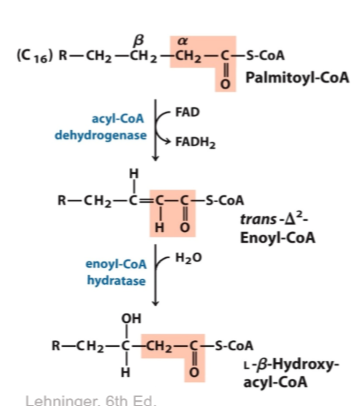
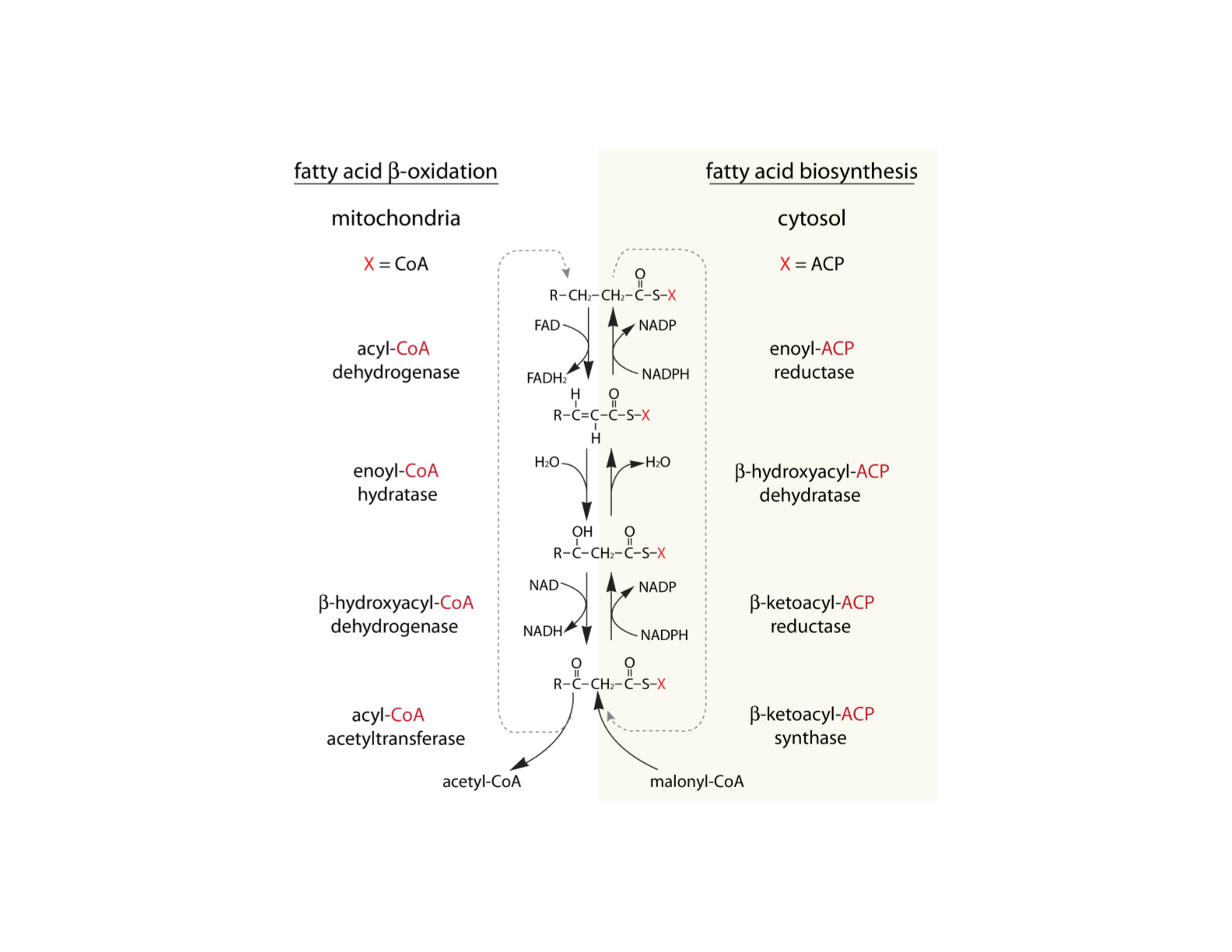
- Dehydrogenation ^^(acyl-CoA dehydrogenase)^^
- fatty acyl-CoA → trans enoyl CoA
- FAD → FADH2
- Hydration ^^(enoyl-CoA hydratase)^^
- trans enoyl CoA → L-B-hydroxyacyl- CoA
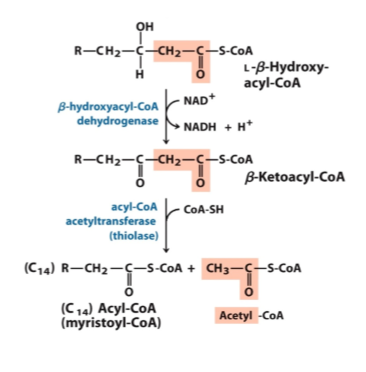
- Dehydrogenation ^^(B-hydroxyacyl-CoA dehydrogenase)^^
- L-B-Hydroxyacyl-CoA → B-ketoacyl-CoA
- NAD+ → NADH + H+
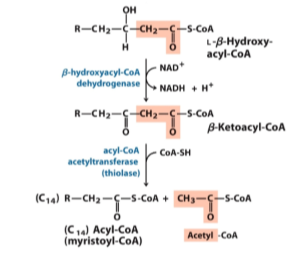
- Cleavage ^^(acyl-CoA acetyltransferase/thiolase)^^
- B-Ketoacyl- CoA → Acetyl CoA + Fatty acyl CoA
2. Acetyl CoA is oxidized in the citric acid cycle
3. NADH and FADH2 donate electrons to the mitochondrial respiratory chain yielding ATP
4. Problem cases for fatty acid oxidation
Problem 1: Cis Double Bond
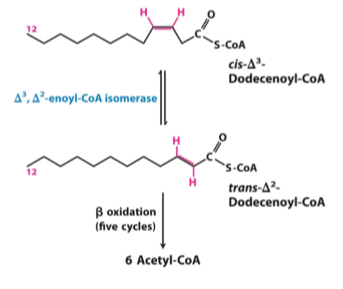
- B-ox enzymes process cis-fatty acids normally and proceed as normal for 3 rounds
- cis delta 3 fatty acids are the issue
- C3 in a double bond already, cannot be a substrate for acyl-CoA dehydrogenase
- ^^Delta 3, Delta 2-enoyl CoA isomerase^^ moves the double bond, converting Cis delta 3 → trans delta 2
- substrate for enoyl CoA hydratase, Box proceeds normally
- NET: one less FADH2 (acyl-CoA skipped this cycle)
Problem 2: Two double bonds
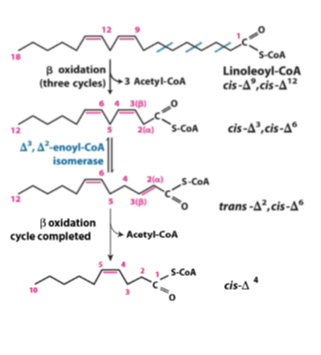
- The first DB is in 9 and the second is in 12
- B-ox will then produce both Cis delta 3 and delta 4 intermediates
- a cis delta 3 and cis delta 6 are produced
- Trans delta 2 and cis delta 6 FA are substrates for enoyl CoA hydratase
- B-Ox completes normally
- RESULTS IN Cis Delta 4 fatty acid
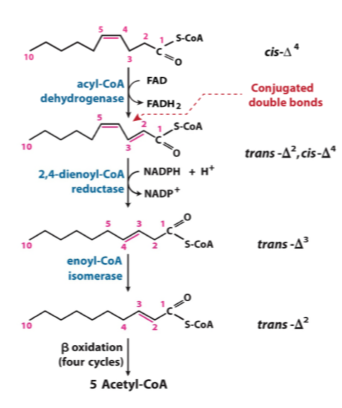
- Cis delta 4 substrate = trans delta 2 and cis delta 4 produced by acyl-CoA dehydrogenase
- conjugated DB cant be hydrated by enoyl-CoA hydratase
- Reduced by 2,4,-dienoyl-CoA reductase, yielding a trans delta 3 fatty acid
- Trans delta 3 fatty acid → trans delta 2 fatty acid (Delta 3, delta 2 enoyl-CoA isomerase)
- B OX then proceeds normally
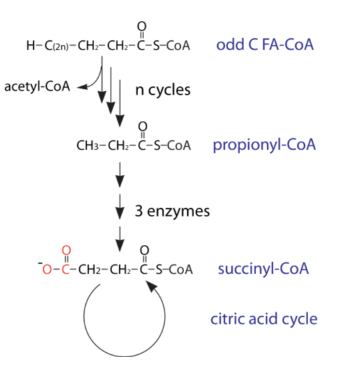
Problem 3: Odd # of Carbons
- Initially, B-ox is normal
- Propionyl-CoA (3 carbon atoms) cannot be oxidized by acyl CoA dehydrogenase
- A separate enzyme pathway CARBOXYLATES propionyl CoA to succinyl CoA (makes it 4 c atoms)
- proceeds in TCA cycle (succinyl CoA is TCA)
5. Ketone Bodies
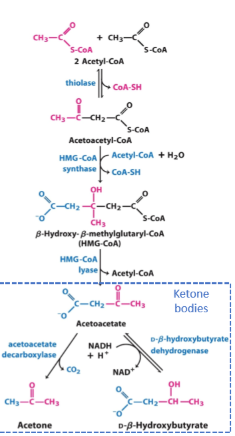
- Acetyl-CoA can either enter the TCA OR Be turned into ketone bodies in the liver
- allows acetyl-CoA to enter the citric acid cycle in a different cell
- Frees up CoA so more fatty acids can be degraded
- Ketone bodies act as an alternative fuel for the brain (can’t use fatty acids)
- What are the fates of acetyl CoA in the cell?
Ketone Bodies Anabolism (LIVER)
- Acetoacetate = formed by condensing 3 acetyl-CoA molecules and cleaving 1
- D-B-hydroxybutyrate = formed by reducing acetoacetate
- Acetone = formed by decarboxylation and then exhaled
Ketone Bodies Catabolism
- converts ketone bodies back to acetyl coA
- RESULT: 2 molecules of acetyl-CoA are regenerated for the citric acid cycle
6. Fatty acid biosynthesis
- Occurs in the CYTOPLASM
- REDUCTIVE using NADPH
- Acetyl-CoA = Substrate
- Malonyl CoA = product in the committed step
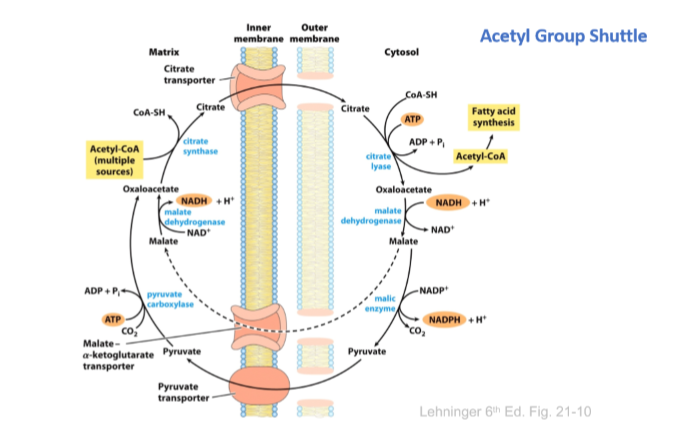
Acetyl Group Shuttle
In the mitochondria
- Only citrate can be transported to the cytosol directly from mitochondria (Not Acetyl CoA)
- Mitochondrial Acetyl CoA + oxaloacetate = Citrate
In the cytosol
- citrate lyase produces Acetyl-CoA + oxaloacetate
- Oxaloacetate is reduced to malate
- returns to mitochondria directly
- or becomes pyruvate after decarboxylation
- pyruvate is used by mitochondrial enzymes to regenerate oxaloacetate
Malonyl CoA
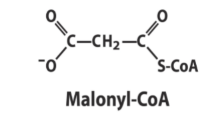
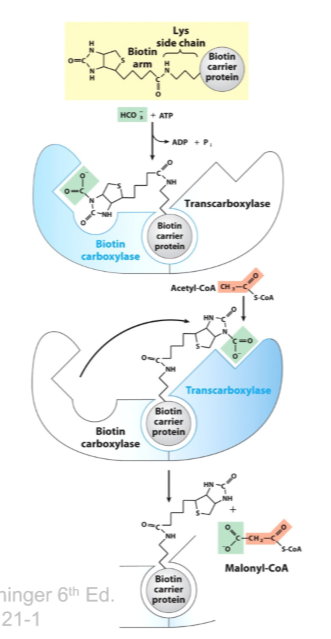
- Malonyl coA is an activated intermediate used to make fatty acids
- acetyl CoA + HCO3 = malonyl CoA
- ATP dependant
- Catalyzed by ^^acetyl-CoA carboxylase^^
Acetyl CoA carboxylase
Biotin Carrier protein binds to the Biotin Carboxylase, Transcarboxylase
- carries the biotin cofactor
- uses ATP to activate biotin with CO2
- transfers co2 from biotin to acetyl CoA to form malonyl CoA
Fatty Acid Biosynthesis
- Carbons added 2 at a time
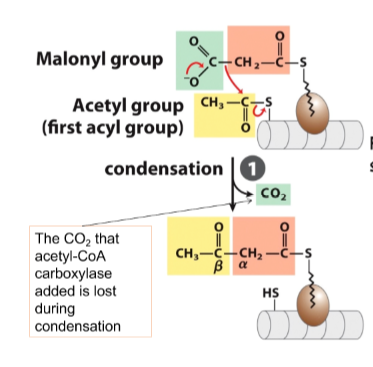
- Condensation of malonyl-CoA with growing FA
- Keto Reduction
- Dehydration
- Enoyl reduction
- Saturated acyl groups = substrates for condensation with activated malonyl groups
- Reduction = NADPH
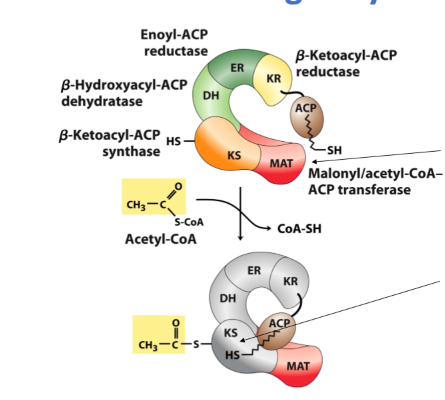
- Growing fatty acid chain is attached to a small Acyl Carrier Protein (ACP)
]]STEP 0]]
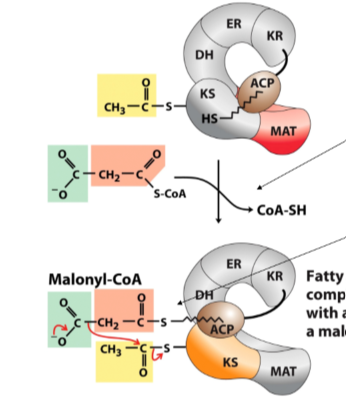
- FA synthase gets charged with acetyl-CoA and malonyl-CoA ^^(malonyl/acetyl-CoA-ACP transferase)^^
- MAT transfers acetyl from Acetyl CoA to ACP
- KS transfers acetyl from ACP to itself (binding ACP)
- MAT transfers malonyl group to ACP
- RESULTS IN:
- malonyl bound to ACP
- ACP bound to KS
- KS bound to acetyl
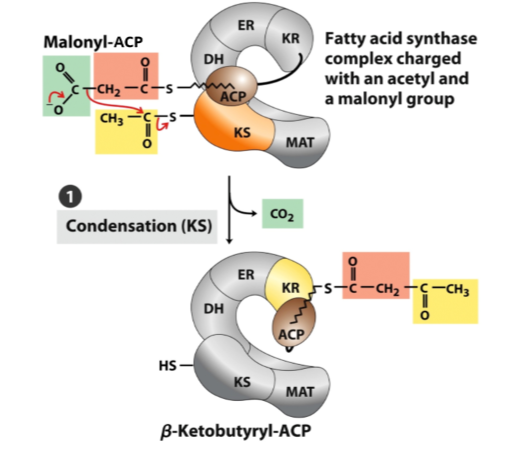
]]STEP 1]]
- Condensation of activated acyl group with malonyl CoA ^^(B-ketoacetyl-ACP synthase)^^
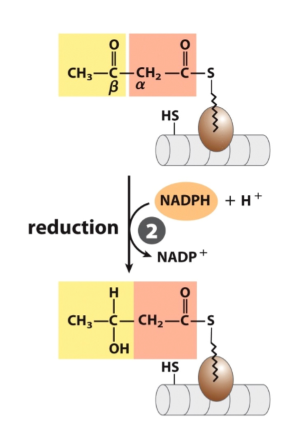
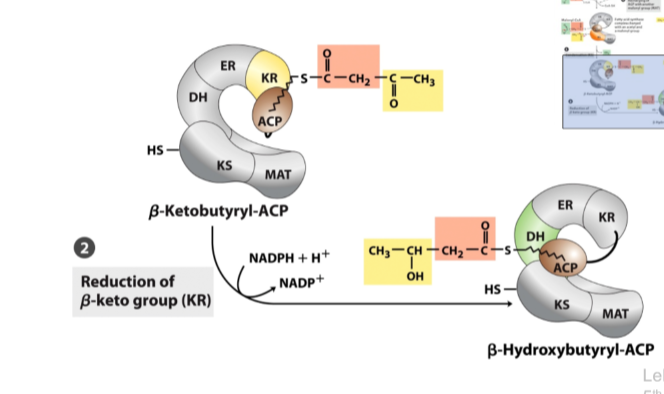
]]STEP 2]]
- Reduction of B-keto to B alcohol ^^(B-Ketoacetyl-ACP reductase)^^
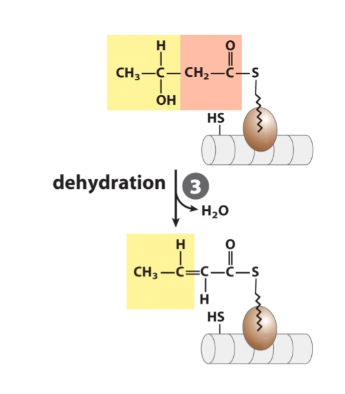
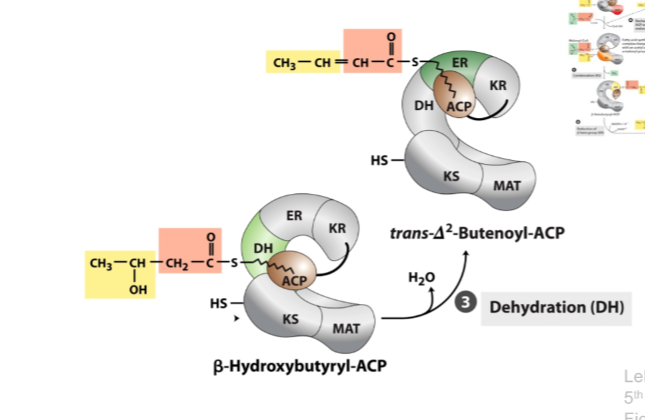
]]STEP 3]]
- Elimination of H20 to form C=C ^^(B-hydroxyacyl-ACP dehydratase)^^
]]STEP 4]]
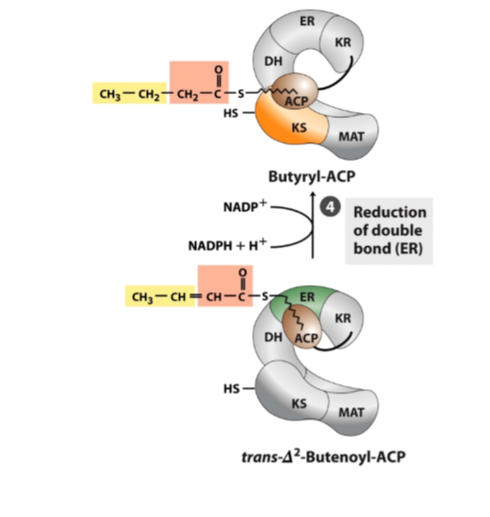
- C=C reduced to a saturated acyl group ^^(Enoyl-ACP reductase)^^
]]STEP 5]]
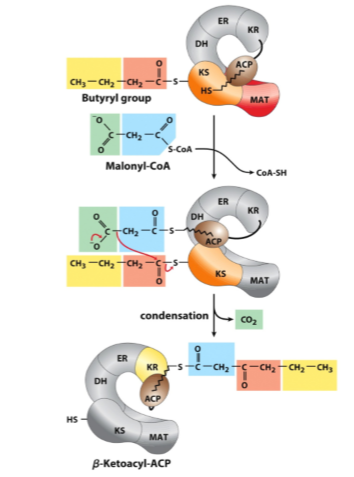
- KS transfers butyryl group from ACP to itself
- MAT transfers new malonyl group to ACP
- KS condenses malonyl group with butyryl group
- RESULTS IN SECOND ROUND OF FA SYNTHESIS
Organization of Fatty Acid Synthase
- Plants and bacteria = separate polypeptides
- Vertebrates = single polypeptide, bilobed dimer
- Fungi = two separate chains (double ring)
- Mammalian = 6 enzyme functions + ACP in one polypeptide chain
Palmitate C16 Synthesis
- First acetyl = farthest from carboxylate
- Substrate is physically linked to Fatty Acid Synthase during the whole process
- Palmitic acid is released from FAS by ^^thioesterase^^ cleavage
- Palmitate is the precursor for longer-chain fatty acids
- ELONGATION = 2C at a time (malonyl)
- CoA instead of ACP
- Elongases and Desaturases
Delta 9 unsaturated Fatty Acids
- Fatty acyl CoA desaturases = introduce Cis double bonds
- Desaturate only at the 9 position
- Palmitate 16:0 is oxidized to palmitoleate 16:1Delta9
- Stearate 18:0 to oleate 18:1delta9
- Require oxygen to accept 2 electrons (one from NADPH and one from Saturated fatty acid bond
- Require NADPH which is passed through cytochrome C (NADPH gets oxidized)
Other unsaturated fatty acids
- mammals can’t further desaturate delta 9’s
- mammals require linoleate (18:2delta9,12) as precursor for other products (prostaglandins)
- plants and bacteria make linoleate to promote membrane fluidity
- Linoleate is an essential dietary fatty acid
7. Triacylglycerol assembly
- Triacylglycerols are the stored form of fatty acids
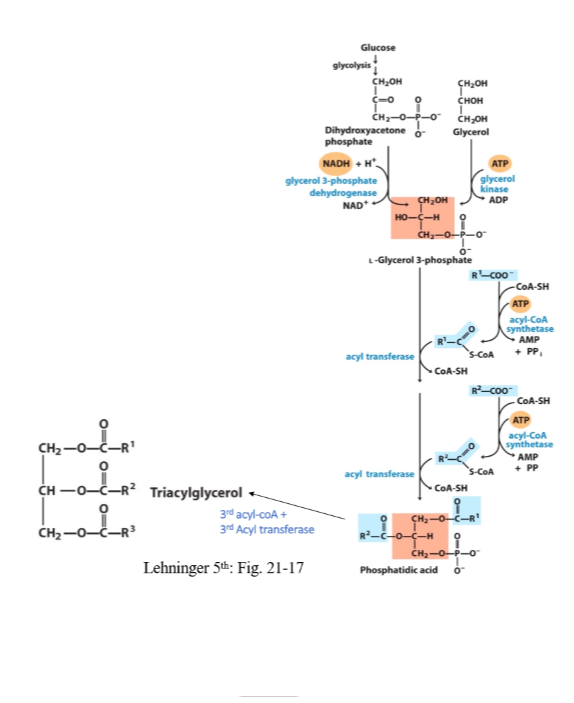
- Sources of g3po4
- major source is dihydroxyacetone PO4
- Acetyl-CoA synthetases activate FA groups with CoA
- Acyl transferases transfer the FA to glycerol-3-PO4
Triacylglycerol Cycle
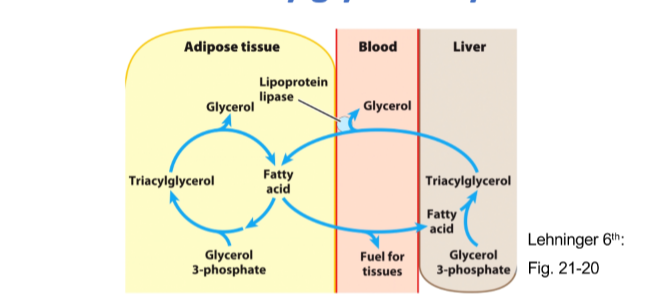
- made in adipose tissue or liber
- broken down (only in adipose)
- 75% of fatty acids released by lipolysis are reesterified to form triacylglycerols
- Futile cycle = makes the system more responsive to quickly changing needs
8. Regulation and integration of metabolism
- Rapid = cellular regulation of enzymes (s to minutes)
- high ATP inhibits phosphofructokinase-1
- Slow = hormonal regulation (min to h)
- Glucagon and insulin trigger signaling cascades
- Gradual/adaptive = changes in gene expression (h to days)
- high-fat diet triggers B oxidation enzyme synthesis
1. Regulation of Fatty acid Oxidation
- Regulation at the committed step (aka when fatty acids are transferred to the mitochondria)
- Malonyl-CoA
- inhibition of carnitine acyltransferase I
- Mitochondria
- NADH/NAD+ inhibits B-hydroxyl-CoA dehydrogenase
- Acetyl-CoA
- inhibits acyl-CoA acetyltransferase (thiolase)
2. Regulation of fatty acid synthesis
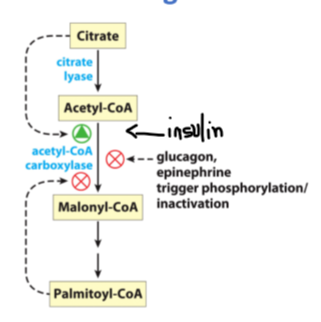
- Acetyl-CoA carboxylase is the committed step
- Citrate lyase is activated by insulin
- Regulated by both metabolites and hormones
- allosteric and phosphorylation
- Acetyl CoA carboxylase regulation
- Metabolites
- palmitoyl-CoA (end product) inhibits ACC
- citrate (precursor) activates ACC
- Hormones
- epinephrine/glucagon causes phosphorylation of ACC = inhibiting it
- insulin (dephosphorylation of ACC, activating it by polymerizing it into active ACC filaments)
3. Reciprocal regulation
- Synthesis and degradation are regulated at the same time, so only one occurs at once
4. Tissue-Specific regulation