Late Adulthood (12)
Definition (#f7aeae)
Important (#edcae9)
Extra (#fffe9d)
Longevity:
Life expectancy:
The number of years that will probably be lived by the average person born in a particular year.
Life span:
Maximum number of years an individual can live.
The life span of human beings is about 120 to 125 years of age.
The sex difference in longevity also is influenced by biological factors.
Women have more resistance to infections and degenerative disease.
Centenarians:
In developed countries, the number of centenarians (individuals 100 years +) is increasing at a rate of approximately 7%each year.
In a study of US and Japanese centenarians, health resources (better cognitive function, fewer hearing problems, and positive activities in daily living) were linked to a higher level of well-being.
Chronic high-mortality diseases are markedly delayed for many years in centenarians, with many not experiencing disability until near the end of their lives.
Researchers also discovered a strong genetic component of living to be 100 that consists of many genetic links that each have modest effects but as a group can have a strong influence.
These genes play roles in Alzheimer disease, diabetes, cardiovascular disease, cancer, and various biological processes.
The youngest and oldest-old:
A distinction is being made between the young-old (65-84) and oldestold (85+).
Compared with the oldest-old, the young-old have a substantial potential for physical and cognitive fitness, higher levels of emotional well-being, and more effective strategies for mastering the gains and losses of old age.
The oldest-old today are mostly female, and the majority of these women are widowed and live alone if they are not institutionalized.
Biological theories of aging:
Evolutionary theory:
Natural selection has not eliminated many harmful conditions and non-adaptive characteristics in older adults.
Benefits conferred by evolution decline with age because natural selection is linked to reproductive fitness
Cellular clock theory:
Cells can divide a maximum of 75 to 80 times.
Age makes cells less capable of dividing.
Telomeres: Tips of chromosomes; DNA sequences that cap chromosomes
Free-radical theory:
A microbiological theory of aging that states that people age because normal metabolic processes within their cells produce unstable oxygen molecules known as free radicals.
People age because normal metabolic processes within cells produce unstable oxygen molecules that ricochet around inside cells damaging DNA and cellular structures.
Biological theories of aging:
Mitochondrial theory:
Aging is caused by the decay of mitochondria, tiny cellular bodies that supply energy for function, growth, and repair.
Hormonal stress theory:
Aging in the body’s hormonal system can decrease resistance to stress and increase the likelihood of disease.
Physical Development:
The aging brain:
Shrinking, slowing brain:
1 study found a decrease in total brain volume and volume in key brain structures such as the frontal lobes and hippocampus from 22-88 years.
Recent analyses concluded that in healthy aging the decrease in brain volume is due mainly:
Shrinkage of neurons
Lower numbers of synapses
Reduced length of axon
Prefrontal cortex is 1 area that shrinks the most with aging, and research has linked this shrinkage with decreased working memory and slower motor behaviour in older adults.
Recent research indicates that demyelination occurs with aging in older adults.
Demyelination: Deterioration in the myelin sheath of the brain.
The adapting brain:
The aging brain also has remarkable adaptive capabilities.
The brain loses only a portion of its ability to function, and the activities older adults engage in can influence the brain’s development.
A recent study found that a higher level of aerobic fitness embedded in a health promotion program for older adults was associated with higher cortical and hippocampal volumes.
3 topics reflect the adaptiveness of the human brain in older adults:
The possibility that the brain might be able to generate new neurons.
The role of dendritic growth.
The adaptive potential of delateralization.
Decrease in the brain:
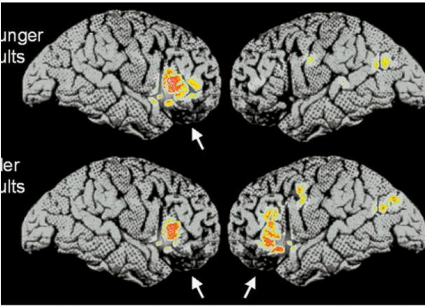
Laterization in older adults
Younger adults primarily used the right prefrontal region of the brain (top left image) during a recall memory task.
Whereas older adults used both the left and right prefrontal regions (bottom two images).
Sleep, physical appearaance and movement:
Sleep:
50% of older adults complain of having difficulty sleeping.
Result in earlier death.
Linked to a lower level of cognitive functioning.
Poor sleep is a risk factor for falls, obesity, a lower level of cognitive functioning, and earlier death.
Physical movement:
Wrinkles and age spots are the most noticeable changes.
Both men and women become shorter because of bone loss in their vertebrae.
Weight usually drops after we reach 60 years of age. Occurs because of muscle loss, which also gives our bodies a “sagging” look.
The risk of falling in older adults increases with age and is greater for women than for men.
Sensory development:
Vision:
Visual acuity.
Color vision.
Depth perception.
Disease of the eye:
Cataracts: Thickening of the lens of the eye that causes vision to become cloudy, opaque, and distorted.
Glaucoma: Damage to the optic nerve because of pressure created by a buildup of fluid in the eye.
Macular degeneration: Deterioration of the macula of the retina, which corresponds to the focal center of the visual field.
Hearing:
Impairments becomes an impediment.
Hearing aids and cochlear implants minimize the problems linked to hearing loss.
Smell & taste:
Losses begin at about age 60 years.
Course of physical development in old age:
Circulatory and respiratory system:
Cardiovascular disorders increase in late adulthood.
Recent study of older adults, a faster exercise walking pace, not smoking, modest alcohol intake, and avoiding obesity were associated with a lower risk of heart failure.
Older adults can improve lung functioning with diaphragm-strengthening exercises.
Severe impairments in lung functioning and death can result from smoking.
Sexuality:
Aging does induce some changes in human sexual performance, more so in males than in females.
Older adults may express their sexuality differently from younger adults, focusing on touching and caressing in their sexual relationship when sexual intercourse becomes difficult.
Health:
Health problems:
Majority of adults who are alive at 80 years or older are likely to have some type of impairment, like chronic diseases.
Low income is also strongly related to health problems in late adulthood.
Recent studies document links between low socioeconomic status and health problems.
Causes of death:
Cancer recently replaced cardiovascular disease as the leading cause of death in US middle-aged adults.
The decline in cardiovascular disease in middle-aged adults has been attributed to improved drugs, decreased rates of smoking, improved diets, and increased exercise.
Among ethnic groups in the US, African Americans have high death rates for stroke, heart disease, lung cancer, and female breast cancer.
Arthritis, osteoporosis are some of the most common causes.
Substance use and abuse:
Older adults are taking multiple medications, which can increase the risks associated with consuming alcohol or other drugs.
Late-onset alcoholism: Used to describe the onset of alcoholism after the age of 65.
Late-onset alcoholism is often related to loneliness, loss of a spouse, or a disabling condition.
1 study revealed better physical and mental health and increased longevity in older adults who drank moderately compared with those who drank heavily or did not drink at all.
Exercise, nutrition and weight:
1 study, exercise literally made the difference between life and death for middle-aged and older adults.
Sedentary participants (low fitness) were more than twice as likely to die during the 8 year time span of the study than those who were moderately fit.
4 aspects of nutrition are important in older adults:
Getting adequate nutrition.
Avoiding overweight and obesity.
Deciding whether to restrict calorie intake to improve health and extend life.
Determining whether to take specific vitamin supplements to slow the aging process.
Cognitive Development:
Multidimensional and multidirectional:
Multidimensional: The change across 3 general domains/dimensions (physical, cognitive, socioemotional).
Multidirectional: Some dimensions or components of dimension expand and others shrink throughout one’s life.
Cognitive mechanics and cognitive pragmatics:
The distinction between cognitive mechanics and cognitive pragmatics is similar to the one between fluid (mechanics) and crystallized (pragmatics) intelligence.
Cognitive mechanics:
The “hardware” of the mind, reflecting the neurophysiological architecture of the brain.
Involve the speed and accuracy of the processes involving sensory input, visual and motor memory, discrimination, comparison, and categorization.
Cognitive pragmatics:
The culture-based “software programs” of the mind.
Include reading and writing skills, language comprehension, educational qualifications, professional skills, and also knowledge about the self and life skills that help us to master or cope with life.
Speed processing:
Meta-analysis confirmed that processing speed increases through the childhood and adolescent years, begins to decline at some point during the latter part of early adulthood, and then continues to decline through the remainder of the adult years.
Researchers have found that a slowing of processing speed at baseline is linked to the emergence of dementia over the next 6 years.
The decline in processing speed in older adults is likely due to a decline in functioning of the brain and central nervous system.
Age-related losses in processing speed were explained by a decline in neural connectivity or indirectly through changes in dopamine, or both.

Attention:
Changes in attention are important aspects of cognitive aging.
Researchers have found that older adults are less able to ignore distracting information than younger adults, and this distractibility becomes more pronounced as attentional demands increase.
Types of attention:
Selective attention: Focusing on a specific aspect of experience that is relevant while ignoring others that are irrelevant. Generally, older adults are less adept at selective attention than younger adults are.
Divided attention: Concentrating on more than 1 activity at the same time. The more difficult the competing tasks are, the less effectively older adults divide attention.
Sustained attention: Focused and extended engagement with an object, task, event, or some other aspect of the environment.
Executive attention: Planning actions, allocating attention to goals, detecting and compensating for errors, monitoring progress on tasks and dealing with novel or difficult circumstances.
Memory:
Explicit memory: Memory of facts and experiences that individuals consciously know and can state.
Implicit memory: Memory without conscious recollection; involves skills and routine procedures that are automatically performed.
Episodic memory: The retention of information about the details of life’s happenings.
Semantic memory: A person’s knowledge about the world, including one’s fields of expertise, general academic knowledge and everyday knowledge.
Older adults often take longer to retrieve semantic information, but usually they can ultimately retrieve it.
The ability to retrieve very specific information usually declines in older adults.
Education, work and health:
Education:
Older adults with less education had lower cognitive abilities than those with more education.
However, for older adults with less education, frequently engaging in cognitive activities improved their episodic memory.
Work:
Researchers found that when older adults engage in complex working tasks and challenging daily work activities, their cognitive functioning shows less age-related decrease.
Study of middle-aged & older adults found that employment gaps involving unemployment or sickness were associated with a higher risk of cognitive impairment.
Health:
Many illnesses, such as stroke, heart disease, and diabetes have a negative impact on intellectual performance.
Hypertension has been linked to lower cognitive performance in a number of studies, not only in older adults but also in young and middle-aged adults.
Cardiovascular disease is associated with cognitive decline in older adults.
Number of studies found that exercise is linked to improved cognitive functioning in older adults.
Use it or lose it:
Use it or lose it: A significant component of the engagement model of cognitive optimization that emphasizes how intellectual and social engagement can buffer age-related declines in intellectual development.
Mental activities can benefit the maintenance of cognitive skills.
Ex: Those who regularly read, did crossword puzzles or exercised their minds were 47% less likely to develop Alzheimer disease.
Language development:
Common language-related complaints reported by older adults are difficulty in retrieving words to use in conversation and problems understanding spoken language in certain contexts.
Tip-of-the-tongue phenomenon: Individuals are confident that they know something but can’t quite seem to retrieve it from memory.
Older adults also report that in less than ideal listening conditions they can have difficulty understanding speech.
Slower information-processing speed and a decline in working memory, especially in being able to keep information in mind while processing, likely contribute to decreased language efficiency in older adults.
Work and retirement:
Work:
Cognitive ability is one of the best predictors of job performance in older adults.
Older workers have lower rates of absenteeism, fewer accidents, and higher job satisfaction than their younger counterparts.
Several recent studies also have found that older adults who work have better physical and cognitive profiles that those who retire
Adjustment to retirement:
Older adults who adjust best to retirement are:
Healthy
Active and have adequate income
Better educated
Have extended social networks and family
Satisfied with their lives before retiring
Flexible and plan key factors
Mental health:
Major depression:
Mood disorder in which the individual is deeply unhappy, demoralized, self-derogatory and bored.
Less common among older adults than younger adults.
Common predictors:
Earlier depressive symptoms
Poor health or disability
Loss events
Low social support
Dementia:
A global term for any neurological disorder in which primary symptoms involve a deterioration of mental functioning.
Often lose the ability to care for themselves and can lose the ability to recognize familiar surroundings and people.
23% of women and 17% of men 85 years+ are at risk for developing dementia.
Parkinson’s disease:
Chronic, progressive disease characterized by muscle tremors, slowing of movement, and partial facial paralysis.
Triggered by the degeneration of dopamine-producing neurons in the brain.
Several treatments are available,
Alzheimer’s disease:
Progressive, irreversible brain disorder characterised by gradual deterioration of memory, reasoning, language, and eventually, physical function.
Women are more likely to develop Alzheimer’s disease because they live longer than men.
Alzheimer's involves a deficiency in the brain of messenger chemical acetylcholine.
Formation of amyloid plaques and neurofibrillary tangles.
Causes of alzheimers:
Age and genes are important factors with family history being the next greatest risk.
Lifestyles likely interact with genes to influence Alzheimer disease.
Older adults with Alzheimer disease are more likely to have cardiovascular disease than those who don’t.
Number of cardiac risk factors have been implicated in Alzheimer disease:
Obesity
Smoking
Atherosclerosis
Hypertension
High cholesterol
Lipids
Permanent atrial fibrillation
Drug treatment and caring for individuas with alzheimer’s:
Aricept (donepezil), Razadyne (galantamine), and Exelon (rivastigmine), are cholinesterase inhibitors designed to improve memory and other cognitive functions by increasing levels of acetylcholine in the brain.
Respite care: Services that provide temporary relief for those who are caring for individuals with disabilities, individuals with illnesses, or the elderly.
Religious and spiritual life:
Older adults are spiritual leaders in many societies around the world.
Older adults have higher levels of life satisfaction, self-esteem, and optimism.
Religion can provide some important psychological needs in older adults, helping them face impending death, find and maintain a sense of meaningfulness and significance in life, and accept the inevitable losses of old age.
Older adults who derived a sense of meaning in life from religion had higher levels of life satisfaction, self-esteem, and optimism.
Socially, the religious community can provide a number of functions for older adults, such as social activities, social support, and the opportunity to assume teaching and leadership roles.
Socioemotional Development:
Erikson’s theory:
Integrity vs despair:
Reflecting on the past and either piecing together a positive review or concluding that one’s life has not been well spent.
Through different ways, the older adult may have developed a positive outlook in each of the preceding periods.
Integrity: Retrospective glances and reminiscences will reveal a picture of a life well spent, and the older adult will be satisfied.
Despair: If older adult resolved one or more of the earlier stages in a negative way, retrospective evaluations of the total worth of his or her life might be negative.
Healthy arguing:
Growing old by avoiding disease, being engaged with life, and maintaining high cognitive and physical functioning.
The basic premises of healthy aging include keeping a balance between the various gains and losses that occur over time and minimizing the influence of factors unrelated to aging.
Erikson’s view on how positive resolution of the 8 stages can culminate wisdom and integrity in old age.

Other theories:
Activity theory:
The more active and involved older adults are, the more likely they are to be satisfied with their lives.
When older adults are active, energetic, and productive, they age more successfully and are happier than if they disengage from society.
Recent study indicated that an activity-based lifestyle was linked to lower levels of depression in older adults.
Suggests that many individuals will achieve greater life satisfaction if they continue their middle-adulthood roles into late adulthood.
Socioemotional selective theory:
Adults become more selective about their social networks as they grow older.
Older adults consciously choose to decrease the total number of their social contacts in favour of spending increasing time in emotionally rewarding moments with friends and family.
Theory also focuses on the types of goals that individuals are motivated to achieve.
2 important classes of goals:
Knowledge-related
Emotional
Selective optimisation with compensation theory:
Successful aging depends on 3 main factors: Selection, Optimization, and Compensation (SOC).
Selection: Based on the concept that older adults have a reduced capacity and loss of functioning, which require a reduction in performance in most life domains.
Optimization: It’s possible to maintain performance in some areas through continued practice and the use of new technologies.
Compensation: Relevant when life tasks require a level of capacity beyond the current level of the older adult’s performance potential.
Steps:
Master the weakness of old age by reducing the scope of performances (reflects selection).
Spent more time at practice than earlier in life (reflects optimization).
Strategies such as slowing down before fast segments, creating a perception of performing well (reflects compensation).
Model of socioemotional selectivity through the lifespan
This theory of socioemotional selectivity, the motivation to reach knowledge related and emotion-related goals changes across the life span.

Personality, the self and society:
Personality:
Researchers found that several of the Big Five factors of personality continue to change in late adulthood.
In older adults, higher levels of neuroticism predicted higher frailty, as did lower levels of openness and agreeableness.
More severe depression in older adults was associated with higher neuroticism and lower extraversion and conscientiousness.
The self and society:
Older adults may derive self-esteem from earlier successes in some domains, such as work and family, some aspects of their lives require continued support for self-esteem.
Social participation by older adults is often discouraged by ageism.
Ageism: Prejudice against others because of their age, especially against older adults.
Families and social relationships:
Lifestyle diversity:
Older men were far more likely to be married than older women.
Marital satisfaction helped to insulate older adults’ happiness from the effects of daily fluctuations in perceived health.
Male centenarians were more likely to have younger wives and female centenarians were more likely to have older husbands than noncentenarians.
Attachment:
Older adults have fewer attachment relationships than younger adults do.
In late adulthood, attachment security is associated with greater psychological and physical well-being than attachment anxiety.
Insecure attachment is linked to more perceived negative caregiver burden in caring for patients with Alzheimer disease.
Great grandparenting:
More grandparents today than in the past are also great-grandparents.
One contribution of great-grandparents is to transmit family history by telling their children, grandchildren, and great-grandchildren where the family came from, what their members achieved, what they endured, and how their lives changed over the years.
Older adult parenting and their adult children:
Researchers have found that older adults with children have more contacts with relatives than those without children.
Adult daughters are more likely than adult sons to be involved in the lives of their aging parents.
Researchers found that relationships between aging parents and their children are usually characterized by ambivalence.
Adult children’s relationships with their older adult parents revealed that ambivalence was likely to be present when relationships involved in-laws, those in poor health, and adult children with poor parental relationships in early life.
Friendship:
Older adults reported fewer problems with friends, fewer negative friendship qualities, less frequent contact with friends, and more positive friendship qualities with a specific friend.
People choose close friends over new friends as they grow older and as long as they have several close people in their network, they seem content.
Social support and social integration:
Higher level of social support was associated with older adults’ increased life satisfaction.
Higher level of social support also is related to a lower probability of an older adult being institutionalized and depressed.
Altruism and volunteering:
Older adults were more likely to behave in altruistic ways and to value contributions to the public good than younger adults were.
Volunteering is associated with a number of positive outcomes for aging adults
Recent studies found that when aging adults volunteer, they have better health, better cognitive functioning and are less lonely.
Among the reasons for the positive outcomes of volunteering are its provision of constructive activities and productive roles, social integration, and enhanced meaningfulness