Unit 6 Grammar
Хотеть
Я Хочу
Ты хочешь
он она кто хочет
Мы хотим
Вы хотите
Они хотят
Он кто хотел
Она хотела
Они вы мы хотели
Verbs of position (Chap 6.2)
To stand=Стояать (Он стоит, они стоят), to hang= висеть (Он висит, они висят), to be in a lying position= лежать (Он лежит, они лежат)
Genetive case, forms
The genetive case of personal pronouns:
NOM:y + genetive case
Кто: У кого
Я: У меня
ты: У тебя
Он: У него
Она: У неё
Мы: У нас
Вы: У вас
Они: У них
Genetive case of nouns:
Masc & neuter; hard stem: add а. soft stem add Я
Notes: 7 letter spelling rule affects many feminine hard nouns, some masc nouns have end stress whenever an ending is added on, the words мать & дочь become матер & дочер before adding any endings. Their genetive singular forms are матери & дочери. Nouns ending in or that refer to men and boys decline like fem nouns, but they are masc and take masc modifiers: у маленького димы есть книга.
Fem; hard stem: add ы, soft stem: add и
Other category than hard & soft ending: feminine ending with ь. Will take different endings from hard and soft stem endings (и)
Genetive case of adjectives:
Masc/Neut: Hard stems (ый): ого Soft stems(ий): его
Fem: Hard stems (ый): ой Soft stems (ий): ей
Genetive case of special modifiers:
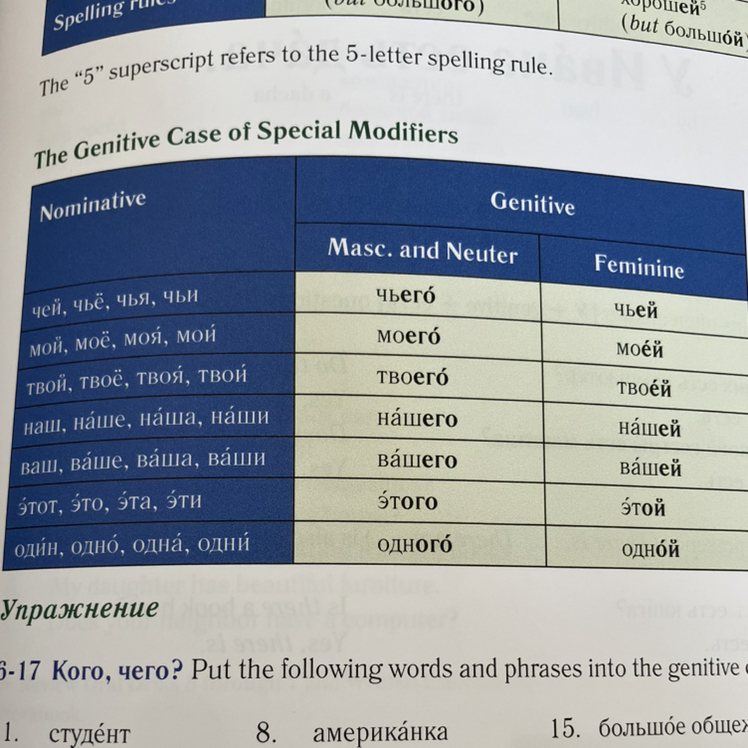
After y: Expressing Ownership, existence & presence: Есть что
Russian has no commonly used verb “to have.” Possession is expressed by saying something is by something (y literally means by)
construction: y + genetive case + есть + nominitive case (у ивана есть дача)
Dacha is “doing” the verb ест, so it is nominative
Russians often answer у + genitive + есть questions by saying “да, есть”
Simple presence (there is, there are) is also expressed by saying есть (Здесь ест книга? да, естъ.)
Expressing nonexistence & absenсe: Нет него
Opposite of есть (there is )is нет (there is not). нет takes the genitive.
Ecть + nom: здесь есть книга
Нет + gen: здесь нет книги
Statements of nonexistence with Нет have no subject
Не есть always turns into нет + gen. (never say не есть)
This also applies to personal pronouns eg. катю? Её нет! (Katya is not here)
Нет + gen case to express not having: y + gen + нет + gen (у вана нет дачи)
нет has 2 meanings in this exchange; у вас есть машина? Нет, машины нет (One means no, the other means there is not. This can also be shortned to “Нет, нет.”)
Possession & attribution of gen case of noun phrases
To express possession, use gen case
Gen case used to answer question чей when answer is noun or noun phrase
Can use gen case in most places where English would say “of”
Possessor always comes last
ditch “of’
Specifying quantity
один, (words that end in consonants) одна, (ends in a or soft sign) одно (end in o or e) одни (ends in ы оr и)
один is a modifier that agrees w noun it modifies
2,3,4 + gen singular nouns
A noun that comes after a number other than 1 is in genitive singular
2 is spelled два before masc/neut nouns and две before fem nouns, and numerals w multiple digits that end in 2 3 or 4 also have this rule
Other expressions of quantity: Gen plural used after all other numbers. until learning gen plural, don’t specify quantity unless number ends in 1 2 3 or , and avoid using adjectives w numbers other than 1
Masc, neut, fem, plural chart;
nom singular (1, 21, 31, ect.); masc- один брат neut - один шкаф fem; один сестра - plural - одни часы
gen singular (2, 22, 32, ect.) masc- два брата neut - два окна; fem две сестры
gen singular (3, 4, 23, 24, 33, ect.) masc- три брата neut - четыре окна; fem три сестры
gen plural (5-20, 25-30, ect.) see unit 7
At someone’s place: у кого
To indicate someone’s place, use y plus gen case. Context will dictate what the ‘place’ is (house, country, office, ect.)
eg. у брата