Origin Of Life
Eukaryotes and prokaryotes are two broad categories used to classify cellular organisms based on their cell structure and organization. Here's a simplified comparison between the two:
Prokaryotes:
Cell Structure:
Prokaryotic cells are typically smaller and simpler in structure compared to eukaryotic cells.
They lack a true nucleus and membrane-bound organelles. Instead, their genetic material is located in a single circular DNA molecule called the nucleoid region, which is not enclosed by a membrane.
Prokaryotic cells may contain other structures such as ribosomes (for protein synthesis), cell walls (for structural support and protection), and flagella or pili (for movement and attachment).
Organisms:
Prokaryotes include bacteria and archaea.
Bacteria are diverse single-celled organisms found in various environments, including soil, water, and living organisms. Some bacteria are beneficial, while others can cause disease.
Archaea are a group of single-celled microorganisms that often inhabit extreme environments such as hot springs, acidic or alkaline environments, and deep-sea hydrothermal vents.
Eukaryotes:
Cell Structure:
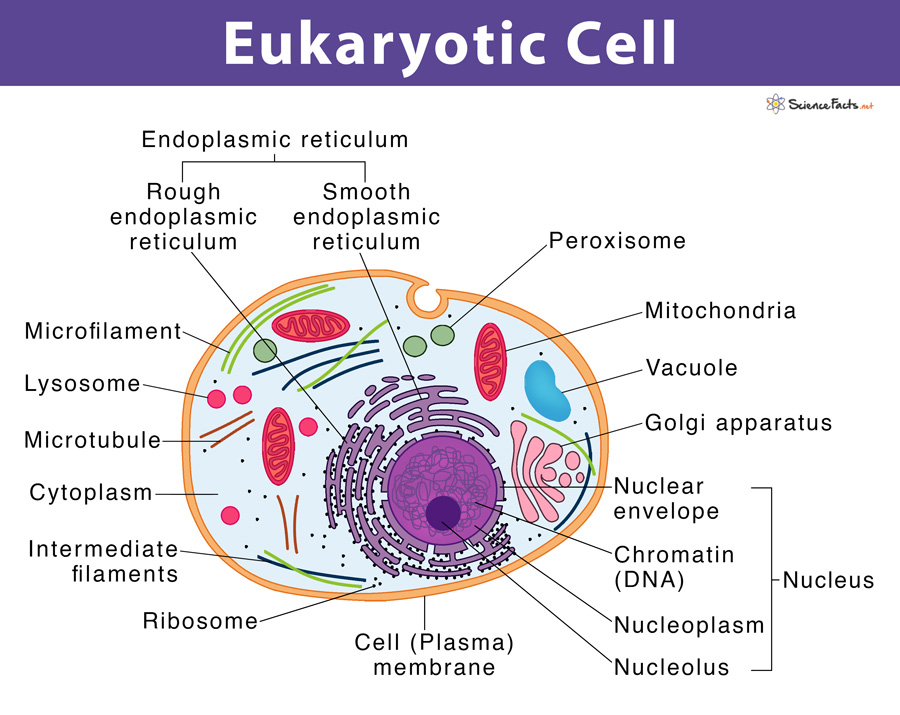
Eukaryotic cells are typically larger and more complex in structure compared to prokaryotic cells.
They have a true nucleus enclosed by a nuclear membrane, which houses the genetic material (DNA) organized into multiple linear chromosomes.
Eukaryotic cells contain various membrane-bound organelles, including the endoplasmic reticulum, Golgi apparatus, mitochondria, chloroplasts (in plant cells), lysosomes, and others. These organelles perform specialized functions within the cell.
Organisms:
Eukaryotes include a wide range of organisms, from unicellular protists to multicellular plants, animals, and fungi.
Protists are a diverse group of eukaryotic microorganisms that do not fit into the categories of plants, animals, or fungi. They include organisms such as amoebas, algae, and protozoans.
Plants are multicellular eukaryotic organisms that typically possess cell walls made of cellulose, chloroplasts for photosynthesis, and specialized tissues for support, transport, and reproduction.
Animals are multicellular eukaryotic organisms characterized by their ability to move, obtain energy through consumption of other organisms, and possess specialized tissues and organ systems.
Fungi are multicellular or unicellular eukaryotic organisms characterized by their heterotrophic mode of nutrition, cell walls made of chitin, and ability to decompose organic matter.
In summary, prokaryotes are single-celled organisms lacking a true nucleus and membrane-bound organelles, while eukaryotes are more complex organisms with a true nucleus and membrane-bound organelles, found in both single-celled and multicellular forms.
 The origin of life is one of the most fascinating and complex questions in science. While the exact details are still uncertain, several hypotheses have been proposed to explain how life may have originated on Earth:
Abiogenesis (Chemical Evolution):
Abiogenesis proposes that life arose from non-living matter through natural processes on early Earth.
According to this hypothesis, simple organic molecules, such as amino acids and nucleotides, formed spontaneously from inorganic precursors in the primordial soup of Earth's oceans or atmosphere.
These organic molecules then underwent further chemical reactions, eventually leading to the formation of more complex molecules, such as proteins and nucleic acids.
Over time, these complex molecules organized themselves into self-replicating structures, similar to RNA or RNA-like molecules, which could have been the precursors to the first cells.
Panspermia:
Panspermia suggests that life did not originate on Earth but was instead seeded from elsewhere in the universe.
According to this hypothesis, life may have originated on another planet or celestial body and then spread to Earth through interstellar travel, possibly within meteoroids, comets, or interstellar dust grains.
Panspermia does not explain the origin of life itself but proposes that the building blocks of life or even simple organisms may be widespread throughout the cosmos.
Hydrothermal Vent Hypothesis:
Some scientists propose that life may have originated at hydrothermal vents on the ocean floor.
Hydrothermal vents are openings in the Earth's crust where superheated water rich in minerals and gases is released from beneath the ocean floor.
These environments provide a source of energy and a variety of chemical compounds that could support the formation of organic molecules and the emergence of early life forms.
RNA World Hypothesis:
The RNA world hypothesis suggests that RNA played a central role in the origin of life.
RNA is capable of both storing genetic information and catalyzing chemical reactions, similar to DNA and proteins, respectively.
According to this hypothesis, self-replicating RNA molecules, or ribozymes, could have formed spontaneously on early Earth and served as the precursors to the first cells.
Deep-Sea Alkaline Hydrothermal Vent Theory:
This hypothesis proposes that life originated in alkaline hydrothermal vents on the ocean floor.
Unlike the more common acidic hydrothermal vents, alkaline vents provide conditions that could support the synthesis of organic molecules and the emergence of early life.
These hypotheses are not mutually exclusive, and it's possible that a combination of factors and processes contributed to the origin of life on Earth. While there is still much debate and ongoing research in this field, understanding the origin of life has profound implications for our understanding of biology, evolution, and the search for life beyond Earth.