Sound Localization & the Auditory Scene
Auditory Space
Extends around your head in all directions
We perceive objects in different positions based on their sound
Locate sound in 3 dimensions
Azimuth - left to right
Elevation - up and down
Distance - from listener
Sound Localization
Sounds in front - easiest to locate
Sounds off to the side and behind are harder to localize
Clicker task - click at different locations and see if they can locate the sound
Not coded in cochlea, so how’s it done?
Binaural Cues
Interaural time difference (ITD)
Sound reaches one ear before the other
Effective for low frequency sounds
Effective for sounds on azimuth, not elevation
Interaural level difference (ILD)
Sound is quieter at further ear
Difference due to sound shadow caused by head
Effective for high frequency sounds
Effective for sounds on azimuth, not elevation
Monaural Cue - Spectral Cue
3 different elevations of sound
ILD and IRD same (on sone of confusion)
Interactions of the sound with the outer ear (Pinna) create different spectra
HRTF - Head Related Transfer Functions
Unique to each person
Best for high frequencies
Changing the Pinna
Mold placed in the ear
Changes shape of outer ear
People adapt to mold
Learn localizations
Remove mold - go back to original
Perhaps two sets of neurons code the spectral code
Auditory Scene Analysis
Auditory Scene
Array of sounds in the environment
Auditory Scene Analysis
Separating the independent sound sources in the environment
Principles of Auditory Grouping
Heuristics that helps us organize the elements of an auditory scene
Principles of Auditory Grouping
Onset time - sounds start at different times
Location - helps us separate sounds
Similarity of Timbre and Pitch - sounds having same timbre/pitch usually are from same source
Other Grouping Methods
Proximity in Time
Notes played close in time get grouped
If not close in time, even if similar pitch, won’t get grouped
Similar to pitch grouping
Auditory continuity
Past experience
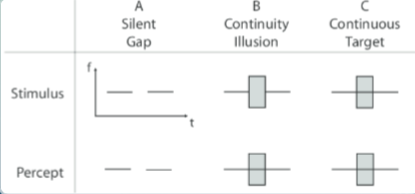
Auditory Continuity Illusion
Stimulus - what is presented
Percept - what is heard by observer
A - 2 tones separated by silence, you hear 2 tones
B - 2 tones separated with white noise, hear continuous tone
C - continuous tone interrupted by white noise, hear continuous tone
Past Experience
Used familiar tunes
Changed octaves on notes
Asked observer to identify tune
At first hard, then easy
Melody schema, match melody to familiar one in memory
Source of Sounds
Direct Sound
Sound straight from source to ear
Indirect Sound
Sound bounces off walls before arriving at ear
Precedence Effect
Direct sound always arrives first
Indirect sounds take longer
Closer sounds arrive first
Most of our indoor experience uses the precedence effect