305 lec 3 - prenatal and infant development
Lecture Overview
Course: PSYC305 - The Developing Mind: Prenatal and Infant Development
Lecture: 3
Presenter: Dr. Kirsty Dunn
Institution: Lancaster University
Learning Objectives
To have an understanding of the way in which researchers have attempted to overcome the inherent barriers to investigating prenatal developmental psychology.
To be able to critically compare methodologies for investigating prenatal and early infant developmental psychology.
Methodologies in Postnatal Developmental Psychology
Behavioural Measures:
Looking Time
Eye Tracking
Motor Measures
Motion Capture
Neurological Measures:
EEG (Electroencephalography)
fNIRS (Functional Near-Infrared Spectroscopy)
fMRI (Functional Magnetic Resonance Imaging)
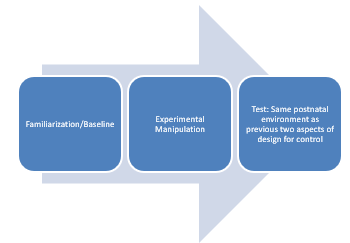
Standard Experimental Procedure:
Familiarisation/Baseline Phase
Experimental Manipulation Phase
Test Phase: Maintaining the same postnatal environment as previous two aspects for control.
Methodologies for Prenatal Developmental Psychology
Preterm Infants
Experimental Approach:
J Can use comparable techniques for mapping trajectories
J Eliminates confound of testing in different environments
L Preterm infants are at higher risk for developmental delays and impairment
L Is this because atypical development caused preterm birth?
L Or is this because they are not provided with the most appropriate sensory input at birth?
L We know very little about how the foetus engages with their sensory environment
L The answers to these questions have a bearing on how useful the conclusions of these studies are to our understanding of typical development.
Postnatal Testing Phase
Example Study:
DeCasper & Spence (1986):
Mothers read The Cat in the Hat by Dr Seuss twice a day for the last 1.5 months of pregnancy.
Methodology:
Changes in the rate of sucking turned on or off a tape recorder of the mother reading.
Half the infants heard the familiar story, the other half heard a different story.
Finding:
Infants adjusted their sucking rates towards producing familiar sounds, indicating recognition of the story.
Implications: babies will react to common sounds, including anger and violence
The use of preterm infants and postnatal testing of prenatal exposure are key methods for exploring prenatal development. These methods maintained proximity to traditional developmental methods for comparison.
Limitations noted in the traditional methods have been addressed with recent technological advancements.
Key Note:
Context is crucial in evaluating the strengths and limitations of prenatal developmental research.
Methodologies for Prenatal Developmental Psychology - Foetal Heart Rate (FHR)
Experimental Studies Using FHR:
Research exemplified by Kisilevsky papers.
Advantages:
Provides an online measure of response to experimental stimuli.
Limitations:
Limited comparability to postnatal measures since heart rate is not a standard measure in postnatal research.
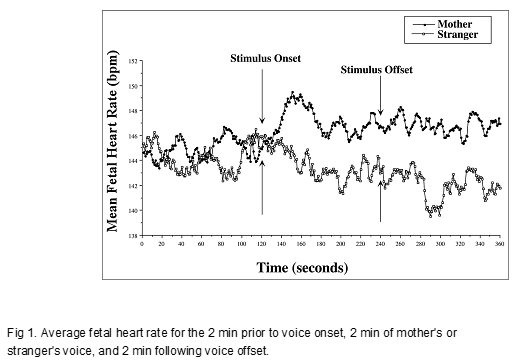
Babies heart rate increases during mothers voice, indicating recognition
FHR decreases at strangers voice
Methodologies for Prenatal Developmental Psychology - foetal Magnetic Resonance Imaging (fMEG)
Experimental Studies Using fMEG:
e.g. Hari Eswaran papers
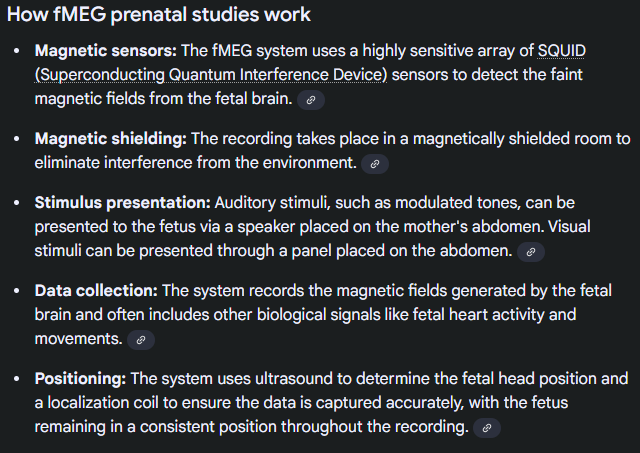
use a non-invasive technique to measure the magnetic fields produced by the foetal brain to investigate its development. These studies can record both evoked brain responses to stimuli, like auditory tones, and spontaneous brain activity to understand cognitive precursors like habituation and stimulus specificity. The research aims to establish normative data for a healthy fetal brain, which could help in detecting developmental delays and guiding intervention strategies.
Advantages:
Offers an online measure of response to stimuli that is aligned with postnatal measures.
Limitations:
Movement artifacts are challenging to control.
Limited in presenting stimuli (only basic flashes of light can be shown).
Recent advancements allow for online measurement of fetal responses.
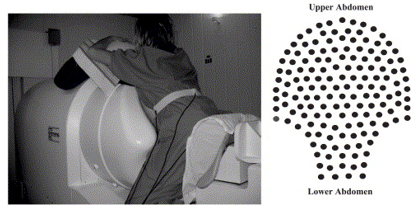

Squiggles indicate where there is movement in the womb
Conclusion on fHR and fMEG:
FHR is a cost-effective tool but lacks comparability to postnatal literature.
fMEG is promising but requires significant investment; only a limited number of labs can utilize it effectively.
Methodologies for Prenatal Developmental Psychology - Ultrasound Imaging
Behavioral Measures In Utero Using Ultrasound:
Ultrasound technology operates like sonar: emitting ultrasound waves and detecting echoes.
Used to map the boundaries of objects, such as fetal anatomy.
Advances in Imaging Techniques
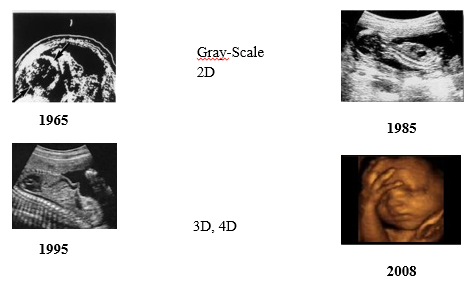
Transition from 2D to 3D Imaging:
Example: A 2D ultrasound scan of a fetus's foot illustrates visible bones.
Surface rendering allows for processing images to outline structures, significantly enhancing visual accuracy.
Improvements in Ultrasound Technology
Historical technological advancements from 1965 to 2008, with notable shifts from gray-scale 2D imaging to enhanced 3D and 4D imaging.
Action Anticipation Studies
Cited Work: Myowa-Yamakoshi & Takeshita (2006)
Facial Expression Research Nadja Reissland, Durham University
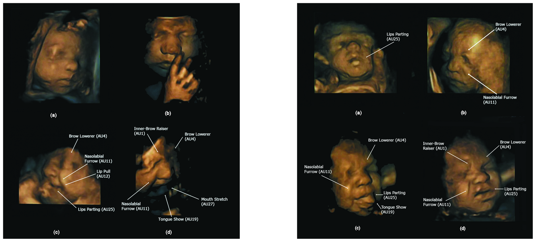
Key Study: Reissland et al. (2011)
Investigated the development of facial expressions before birth.
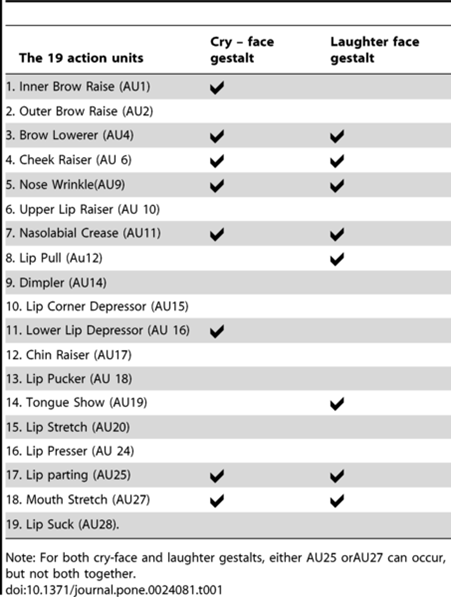
Methodology included frame-by-frame coding using Observer XT to identify facial expression patterns.
Relevant identifiers of a facial expression were uniquely coded.
Prenatal Facial Expression Studies
Studies published in PLOS ONE on the development of facial expressions in fetuses:
Reference #1: Reissland N, Francis B, Mason J, Lincoln K (2011) - Do Facial Expressions Develop before Birth?
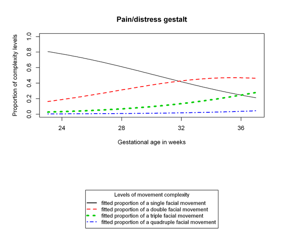
Reference #2: Reissland et al. (2013) - Can Healthy Fetuses Show Expressions of “Pain” or “Distress”?
Methodologies for Prenatal Developmental Psychology - Ultrasound
Example: Reissland et al. (2015) studied fetal movements among smoking vs. non-smoking mothers.
Key advantages:
All measures taken in utero, avoiding environmental change confound.
Utilizes behavioral measures often employed in postnatal studies.
Limitations include lack of experimental manipulation hindering definitive causal conclusions and typically smaller exploratory sample sizes.
Foetuses of smoking mothers showed a significantly higher rate of mouth movements compared to foetuses of nonsmoking mothers (p = 0.02), after controlling for maternal stress and depression. As pregnancy progressed, these differences between the smoking and nonsmoking groups widened
Using Ultrasound to Investigate Prenatal Social Development
Findings:
Newborns show a preference for gazing at faces and can distinguish among different faces.
Newborns use familiar voices to help identify their mother's face.
Research inquiries into developmental origins:
When does this ability activate? Is it driven by genetics, imprinting, or observable development before birth?
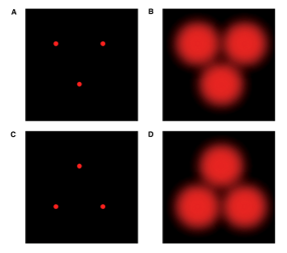
A and B designed to mimic a face and be more engaging to the infant.
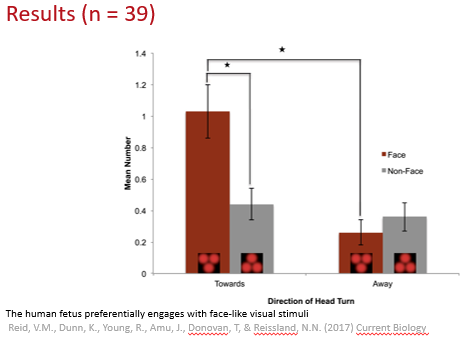
Implications
The preference to engage with face-like stimuli is present prior to birth
–Prenatal learning?
–Genetic drive?`
–Unlikely imprinting
–We engage with visual information in the womb
–So what about the visual information in their natural environment?
Visual cognition can be examined in the fetus.
Conclusions
Researchers have attempted to overcome the inherent barriers to the study of prenatal perceptual and cognitive development
So far, fMEG and ultrasound techniques appear to have the most promise for bridging the gap between postnatal and prenatal developmental psychology
Research teams can now begin to adapt postnatal procedures to prenatal samples for informative comparisons, developmental trajectory mapping and discussion of theoretical origins of development.
Research Literature References
DeCasper, A. J., & Spence, M. J. (1986). Prenatal maternal speech influences newborns' perception of speech sounds. Infant Behavior and Development, 9(2), 133-150.
Dunn, K., Reissland, N., & Reid, V. M. (2015). The functional fetal brain: a systematic preview of methodological factors in reporting fetal visual and auditory capacity. Developmental Cognitive Neuroscience, 13, 43-52.
Kisilevsky, B. S. et al. (2009). Fetal sensitivity to properties of maternal speech and language. Infant Behavior and Development, 32(1), 59-71.
Myowa-Yamakoshi, M., & Takeshita, H. (2006). Do human fetuses anticipate self-oriented actions? A study by four-dimensional (4D) ultrasonography. Infancy, 10(3), 289-301.
Summary of Key Takeaways
Recognition of fetal responses to stimuli opens avenues into understanding prenatal sensory development.
The evolution of research methodologies continues to provide insights into prenatal and postnatal connections.