Quasi exp & non-exp designs
Classification of Psychological Studies
Types of Designs:
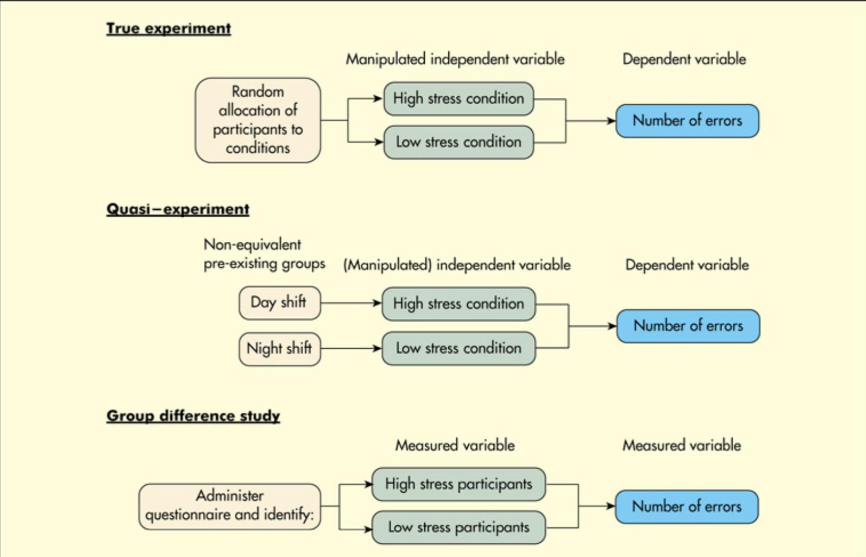
True (randomized) experimental design
Quasi-experimental design
Non-experimental design
True (Randomized) Experiment - Key Elements
Random Assignment: Participants are randomly assigned to conditions to mitigate bias.
Experimental Manipulation: Independent variable is manipulated to observe effects on dependent variable.
Standardization of Procedures: Control all variables except for independent variable to ensure reliability.
Quasi- and Field Experiments
The difference between quasi and true experiment is the lack of randomization in quasi and field experiments.
True (Randomized) Experiments
Controlled Environments: Settings like interview or discussion rooms with necessary equipment.
Field Experiments
Field Study Definition: Conducted outside the lab, capturing natural behaviors in participants' environments.
Naturalistic Design: Observing behavior as it naturally happens without artificial constraints.
Limitations: Less control over variables, potential awareness of participants regarding the research.
Differences in Validity
Threats to Validity in Field Experiments: Greater due to uncontrollable environmental variables and often non-equivalent groups.
Quasi-experiment Characteristics
Control Issues: Lacks random allocation, leading to non-equivalent groups.
Limitations of Quasi-experimental Design
No randomization can lead to initial differences affecting post-test outcomes.
Biases: Self-selection in conditions.
Non-experimental Designs Types
Observational Studies: Recording behavior without manipulation.
Group Difference Studies: Essentially, these studies tell us how groups vary from one another without explaining why those differences exist.
the main distinction lies in the intent to manipulate variables and the goal of establishing causality in quasi-experimental designs versus merely observing differences in group characteristics in group difference studies. Group difference studies are one type of cross-sectional studies
Observational Techniques
Participant vs. non-participant observations; systematic coding and recording are essential for data integrity.
Main Types of Observation
Event Sampling: Documenting specific behaviors each time they occur.
Interval Sampling: Counting behavior occurrences in set durations.
Time Sampling: Observing behaviors at designated times.
Participant Observation
Types of roles range from full participation as a member to merely observing within a group.
Summary of Observational Methods
Balancing flexibility and authenticity against the challenges of observer bias.
Comparison of Controlled vs. Naturalistic Observation
Controlled: High manipulation, may affect natural behavior.
Naturalistic: More genuine behaviors, but higher risks of observer bias.
Cross-Sectional vs. Longitudinal Designs
Cross-sectional: Evaluates participants at one time point, lacks causality.
Longitudinal studies: track the same group of participants over an extended period.
Cross-cultural Studies
Investigates psychological constructs across cultures to promote understanding and validity of research.
Process of Conducting Longitudinal Studies
Consistent measurement across time enhances the understanding of behavioral changes.
Experience Sampling Method (ESM) and Ecological Momentary Assessment (EMA) are research techniques used to gather real-time data on participants' thoughts, feelings, and behaviors in their natural environment.
ESM involves prompting participants to report their experiences at random intervals throughout the day, providing insights into their daily lives and fluctuations in mood or behavior.
EMA, similar to ESM, focuses on collecting data when participants are experiencing specific events or contexts, allowing researchers to track changes over time and in response to various stimuli.