1e. Restrictions on free trade
The 3 main types of Protectionism we will use are
Tarrifs
Quotas
Subsidies
Why a country would use protectionism
To avoid structural unemployment from trade
To stop dumping (the selling of products below average cost)
To improve a current account deficit
To protect an infant industry (one which is growing and has yet to fully benefit from economies of scale) or a sunset industry (one which is losing competitiveness)
To reduce negative externalities e.g. Unsafe/illegal goods
To protect strategic industries e.g. Defence/farming
In retaliation to protectionist measures
To raise tax revenue from tariffs
Why a country wouldn’t use protectionism
risk of retalliation
market distortion
higher prices for consumers
regressive effect on income inequality as tariffs are taxes on imports and theres no great way to make the impact of the increase to prices lower for people with lower incomes
by-passing import controls
higher costs for exporters in some senarios like brexit having to fill out more paperwork which causes the cost of production to increase as each shippment takes longer
The impact of protectionist policies
Perfectly elastic world supply
World supply is perfectly elastic because demand can be met for an individual country without it having any impact on world prices.
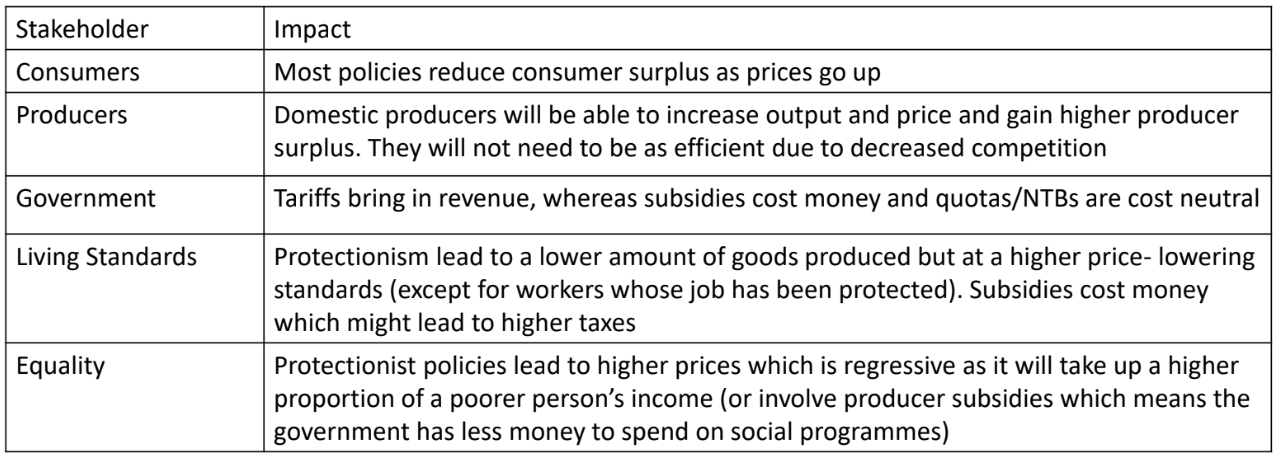
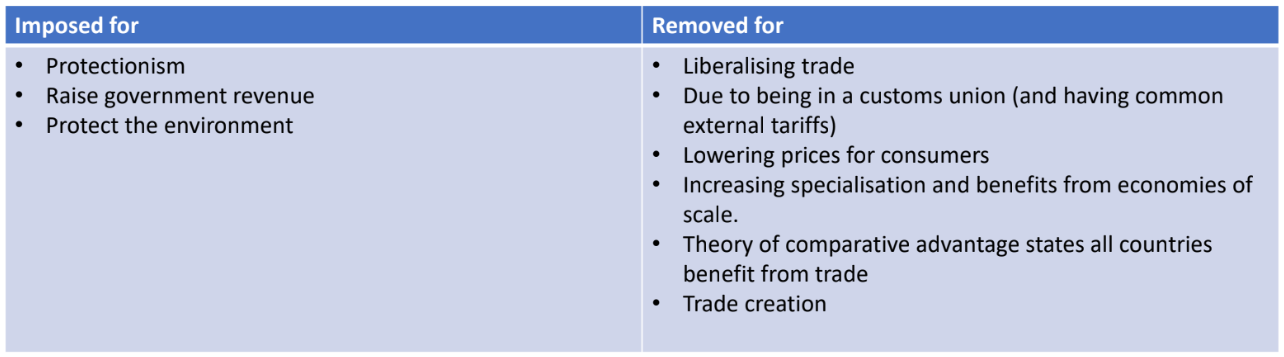
Tariffs
A tariff is a tax on imported goods and services, and is also called a customs orr imports duty.
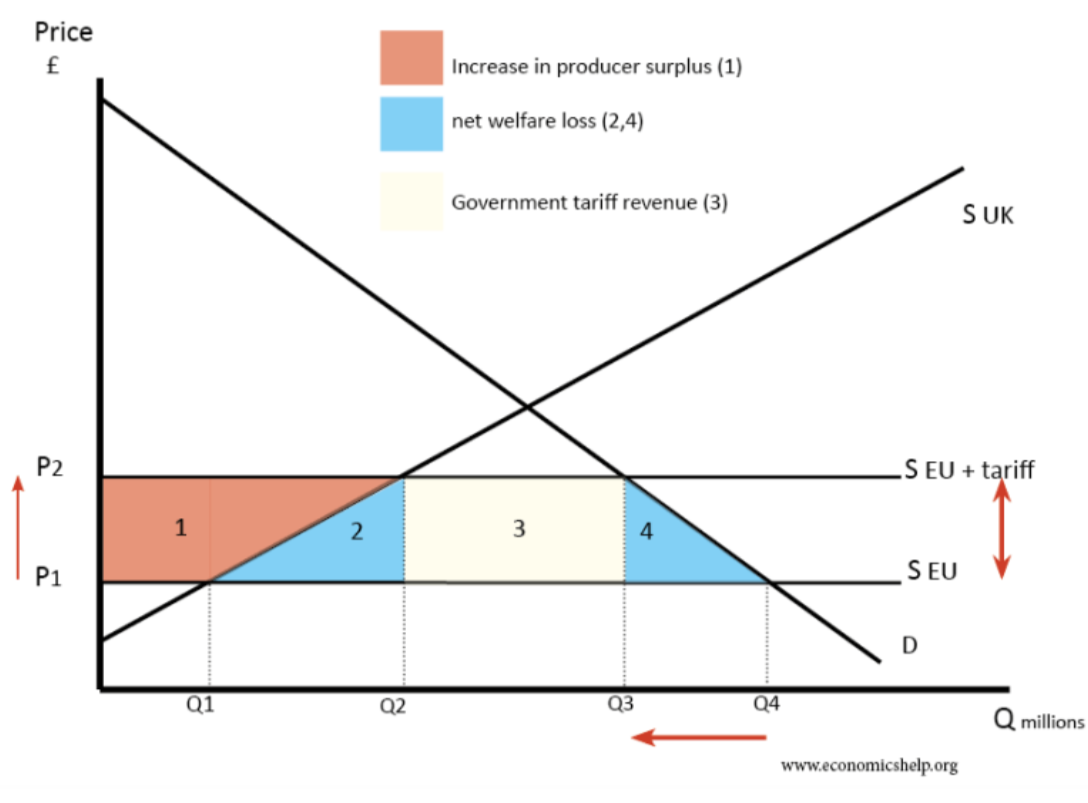
Between 0 to q1 we have domestic supply
After q1 up till q4 we use world supply/ imports as they are willing to provide goods at the same price unlike domestic firms who increase price as demand increases
we add a tariff EU + tariff which causes a shift up in the world supply price
now we have domestic supply between 0 to q2 and consumers will demand world supply from q2 to q3
so now domestic firms are producing more as demand is higher at new price level and imports dwindle annd decrease to to greater prices
In this case, the tariff is P1-P2.
The tariff leads to a decline in imports. Imports were Q4-Q1. After the tariff, imports fall to Q3-Q2.
Consumer surplus falls by 1+2+3+4
Government raises tariff revenue of area 3
Domestic suppliers gain an increase in producer surplus of area 1
The net welfare loss is (1+2+3+4) – (1+3) = 2+4
consider this a deadweight loss as we now have to pay more to get this good from a less effiencent and more expensive supllier.
Tariffs
A tariff is a tax on imported goods and services, and is also called a customs duty.
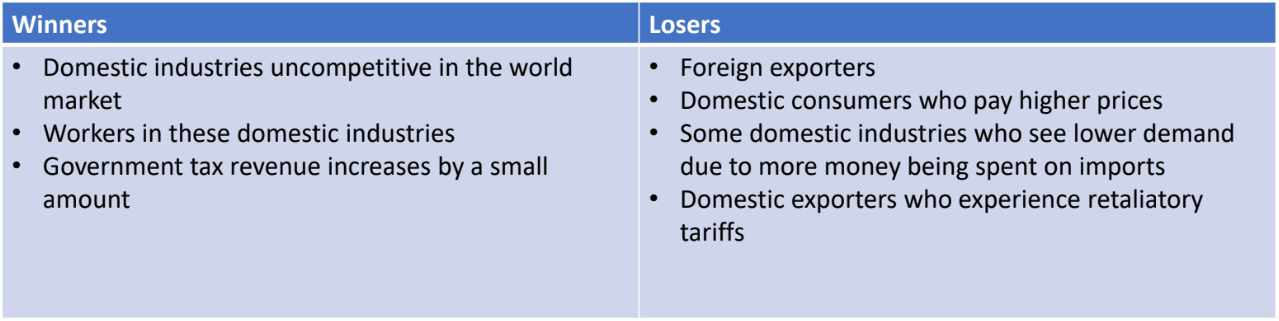
Types of quota
Absolute quota – a simple physical limit on number.
Tariff rate quota – These allow a certain number of imports to gain a discount on the usual tariff rate.
Voluntary export restraints (VER) This is when a government limits the amounts of exports from one country to another for a particular type of good. In the early 1980s, there was a VER on exports of Japanese cars to the US. The cap on export of Japanese cars lasted from 1981 to 1994 because the US government wished to protect the US car industry.
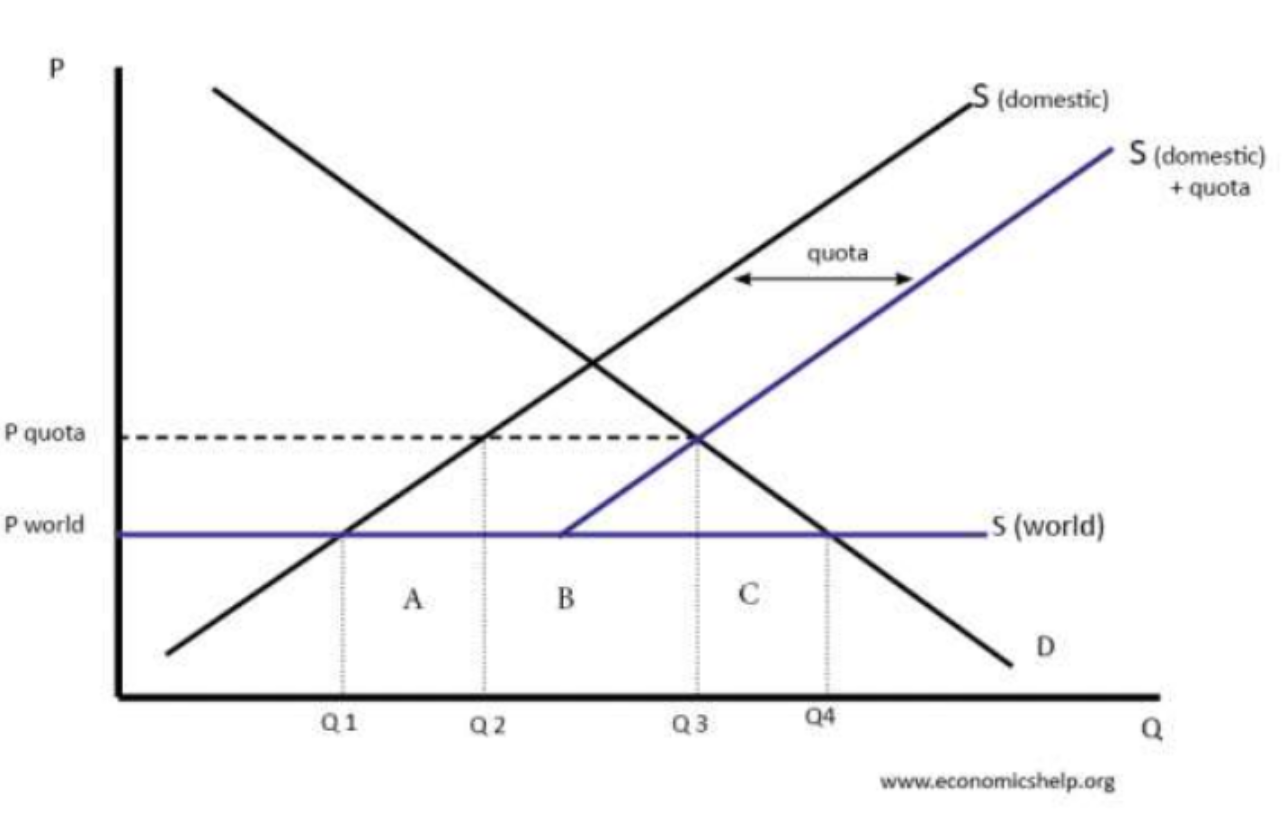
How a quota works
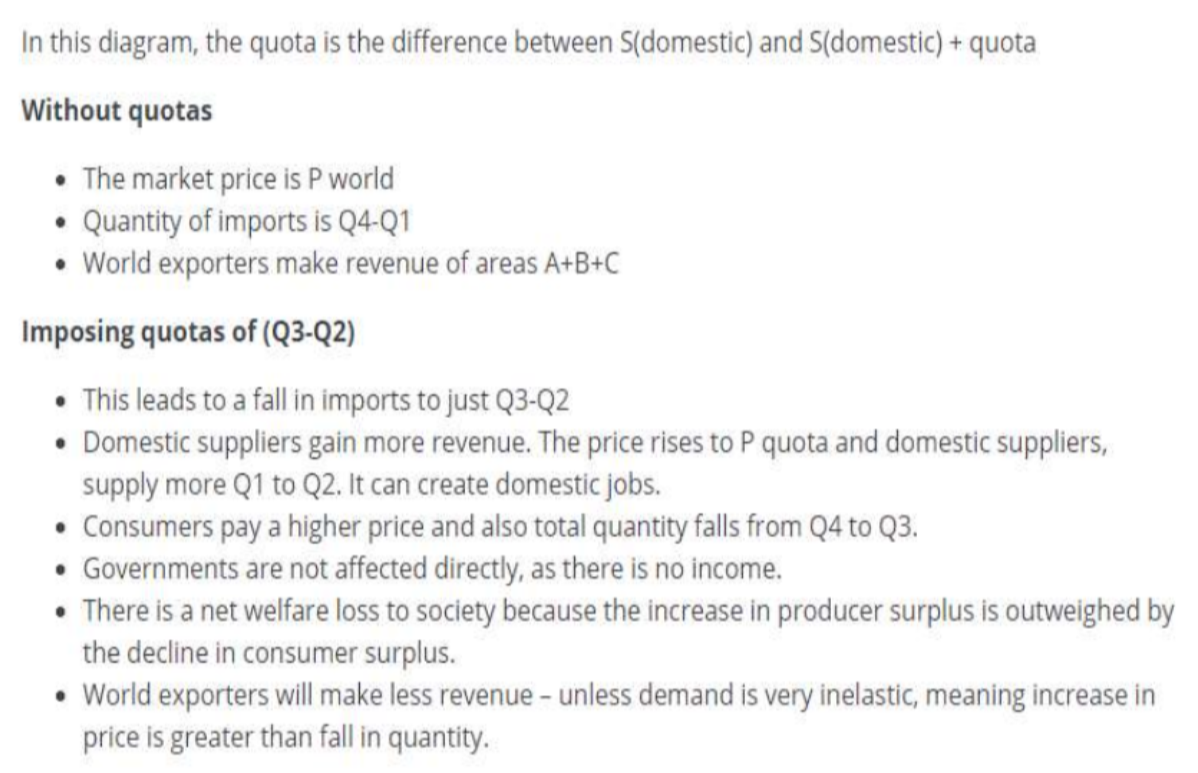
The quota means that consumers will have to buy more domestic products (at a higher price) as there are only a limited number of products allowed.
If the product cannot be made domestically there will be shortages
Unlike a tariff this raises no tax revenue for the government.
Quotas
The choice between quotas and tariffs
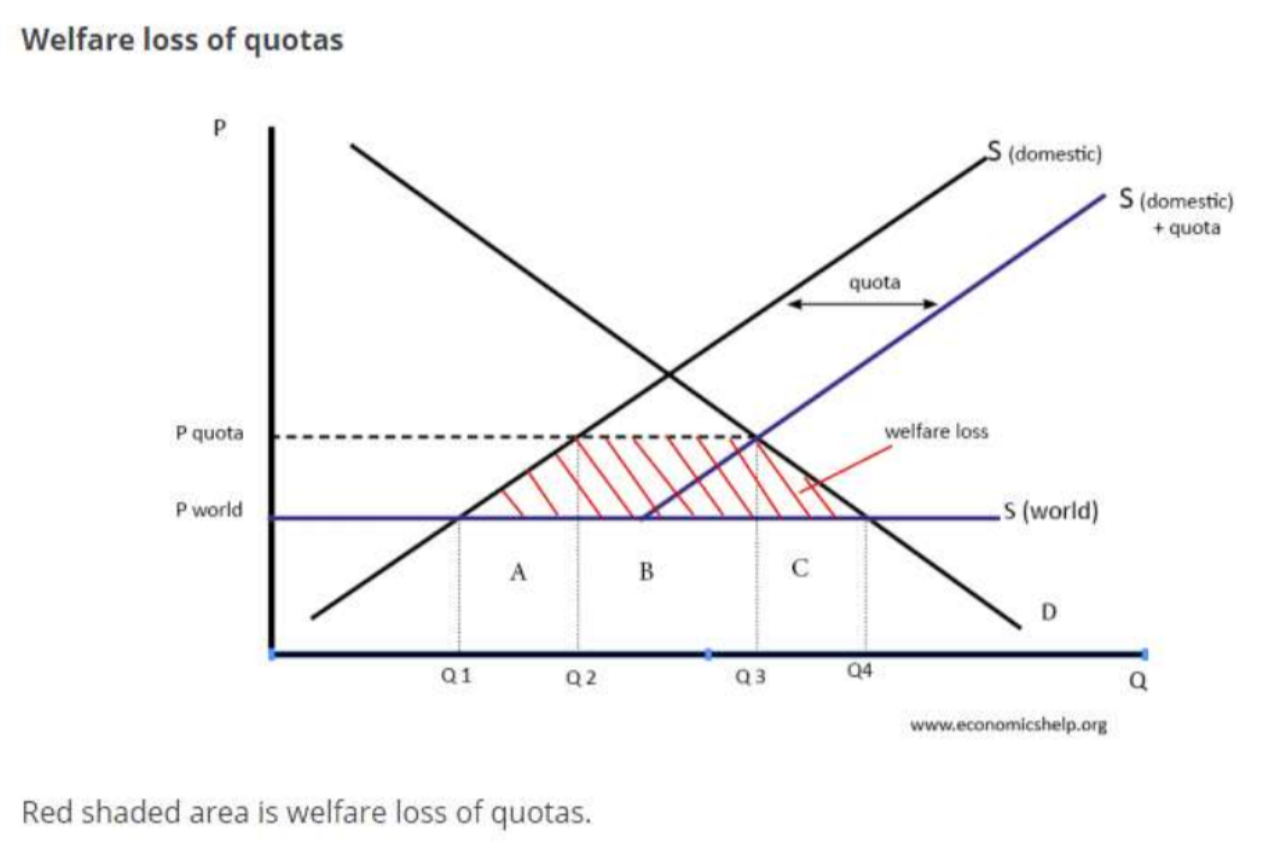
Quotas tend to cause a bigger fall in economic welfare because the government don’t gain any tax revenue, that you get with tariffs.
Quotas allow the country to be certain on the number of imports coming in. Tariffs is more unknown because it depends on the elasticity of demand and how consumers and suppliers react to the tariff.
Quotas may be harder to enforce if it is difficult to count the amount of the good coming into the country.
Quotas could be more unfair. Some export firms may do well, if they get the quota allowance, but others may lose out. It becomes a political issue on how to distribute the quotas. Firms may also dislike the uncertainty of not knowing how many quotes to gain
Other restrictions on free trade
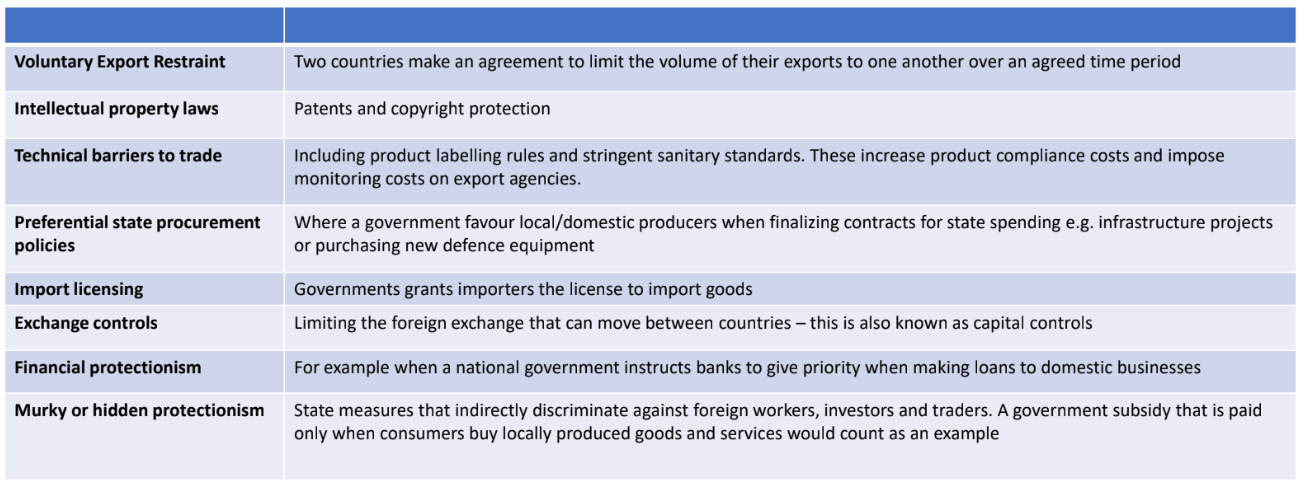
How does an export subsidy work
Export subsidies make exports appear cheaper to foreigners as they receive funding from the government. This should boost the current account.
This is normally regarded as anti-competitive as these firms have an unfair advantage.
This can have a negative impact on the government budget.
Export subsidy
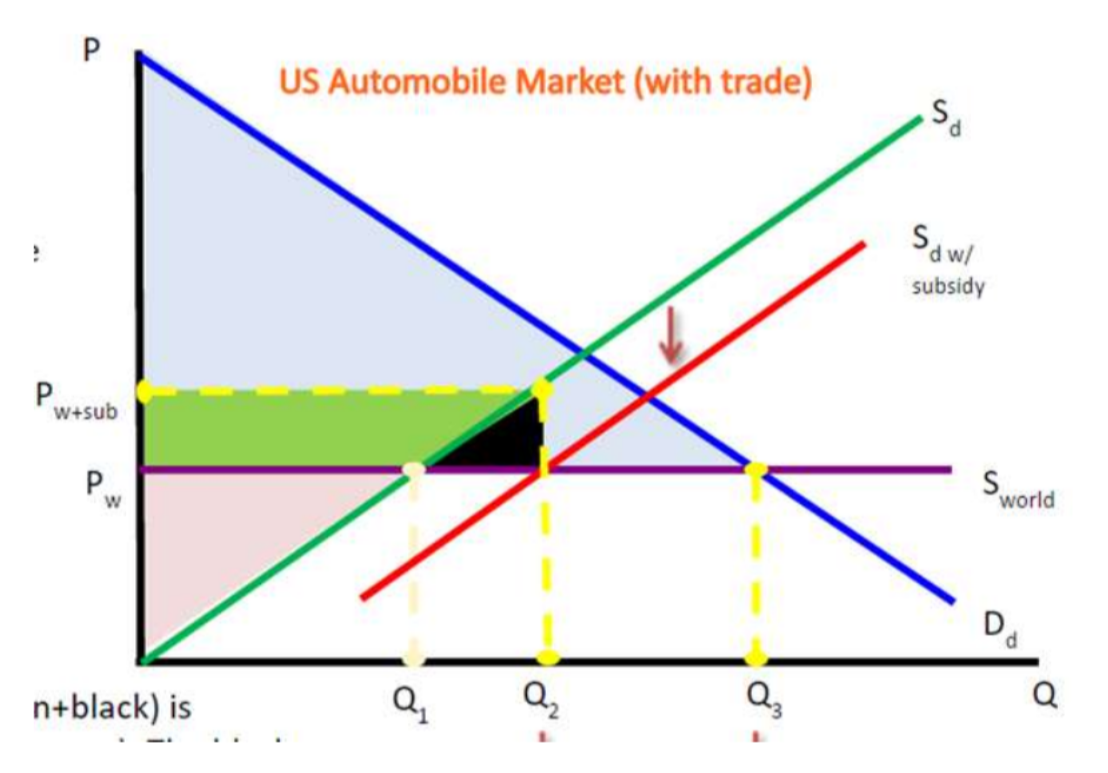
Price- No change
Domestic production changes from Q1 to Q2
Imports change from Q3-Q1 to Q3-Q2
Consumer Surplus- No change
Producer Surplus gain of
Green Areared areaSubsidy cost of Green Area + Black Triangle
No net welfare loss
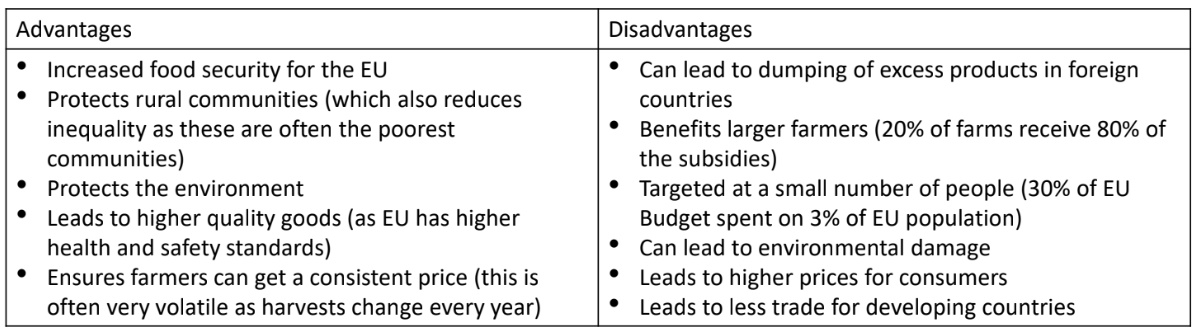
Common Agricultural Policy (CAP)
A series of subsidies and regulations targeted at agricultural markets
Was introduced to encourage EU food security and protect rural communities
Reform has proved challenging due to political resistance from farmers (unsurprisingly)
The CAP has been one of the biggest barriers to the agreement of the Doha Round.
Common Agricultural Policy (CAP)