Nutrient Cycle
Nutrient cycle refers to the way important nutrients like water nitrogen and carbon are used and cycled through the atmosphere, down to the soil to living organisms and back to the atmosphere. These are called cycles because it goes on and on.
Water cycle
Evaporation/Transpiration → Condensation → Precipitation → Collection
Carbon cycle
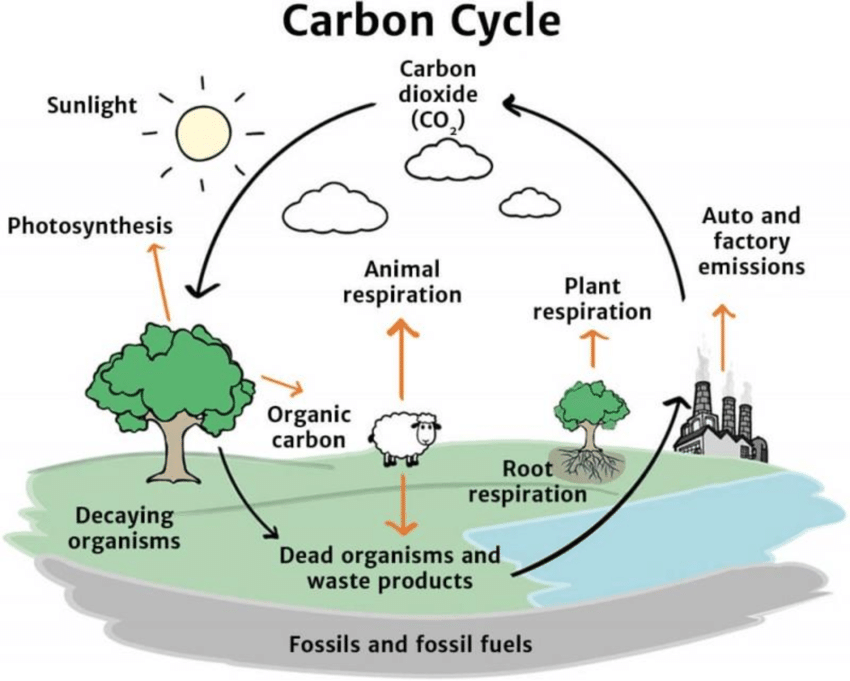
This image explains the carbon cycle.
Nitrogen cycle
The nitrogen cycle describes the processes by which nitrogen is converted into various forms, allowing it to be used by living organisms. Although nitrogen is abundant in the atmosphere, plants and animals cannot directly absorb it. Bacteria play a crucial role in transforming atmospheric nitrogen into usable states like ammonium and nitrates, which are then absorbed by plants. The cycle involves several key steps: fixation, nitrification, assimilation, ammonification, and denitrification. Human activities, particularly the use of fertilizers, significantly impact this natural cycle.
Highlights
Nitrogen is an odorless, colorless element, making up 78% of the atmosphere.
It is essential for all living things, particularly for food supply.
Plants and animals cannot directly absorb atmospheric nitrogen (N2).
Bacteria are vital for converting nitrogen into usable forms.
Human activities, especially fertilizer use, disrupt the natural nitrogen cycle.
Key Information/Topics
Forms of Nitrogen
Atmospheric Nitrogen (N2): The most abundant form, but unusable by most organisms.
Ammonium (NH4): A usable form of nitrogen.
Nitrates (NO3): A usable form of nitrogen, readily absorbed by plants.
Nitrites (NO2): An intermediate form in the cycle.
Steps of the Nitrogen Cycle
Fixation:
Bacteria convert atmospheric nitrogen (N2) into ammonium (NH4).
This is the first step to make nitrogen usable by plants.
Nitrification:
Bacteria convert ammonium into nitrates (NO3).
Nitrates are the form plants can absorb.
Assimilation:
Plants absorb nitrates from the soil through their roots.
Nitrogen is then used to synthesize nucleic acids, amino acids, and chlorophyll.
Animals obtain nitrogen by consuming plants.
Ammonification:
When plants or animals die, decomposers (bacteria and fungi) convert organic nitrogen back into ammonium.
This ammonium re-enters the nitrogen cycle.
Denitrification:
Excess nitrogen in the soil is converted back into atmospheric nitrogen (N2) by denitrifying bacteria.
Examples of denitrifying bacteria include Thiobacillus denitrificans, Seratia, and Pseudomonas species.
Impact of Human Activity
Human activities, such as adding nitrogen-rich fertilizers to soil, disrupt the natural balance of the nitrogen cycle.
This adds more nitrogen than the natural cycle can process, potentially harming the environment.
Tasks
Understand the different forms of nitrogen and their roles in the cycle.
Memorize the five key steps of the nitrogen cycle and the transformations that occur in each.
Recognize the critical role of bacteria in facilitating nitrogen transformations.
Consider the environmental implications of human interference with the nitrogen