Soft Palate & Pharynx
Soft Palate
Moveable partition between the oropharynx + nasopharynx
made of muscle covered by non-keratinised squamous epithelium
Extends laterally to form the palatoglossal + palatopharyngeal arches
receives sensory innervation via the maxillary division of trigeminal nerve
Muscles
Levator veli palatini
O- auditory tubes & petrous part of the temporal bone
Ins- palatine aponeurosis
A- elavates soft palate & equalises pressure in the middle ear
Inn- Vagus (pharyngeal plexus)
Tensor veli palatini
O- auditory tubes & sphenoid bone
Ins- palatine aponeurosis
A- tenses soft palate & equalises pressure in middle ear
Inn- Mandibular division of trigeminal
Palatoglossus
O- palatine aponeurosis
Ins- posterolateral aspect of the tongue
A- elevates the tongue and narrows the oropharyngeal isthmus
Inn- vagus (pharyngeal plexus)
Palatopharyngeus
O- palatine aponeurosis
Ins- lateral phayngeal wall
A- elevates the pharynx
Inn- vagus (pharyngeal plexus)
Functions of the soft palate
seals off the nasopharunx in swallowing and speech
narrows orophayngeal isthmus
elevates tongue
assists in elevationof pharunx during swallowing
Pharynx
Afibromuscular tube that extends from the base of the skull to the oesophagus
Functions
passageway for food and air
Important roles in swallowing
Articulation
Anterior openings for nose, mouth and larynx
Divisions- Nasopharynx, oropharynx & laryngopharynx
Nasopharynx
Extends from base of skull to tip of uvula
Lined by pseudostratified ciliated columnar epithelium with goblet cells
Important features- ostium of the eustachian tube, pharyngeal tonsils, tubal tonsils
sensory innervation: maxillary division of the trigeminal & glossopharyngeal
Orpharynx
extends from uvula to tip of epiglottis
lined by non- keratinised stratified squamous epithelium
Oropharyngeal isthmus in anterior wall contains- palatoglossal folds, palatopharyngeal folds, tonsillar recess and palatine tonsils
Posterior 1/3 of tongue runs vertically in the anterior wall- lingual tonsils
mucosa of tongue reflected onto epiglottis to form the valleculae and the medial and lateral glossoepiglottic folds
sensory innervation: plossopharyngeal nerve
Laryngopharynx
extends from the epiglottis to the oesophagus
laryngeal inlet located anteriorly- bounded by the arepiglottic folds and the epiglottis
piriform recess lateral to laryngeal inlet
lined by non-keratinised stratified squamous epithelium
sensory innervation: plossopharyngeal & vagus nerve
Waldeyer’s ring
A ring of lymphoid tissue that guards the entrance of the respiratory & gastointestinal systems
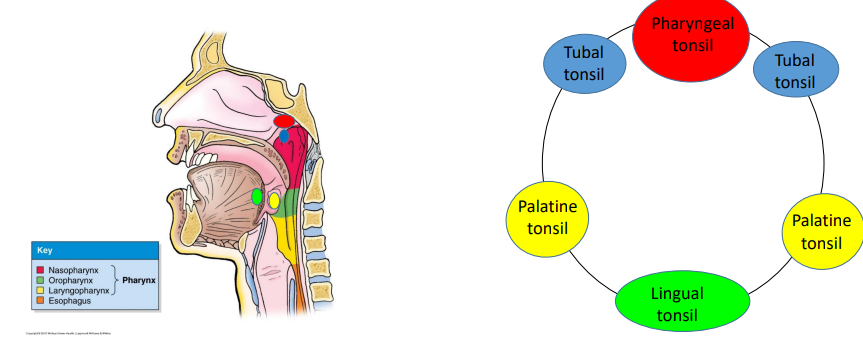 Muscles
constrictor- contract sequentially to push bolus of food into oesophagus: innervated by pharyngeal plexus (vagus)
Superior constrictor
O- Sphenoid bone, mandible & pterygomandibular raphe
Ins- Pharyngeal tubercle & pharyngeal raphe
Middle constrictor
O- hyoid bone & stylohyoid ligament
Ins- pharungeal raphe
Inferior constrictor
thyropharyngeaue part
O- thyroid cartilage
Cricopharyngeus part
O- cricoid cartilage
Ins- Pharyngeal raphe
Longitudinal- shroten and widen the pharynx, elevate the pharynx & larynx, open the auditory tube
Salpingopharyngeus
O- auditory tube
Ins- Lateral pharyngeal wall
Inn- Pharyngeal plexus (vagus)
Stylopharyngeus
O- styloid process of the temporal bone
Ins- Posterior aspect of the thyroid cartilage & lateral pharyngeal wall
Inn- Glossopharyngeal nerve
Palatopharyngeus
O- palatine aponeurosis
Ins- posterior aspect of the thyroid cartilage & lateral pharyngeal wall
Inn- pharyngeal plexus
Pharyngeal plexus
located on the outer wall of the constrictor muscles
Consists of
sensory fibres from glossopharyngeal nerve
motor fibres from vagus nerve
sympathetic fibres (vasomotor)
CN IX- Glossopharyngeal nerve
Arises in the medulla oblongata
Exists the skull at the jugular foramen
Functions
general sensation- pharynx, post 1/3 tongue & ear
taste sensation from pst 1/3 tongue & pharynx
visceral sensation from carotid body & sinus
parasympathetic to parotid gland
motor to stylopharyngeus muscle
CN X- Vagus Nerve
Arises in the medulla oblongata
exits the skull at the jugular foramen
Functions
General sensation- pharynx, larynx & oesophagus
motor to muscles of larynx, pharynx & palate
Parasympathetic to viscera of chest & abdomen
visceral sensory to aortic bodies & sinus, abdominal & thoracic viscera