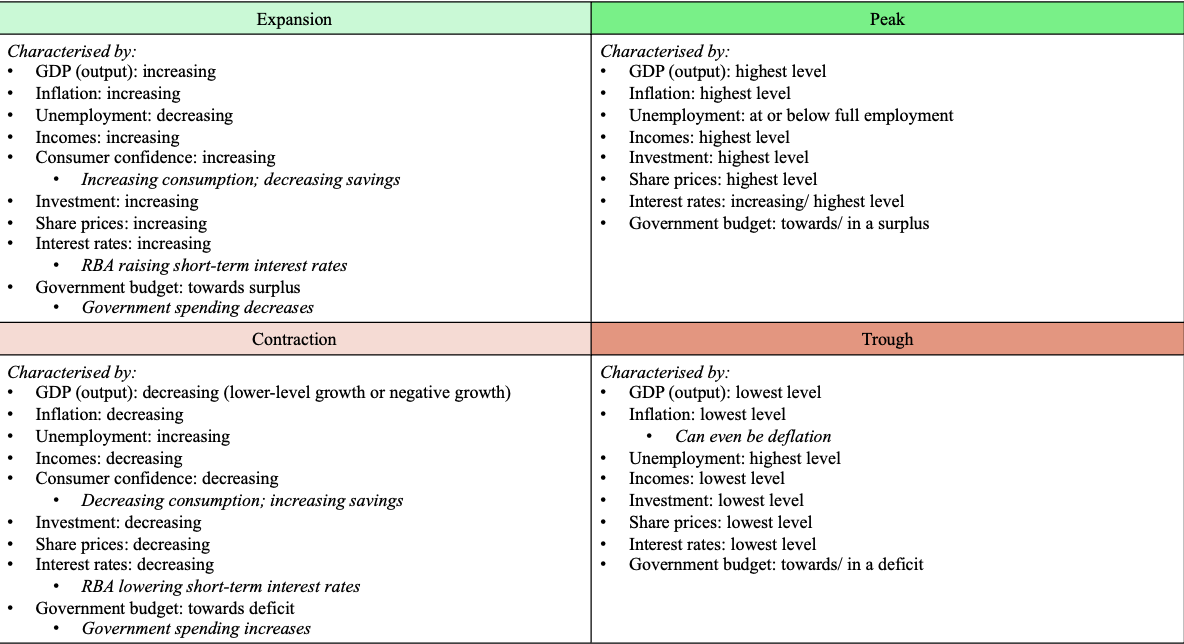
Phases of the Business Cycle
Phases of the Business Cycle
Expansion
Most common phase of the business cycle.
Occurs with the first of two consecutive quarters of real GDP growth.
The initial part of the expansion, just after the trough is often referred to as the recovery phase.
During an expansion, economic activity increases.
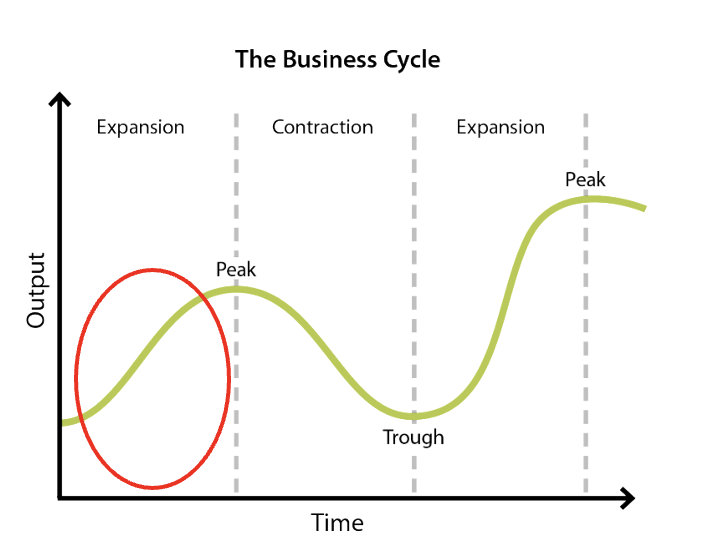
The economy is growing, the result of increased consumer expenditure and increased investment
Unemployment is falling as firms hire more workers to increase their output; hours worked also rises.
•Sometimes, as more people start to look for work, the unemployment rate can actually rise slightly – if the participation rate (percentage of labor force either working or looking for work) is rising this is a very positive sign
Consumers are confident spending money & borrowing to fund large purchases (cars, new TV, homes) – consumer spending is also rising as a result
Businesses are confident taking on debt for investment – private investment rises
Government revenue rises (more tax is raised) – the budget will start to move into surplus and allow governments to start paying off their debt.
Inflation isn’t a problem because there is plenty of unused capacity in the economy (e.g., unemployed people) – business don’t need to offer large wage rises to attract workers at this stage, since there are plenty of unemployed still looking for work
Peak (Boom)
This is the upper turning point of the business cycle.
It marks the end of the expansion phase and the beginning of the contraction.
At the peak or boom, the rate of economic growth would have started to slow - there is no more labour resources (i.e., full employment) to expand production and therefore the growth rate will slow.
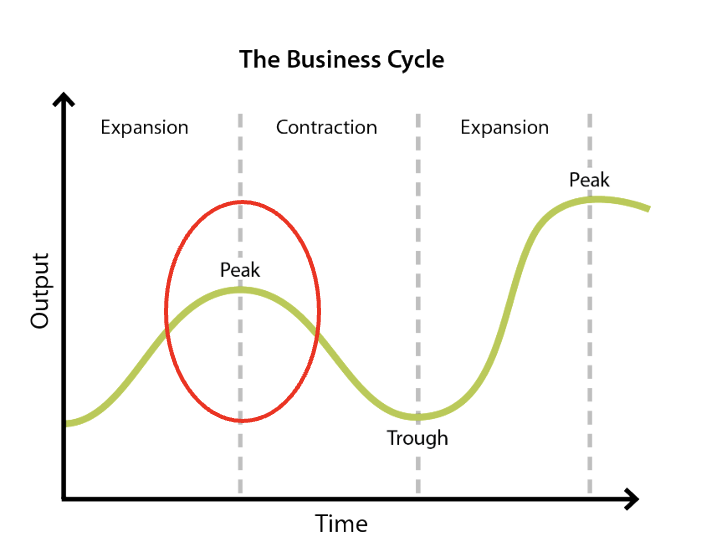
The key characteristics:
•very low unemployment rate (4.5% or less)
•rapidly rising wages
•high inflation rate (above 3%)
Full employment (4.5 %) means firms have trouble finding new workers
Start of the downturn
Firms have to raise wages to attract and keep workers and this means less profits
Falling profits means businesses worry about taking on new debt, so they cut back investment;
Consumers are still spending (their big pay cheques) but inflation starts to rise since the level of output does not rise as fast as wages (more money chasing the same amount of goods)
Eventually, inflation (wages and prices) rise so much that consumers start to notice
This coincides with dropping private investment, as firms become wary about taking on more debt.
Contraction
A contraction is when the level of real GDP falls, or the growth rate of GDP is negative.
A recession occurs with two consecutive quarters of negative economic growth.
A deep or prolonged contraction lasting more than a year is known as a depression.
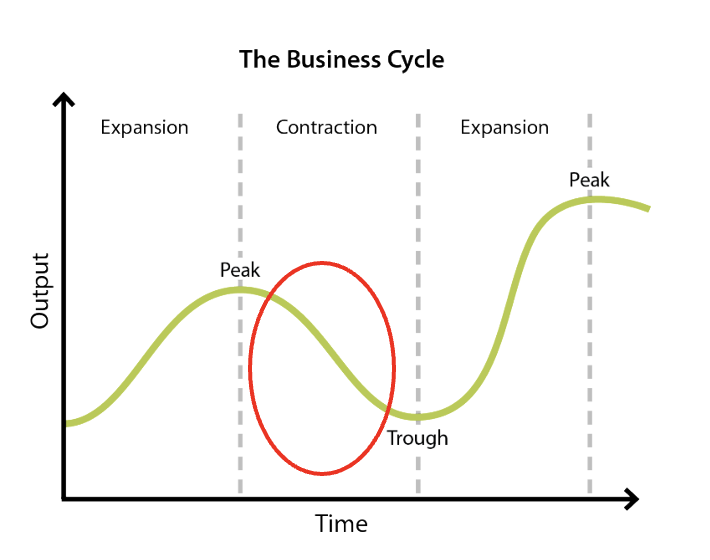
As the economy slows, the following cycle begins:
•Consumers spend less, worried about the future
•Businesses cut back production, firing staff in the process (or cutting shifts and wages to save costs)
•As unemployment rises, consumer spending falls even more (unemployed people spend less)
… and so on
As this occurs, government budgets go into deficit (tax income falls, welfare payments rise)
Although unemployed people might take on more debt to survive, the economy as a whole reduces its borrowing, fearful of the future
•Private debt levels fall
•Consumer spending both fall
Trough
A trough is the lower turning point of the business cycle - it mars the beginning of an expansion.
A trough is a turning point because at some stage spending will begin to rise.
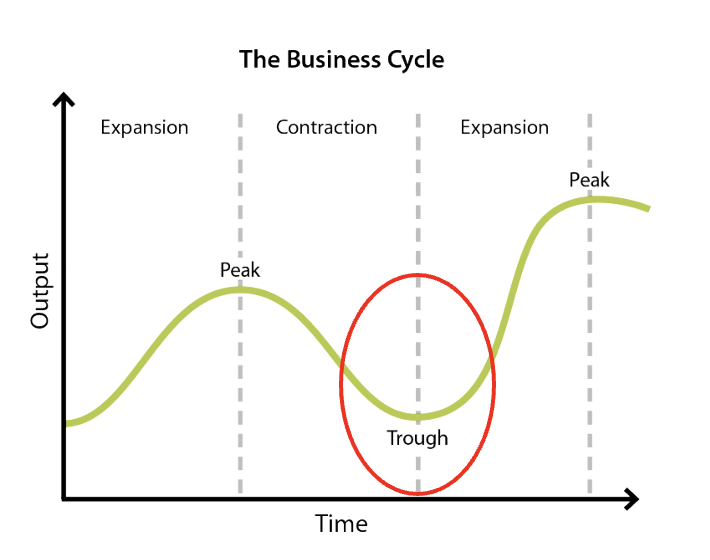
The point in the cycle where the economy is not growing or shrinking – operates at minimum output
•Unemployment is highest
•Inflation is lowest
•Consumer confidence and spending both at lows –
•Minimal private investment is occurring
•Firms go bankrupt (they eventually run out of cash reserves)
•
What ends the trough and restarts the growth cycle?
•Eventually…businesses need to start replacing worn out equipment and start to invest out of necessity...this starts the economy growing again and a new cycle begins
OR
•Government intervention (stimulus payments) sparks growth → RBA lowering interest rates 0.1%