Public Law: S1 L7: Devolution (part 1)
What is devolution?
“[I]nvolves the transfer of powers from a superior to an inferior political authority” - V. Bogdanor, Devolution in the United Kingdom (OUP 2001)
“Devolution may be defined as consisting of three elements: The transfer of to a subordinate elected body, on a geographical basis, of functions at present exercised by ministers and Parliament” - V.Bogdanor
On a geographical basis?
Devolution transfers executive and/or legislative power…
…from central (UK) government and/or Parliament….
…to regional (Welsh, Scottish, Northern Irish)
Executives and/or legislatures.
This is why Devolution is described as relating to the territorial constitution’
Devolution v Federalism
= different
“Devolution is to be distinguished from federalism which would divide not devolve supreme power between Westminster and various regional or provincial Parliaments.”
Federalism divides sovereignty:
neither central nor regional institutions have supremacy over the other.
But they each have supremacy over a defined range of issues.
Devolution devolves powers while preserving the supremacy of central institutions:
Legislative and executive powers are granted to regional institutions.
But central institutions can override regional institutions or take their powers back
Example of Federalism: USA
Power is divided between Federal (central) and State (regional) institutions by a codified constitution.
Federal institutions hold only those powers conferred by the constitution.
50 states each hold all the powers not conferred to the Federal institutions.
Neither side can overrule the other.
Neither side can increase its share of power unilaterally - constitutional amendment is needed.
Background to devolution (1066-1801)
Before the 16th Century
England, Wales, Scotland and Ireland were four separate countries…
English kept trying to invade the other three.
In the 16th Century
Henry VIII passed The Laws of Wales Act 1536 and 1542.
The Acts abolished most Welsh institutions and subjected Wales to English institutions.
18th Century
Acts of Union 1706 and 1707 united England and Wales with Scotland
Previously separate English Parliament and Scottish Parliament combined to make a Parliament of Great Britain.
Unlike Wales, Scotland retained its separate legal system and Scotland still has a separate legal jurisdiction.
19th Century
Acts of Union 1800 and 1801 united Great Britain with Ireland.
Previously separate Parliament of Great Britain and Parliament of Ireland combined to make a Parliament of the United Kingdom.
Unlike Wales, Ireland retains its separate legal system- to this day, Northern Ireland is still a separate legal jurisdiction.
Later 19th Century
The Irish were not happy at being governed from Westminster.
They demanded ‘Home Rule’- political institution in in Ireland to govern Ireland.
Early 20th Century
Government of Ireland Act 1914 would have created new political institutions for the whole of Ireland….
But it could not be implemented due to:
Protestant/ Unionist opposition in the North of Ireland.
World War 1
In the 1920’s
Government of Ireland Act 1920 tried again…
Created two separate Parliament for Ireland:
A Parliament for the South of Ireland (initially the ‘Irish Free State’, now ‘Ireland’)
A (devoted) Parliament for the Northern Ireland.
The Court was now fully independent of the UK, but Northern Ireland remains part of the UK.
Northern Ireland and The Troubles (1960’s-1998)
Unionist (mainly Protestant) majority + Irish Nationalist (mainly Catholic) Minority = extreme political tension.
Tension = violence between Nationalists (incl. the IRA) and Unionists (incl. the UVF and British Army).
3500+ people were killed.
The (devolved) Northern Ireland Parliament survived until 1972, when the UK Parliament took over.
Failed Attempts at Devolution 1978
Scotland Act 1978 & Wales Act 1978 provided for referendums on devolution in Scotland & Wales:
Scotland voted in favour by 51.6% but mandatory thresholds were not all passed.
Wales rejected devolution - 79.8% voted against.
So neither country got devolution (yet).
In the 1990s, demand for devolution was strong again…
Why is Devolution a good idea?
Democracy 1: Representation
Wales, Scotland & Northern Ireland have distinct indentity, cultures & political values from England and from one another
Uk Parliament may fail to reflect these differences; devolved institutions should reflect them better.
Democracy 2: Demand
If the people of a region want to govern themselves, they should be allowed to.
If 1997-1998, referendums in Scotland, Wales and Northern Ireland showed demand with majorities in each nation voting favour of devolution.
Legislative and/or Executive Devolution?
Legislative devolution:
Confers power on devolved institutions to carry out primary.
That is: powers to make ‘Acts’ or equivalent.
Executive devolution:
Confers power on devolved institutions to carry out executive functions.
E.g. to make secondary legislation and policy, responsibility for wider executive agencies.
Conferred or Reserved Powers?
Conferred powers:
Powers are transferred by listing the subject areas within which the devolved institutions can lawfully act.
E.g. ‘You have the power to legislate only in relation to health, education etc…”
Reserved Powers:
A general law-making power is transferred but,
It is limited by a list of subject areas in relation to which the devolved institutions can not lawfully act (subject areas reserved to UK institutions).
E.g. ‘You do not have the power to legislate in relation to immigration, defence, etc…’
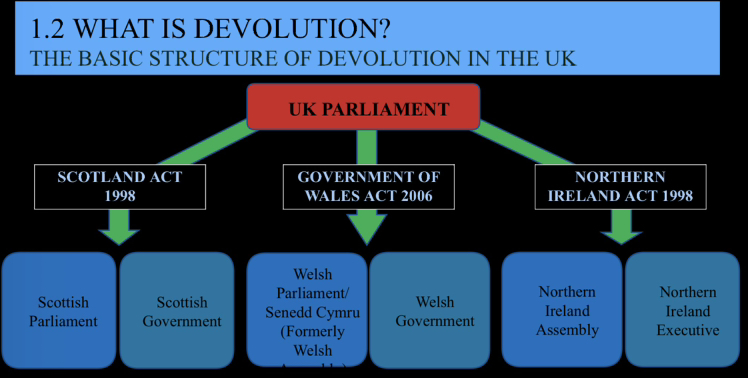
The Scotland Act 1998
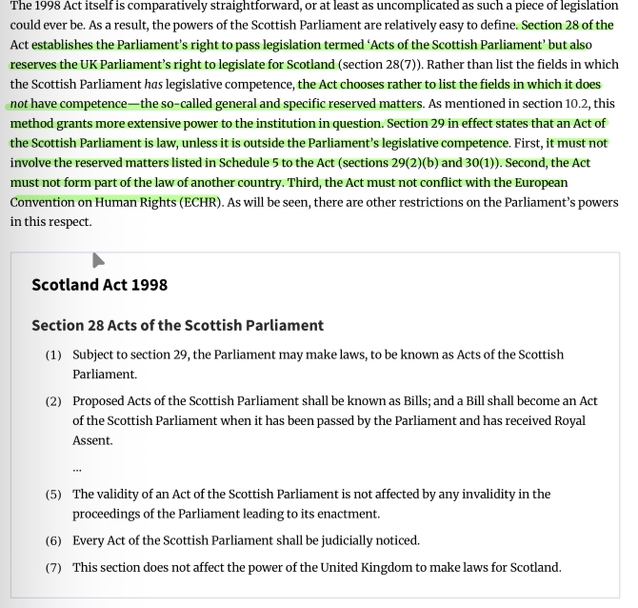
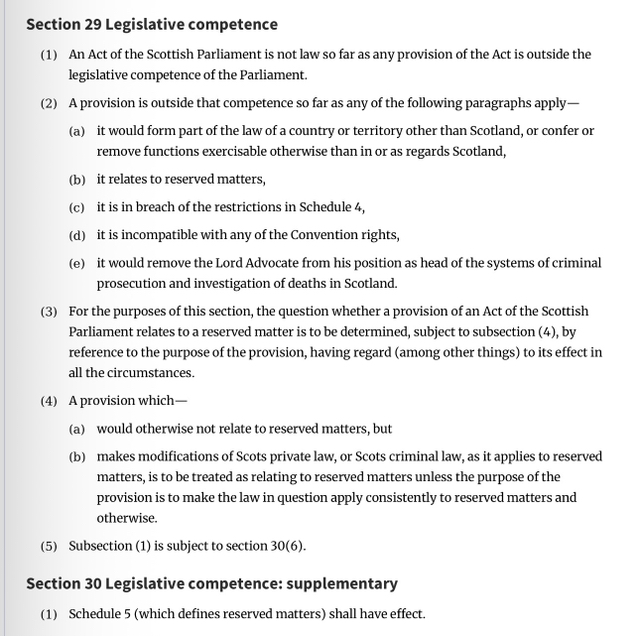
Legislative devolution: A Scottish Parliament is empowered to pass ‘Acts of the Scottish Parliament’(s.28)
Reserved Powers: The Scottish Parliament can legislate on any matter, subject to exceptions (as.28-30) including:
Matters reserved to the UK Parliament, e.g. Foreign Affairs, Defence, Immigration, Economic Matters (s.29(2)(b);sch.5)
Legisaltion violating the ECHR
Legislation amending/repealing specified Acts.
Executive devolution: A Scottish government is drawn from members of the Scottish Parliament.
In 2014…
A referendum: Scotland voted on the question: “Should Scotland be an independent country?”
55.3% of voters answered no.
In 2016
The Scotland Act 2016 devolves further powers to the Scottish Parliament.
Wales
1998…
The Government of Wales Act 1998 (GWA1998)
established a ‘Welsh Assembly’.
Introduced executive devolution not legislative devolution.
2006
GWA 2006
Repealed and resolved the GWA 1998.
Legislative devolution: the Assembly could pass primary legislation (‘Assembly measures’) but these don’t come into force unless approved by UK Parliament.
A conferred powers model: The Assembly can make law only listed in subject areas.
2011:
Another referendum: Welsh voters support full legislative powers for the Welsh Assembly: ‘Assembly acts’ no longer require approval by the UK Parliament.
2017
Wales Act 2017
Amends GWA 2006.
Alters basis of Legisaltive devolution from conferred powers to reserved powers .
But Assembly still had less legislative competence than the Scottish Parliament: More subject areas are ‘reserved’ in relation to Wales.
2020
Using powers created but he Wales Act 2017, the Welsh Assembly passed the Senedd and Elections (Wales) Act 2020
Amongst other things this Act:
Renames the Welsh Assembly as ‘Senedd Cymru or the Welsh Parliament’
Extends the right to vote in Senedd elections to 16 and 17 year olds.
Good Friday Agreement
Signed by politicians in 1993 and approved by referendums in NI and Ireland.
The Agreement marked the end of ‘The Troubles’: all sides agreed to peace in NI.
The agreement required devolution to NI.
Northern Ireland Act 1998
Legislative devolution: A Northern Ireland Assembly empowered to make ‘Acts of the Northern Ireland Assembly’ (s.5).
reserved powers: The Assembly can legislate on any matters subject to exceptions (ss6-8_, including:
‘Excepted matters’ which can only be legislated upon by UK Parliament e.g.: Foreign Affairs, Defence, Immigration, Economic Matters.
‘Reserved matters’ which can be legislated upon by the Assembly but only with matters of consent of the UK government.
Legislation violating the ECHR.
Executive devolution:
Power-sharing- a model designed for communities emerging from conflict.
Government powers shared by Nationalists and Unionists.
E.g. First Minister and Deputy First minister have equal power. One is appointed from either side.
Problems:
Risks of collapse: leading to suspension of Assembly and government from Westminister.
Extra reading:
Devolution:
Process of devolving powers involves the transfer of competence or function from a central governing administration to a regional body within its jurisdiction.
L, E or J powers may be devolved, either together or separately.
Devolved institutions gets to use the powers lent to it but there is the possibility the power may be taking back by the lending institution.
UK context?
The process of establishing such regional or national devolved bodies began with the holding of successful referenda in S, W and NI in 1997-1998.
¾ countries = S, NI and W were granted their own directly elected representative bodies.
By enacting the devolution Acts ( SA 1998, GWA 1998 and NIA 1998) the Westminster Parliament established devolved administrations.
Each with varying degrees of power to legislate and formulate and execute policy for the nation in question.
Unifying factor = Westminster Parliament retains its overall legislative supremacy under each of these devolution settlements,
WP reserved the legal right to take back its legislative power by repealing the Devolution Acts if it chooses to.
Also reserved the right to legislate on any matter.
Federal states:
Central federal government shares the legislative supremacy with the states that constitute the federation.
Central government will retain complete legislative supremacy in certain policy fields; it may share the supremacy with the states in other fields.
Some supremacy us granted to the state government.
These arrangements are set out in the country’s codified constitution and enforced via the courts.
In what ways can power be devolved?
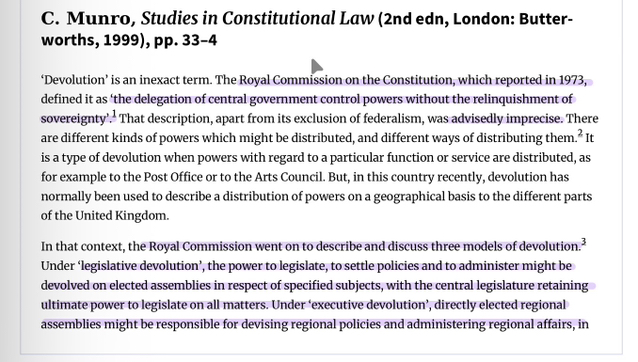
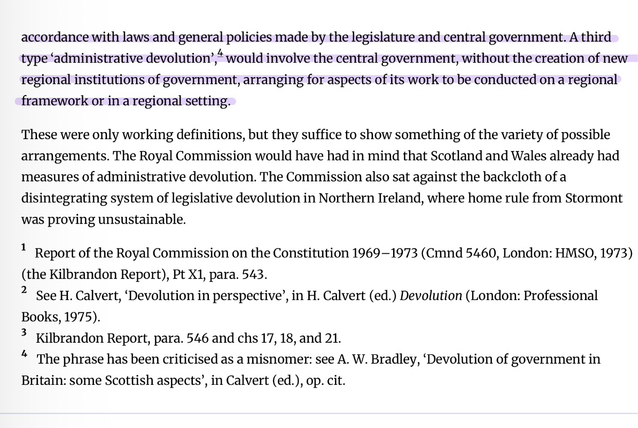
legislative devolution”
Most advanced form of power transfer within a system based on parliamentary supremacy; it involves conferring power on a devolved institution to allow it to legislate (pass primary legislation) and to execute and administer policy.
2 main ways of transferring power to a devolved body:
List the policy areas in which powers have been reserved for central government → transfers most functions to the devolved instituions.
Devolved administration can legisalte on any matter not listed in the legislation.
List only the fields in which the devolved administration has powers; remaining field would be reserved for central administration - > limiting for the devolved body.
UK context:
Kilbrandon Commission Report of 1973 states that in case of Legisaltive devolution, not only was supremacy retained by virtue of the fact that Parliament could repeal the primary legislation that devolves powers to a body (enabling legalisation) and choose to legislate on any issues, including devolved matters even if the enabling legislation remained in force.
Despite conferring full legislative power in a particular field on a devolved administration, Westminster could still choose to legislate on the field in question.
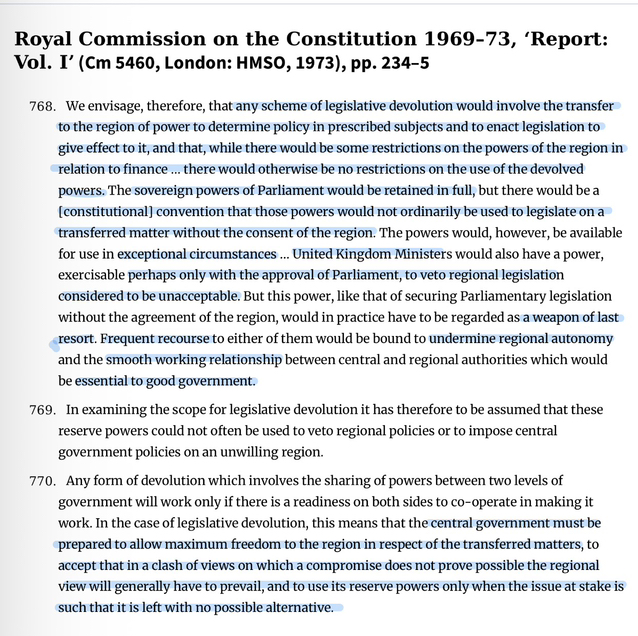
One could argue that the WP sovereignty would have been limited during the operation of devolution, unless the people in a given country are willing to have power taken from their regional body and returned to Westminster.
Alternatively one could argue that W is sufficiently secure in the knowledge that it retains legal sovereignty that it is willing to devolve some of its legislative power to a local body.
Executive Devoltuion:
Key characteristic is that he power-conferring institution (WM) devolves no primary legislative power to the devolved body and retains the power to create general policies in all fields for that country or region.
WP would retain its power to form general policy for the devolved region.
Also retain the only powers to pass framework legisltion.
But the primary legislation would remain vague → detail being supplied by secondary legislation that could be enacted by the devolved body.
Main issues = the split between responsibility for the general policy and responsibility for its implementation and the opportunities for misunderstanding in this regard.
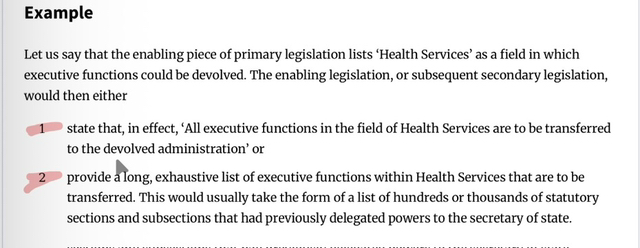
1st option could lead to discontent within Parliament that the devolved body had been granted so much executive power.
2nd option would be complex and may lead to uncertainty within both institutions as to the limits of the devolved body’s powers.
Administrative devolution;
Primarily concerned with the central government exercising its functions in a more regionally responsive capacity, and so it is often more about central government spreading out across a country rather than about it devolving power to independent local entities.
The essence of AD means that the formation of new, directly elected regional or national bodies is not required.
However devolved institutions that exercise executive or legislative functions will also have administrative powers by default.
UK context:
refer to any situation where central gov department is represented outside Whitehall in London, the traditional home of the gov.
Can range form a gov department having regional offices to the existence of powerful secretaries of state for S,W & NI.
Could be argued that UK reached its zenith before the passing of the 1998 devolution legislation when all three nations had their own relatively powerful national offices.
They had the power to administer gov policies within the respective countries but also held executive power to form detailed separate policies for the individual nations.
History of devolution:
One means used over the past few centuries of ensuring that no single institution accumulates too much power.
However devolution is also a product of different peoples’ needs to be ruled by those who acknowledge, understand and respect their cultural and religious indentities.
May make it possible for these different people to remain together in a state that retains popular legitimacy while allowing people to be governed in a manner in keeping with their traditions and identities.
Nevertheless, remains a credible way of ensuring that different institutions exercise different functions → no single body becomes excessively powerful.
Also a way of ensuring local autonomy.
Devolution debates and the American colonies:
Britain trialled different forms of devolution around the world during the operation of its Empire.
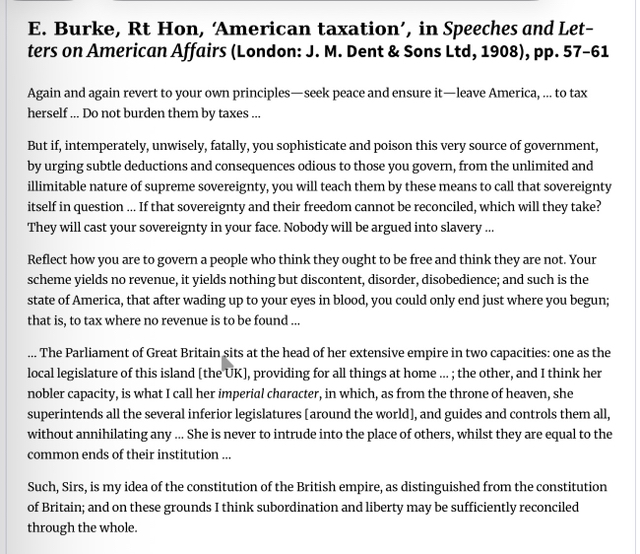
Speech delivered by MP and political theorist Edmund Burke to the House of Commons in 1774: spoke on the issue of taxation in the American Colonies.
Not only acknowledged the existence of the colonial legislatures but also actively encouraged the transfer of functions to them, including taxation powers.
Power to raise taxes is important because without finance is it virtually impossible or a government to do anything meaningful for its people in a practical sense.
Burke noted that it was impractical to have physical representation of the colonies in Parliament + it was both acceptable and advantageous for people in the colony to have their own suitably local legislature, provided that the body accepted Westminsters supremacy.
He argued that such a body should have tax-raising powers of its own for the purpose of furthering government in America.
Delivered a stark general warning to Parliament that if it sought to disregard the will of the people + their regional governing bodies = question the supremacy of WP.
American War of Independence started within a yer of Burke delivering his speech, which directly led to America’s rejection of the sovereignty of the British Parliament.
Home Rule, Devoltuion and Ireland
Term devolution began to be used to describe the various ‘Home Rule’ schemes that were proposed for Ireland.
Ireland
did not become a formal part of the Uk until the enactments of the Acts of Union of 1800, despite the fact that Britain had been asserting influence over Ireland for many centuries.
The legislation concerning tenure ensured the dominant position of the wealthy, mainly Protestant, landowners at the expense of the poorer Catholic majority.
→ massive surge in support for the political parties that called for Irish independence.
PM William Gladstone responded by legislating to remove or limit some of the practises that were fuelling the Irish Catholic resentment.
1885 GE, 85 ‘Home Rulers’ were returned as MPs to Westminster.
Irish Home Rulers held the balance of power at Westminster and could influence the legislative agenda in the House- a situation that Gladstone promptly recognised as one that needed to be given the highest possible political priority.
‘Home Ruler’ = denote those representative who supported a form of Irish self-government.
1866 Gladstone introduced a bill to establish Home rule for Ireland via a legislature in Dublin in which the Irish constituency MPs would sit to legislate on Irish matters.
1866 Bill was defeated by the House of Commons, a later and modified scheme in 1866 was rejected by the House of Lords on the grounds that it would be unjustifiable for MPs representing Irish constituencies to have the right to debat and vote on matters affecting only England (therefore W and S) while Irish constituents benefited from their own devolved legislature.
Ireland Act 1914 finally passed but political climate had moved on.
Ac provided for a devolved legislature body based in Dublin which had legislative control over all Irish domestic affairs and has a separate membership from Westminster which was to remain supreme and retain imperial functions, features that are clearly reflected in each and every one of today’s devolution settlements in the UK.
End of WW1 1918→ Unionists opposition to a single Home Rule scheme for the whole of Ireland had strengthened during the war.
Nationalists, under guidance of the dominant political party, Sinn Fein had turned its sights towards compete independence.
Seemed no one wanted the Home Rule of 1914.
As a result the Government of Ireland act 1920 was passed: providing for two distinct Home Rule regions → one in the north and one in the south of the country.
Despite the amendments the new Act was far from welcomes.
Nationalist republicans argued that the whole of Ireland should remain part of the UK.
1920 Act eventually paved the way for the NI Parliament which remained in existence until 1972.
Gladstone primary reasons for suggesting such a Home Rule scheme were twofold.
His intention was to pacify the Nationalists or to even stunt the remarkable growth in their support = by offering a form of self-government.
However his other hope was that allowing Ireland to have its own legislature would strengthen the union with the rest of Britain.
Both intentions were also present when devolution was on offer for S, W and NI in the 1970s and 1990s
History of the union between England and Scotland
Shared a sovereign since the death of Elizabeth I in 1603 brought the Tudor dynasty to end end and James VI of Scotland became James I of England.
However did not begin to share a parliament until well over a century later when united by the enactment of the Acts if Union in 1706 and 1707.
The Treaty of Union was passed by both English and Scottish Parliaments.
The two countries came together in a voluntary partnership.
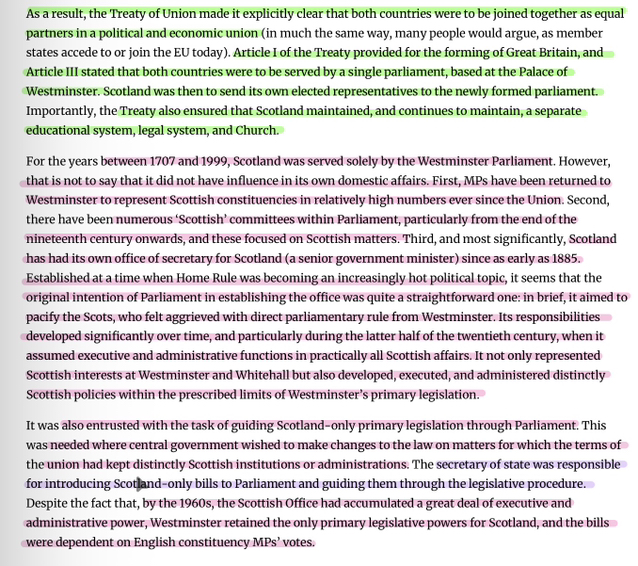
It was vital that the Scottish Parliament was offered sufficient assurances that Scotland would remain a separate nation with its own institutions → convince the Scottish that it was in their interest to join such a union.
Path to Scottish Devoltuion
Prior to Devoltuion the legislative procedure for any Scotland - only bills was indelicate to that for all other bills introduced at Westminster.
This meant that they would be debated and voted upon by both houses.
Despite the fact that the bills would affect only Scotland, MPs representing England, W and NI would all have a vote.
Gave representatives from other three nations a power of veto over the proposed legislation and a right regularly t o determine what would happen in Scotland.
This situation was heavily criticised north of the border and led to Scottish concerns about the democratic legitimacy of Parliament.
14th November 1977 Tam Dalyell, MP for West Lothian = ‘the West Lothian question’
He questioned how long people living in English constituencies would be willing to permit Scottish, Welsh and Northern Irish MPs to vote on English matters were Scotland, Wales and Northern Ireland to be granted devolved legisaltive powers over which English constituency MPs would have no say.
At the time of the Home Rule discussions for Ireland, a total of 13 Scottish Home Rule bills appeared before Parliament.
Ultimately unsuccessful because of the increasing importance of the office of secretary of state for Scotland, but the issue was firmly back on the poltical agenda by the late 1960s and early 1970s.
Dissatisfaction with numerous elements of direct parliamentary rule from Westminster manifested itself in Wales and Scotland in a significant rise in the support for the nationalist parties.
Discontent with what became the West Lothian question + the fact that the executive could not directly and effectively be held account by the Scottish public had led to notable gains for the Scottish National Party (SNP).
SNPs manifesto commitment did not go unnoticed by Harold Wilson’s Labour government.
Spring 1969 it appointed the Royal Commission on the Constitution, the Kilbrandon Commission.
commission investigated the possibilities of establishing devolved administrations for all of the UK’s nations and regions.
Report published in 1973, it proposed the establishment of legislative Assembly for Scotland.
Assembly would have had primary legislative powers in fields such as health, education, the environment and legal services, although UK parliamentary supremacy would be retained.
Majority of the Kilbrandon Commissions recommendations finally found their way on to the statue book through the enactment of the Scotland Act 1978.
Early 1990s, the Labour and Liberal Democrat parties backed the Scottish Constitutional Convention’s calls for the establishment of a full legislative body for Scotland. Also pledged their support to such a scheme in their 1997 general election manifestos, provided that a successful result was had in referendum on the issue.
Devolution and the Scottish Parliament
November 19th 1998 = the Scotland Act 1998 received its royal assent → establishing the Scottish Parliament
History of the union of Wales with England
Much of Wales was conquered by the English Crown in 1282.
Henry VIII’s Laws in Wales Act of 1535 and 1542 (Acts of Union).
Act established a distinct court structure for Wales and established a ‘Welsh Instituion’
continued to be source of great pride until its final abolition in 1830.
Section 20 of the 1535 Act outlawed the use of Welsh language in court proceedings and public office was universally hated in Wales.
Rise of Welsh nationalism
Succeeded in securing a measure of administrative Devoltuion as early as 1907, when the Welsh Department of the Board of Education was established and 1991 when similar boards were established for health and agriculture.
By the end of WWII in 1945, there were 15 such offices dealing with Welsh policy and administration
Churchill established the office of minister for Welsh affairs in 1951 to oversee Welsh affairs, roughly 65 years after its Scottish equivalent.
Popularity wasn’t helped as it was headed by an Englishman representing an English constituency.
sank even lower in 9157 when under the leadership of Henry Brooke the office approved the drowning of the Tryweryn valley in Meirionnydd to supply drinking water to the north-west England,
Despite extremely strong local opposition and the fact that 35/36 Welsh MPs voted against the bill.
Labour general election victory of 1964 that the office of Secretary of State for Wales was established.
The office had executive powers in only two fields, housing and local government.
administrative functions in practically all Welsh matters- but it was not until 1968 that the office was grander executive powers in health matters, and 1970 for powers in the field of education.
By mid-1970s the Welsh office had become a relatively powerful executive body exercising a wide range of functions in most areas of Welsh affairs.
Opinion of most of the members was that Wales Gould be granted its own directly elected executive Assembly, responsible for roughly the same functions as were exercised by the Welsh Office.
Main difference would be that Wales could then hold its executive to account directly and it would have more resources so that it could develop distinctly Welsh policy.
Referendum was anything but successful.
Hugely successful ‘No’ campaign, ;ed by Labour’s ‘gang of six’ MPs ensured that the motion was soundly defeated.
79.8% of the Welsh voters voted ‘No’ to having their own directly elected poltical body.
Margaret Thatcher’s incoming Conservative government quickly repealed the Wales Act 1978 in July 1979 and Devoltuion sank without trace from the central governments political agenda.
GWA 1998 received royal assent on 31st July thus establishing the National Assembly for Wales.
Devoltuion settlement introduced to Wales was fundamentally different from one established in Scotland and far more limited.
The transfer of some executive powers but not all powers in all fields → massive hindrance.
Not only did the public fail to comprehend the Assembly’s powers but also did the Assembly Members.
Numerous other problems: attempt to build consensus- seeking government rather than gladiatorial battles, the institutional framework provided no real institutional distinction between the legislature and the executive branches.
Concept seemly breached the doctrine of the separation of powers and prevented the executive committee from working to its full capacity since it did not have the necessary resources.
Situation was remedied in spring 2002 when a de facto Welsh Assembly government was established thus moving the Assembly towards Westminster-style opposition politics.
Universally accepted the government had no legal basis whatsoever.
A commission was established in July 2002 under the chairmanship of Lord Ivor Richard to enquire into the possibility of amending the Assembly’s powers and procedures.
Sig No of the 2004 Rick Commission Reports recommendations were accepted by the central gov and were enshrined into the GWA 2006
As from 2006 Act’s implementation in May 2007, then then Welsh Assembly government was responsible for all executive functions.
The most significant development were the changers that were proposed to the Assembly’s legislative power.
It introduced the Assembly’s new legislative provisions, termed Assembly Measures, which have the same effect as primary legislation but which need to be ‘switched on’ one by one by the UK Parliament.
in order for the AMs to be lawful they had to relate purely to Wales, not breach the restitutions in Part 2 of Schedule 5 and not be incompatible with Convention rights or EU Law.
Most importantly, the measure must be related to one of the 20 areas listen in Part 1 Schedule 5.
Also the prospect of more extensive legislative power within the GWA 2006 sections 103-109 provided that if the people of Wales were to vote in favour of primary law-making powers in a referendum, the Welsh Assembly would have the power to enact Assembly Acts within the fields set out in schedule 7 without the need for approval from the UK Parliament.
On March 3rd 2011, a referendum was held in Wales with the question ‘Do you want the Assembly now to be able to make laws on all matters int he twenty subject areas for which it has powers?’
In favour were about 63.5% against 36.5%.
UK Parliament transferred the power to the Welsh Assembly and government had competence without the need for permission from UK Parliament.
But at this stage the Assembly’s powers were restricted to the areas listed in schedule 7 of the Act.
The Assembly was a full legislative body in its own right; the only difference between the Scottish Parliament and the Welsh Assembly were the breadth of fields in which the Scottish Parliament was able to legislate.
Silk Commission
Established by the Welsh Secretary