15 AMT 311 - Radio Communication
Page 4:
Radio communication: first use of radio frequency transmissions in aviation
Page 5:
Radio waves: electromagnetic in nature, part of the electronic spectrum
Electromagnetic spectrum: range of wave activity
Shorter wavelength (centimeters) to longer wavelength
Gamma ray, X-ray, Ultraviolet, Infrared, Radio
Higher frequency (number of waves per second) to lower frequency
Visible, UHF, VHF, HF, MF, LF, VLF
Page 6:
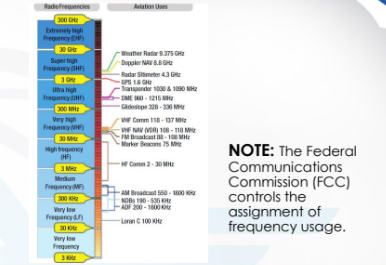
Page 8:
Types of radio waves: Very Low Frequency (VLF), Low Frequency (LF), and Medium Frequency (MF)
Long wavelengths, long antennas
Range from 3kHz to 3MHz
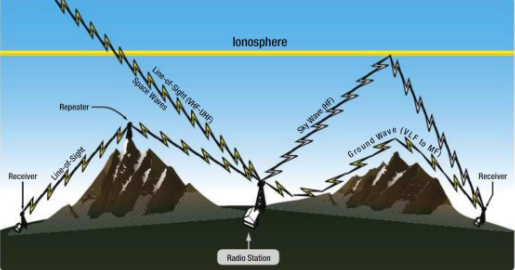
Use ground waves or surface waves
Used by ADF and LORAN navigational aids
Page 9:
High Frequency (HF)
Travels in straight line/line-of-sight transmission
Used by transoceanic aircraft for voice communication
Frequency range between 2 to 25 MHz
Page 10:
Very High Frequency (VHF)
Primary used by communication radios in aviation
Frequency range from 118.0 MHz to 136.975 MHz
Used for aircraft and air traffic control communication, as well as air-to-air communication between aircraft
Transmit and receive function
Page 11:
Page 12:
Loading information onto a radio wave
Carrier wave: continuous electromagnetic radiation of constant amplitude and frequency
Modulation of carrier wave by an information signal
Transmission of information from transmitting radio to receiving radio via antennas
Page 13:
Amplitude Modulation
Varies in relation to the fluctuating current input
Carrier wave altered by information signal
Demodulated signal carries audio information
Page 14:
Frequency Modulation
Carrier wave retains constant amplitude
Signal represented as variations to the normally consistent timing of the oscillations of the carrier wave