PS218 - Critical Review Thought Process
Notes on the CR chosen paper
1. Main aims of the study
The study aimed to examine how screen time and different types of screen activities influence socio-emotional development in 5-year-old children, while also accounting for environmental factors.
“The current research aims to explore the cross-sectional influence of screen use across three measures of socio-emotional development”
2. Author’s initial hypothesis
The authors expected that:
Higher screen time would be associated with poorer socio-emotional outcomes
Different screen activities (e.g., video games vs TV) would have different effects
These effects would still exist even after controlling for environmental factors
(They don’t state a single explicit hypothesis sentence, but this is clearly implied from the aims and design.)
3. Key research questions
The study investigated:
Does screen time affect internalised, externalised, and prosocial behaviour?
Do different screen activities have different effects?
Do these relationships remain after controlling for environmental factors?
4. Key arguments made
Screen time does have an effect, but it is small
Type of screen activity matters, especially video games
Environmental factors (e.g., parent-child closeness) are more important than screen use
“screen time, activities, and wider ecological factors are all important to consider… to provide a more nuanced understanding”
5. What experiments did they conduct?
This wasn’t a lab experiment — it was a secondary data analysis study using a large national cohort dataset (GUI study).
They conducted:
Hierarchical multiple regression analyses
Compared:
Screen time levels
Screen activity types
Socio-emotional outcomes
6. HOW the experiments were conducted
Used data from 9001 Irish 5-year-olds
Parents reported:
Screen time (hours per day)
Type of activity (TV, video games, etc.)
Socio-emotional development measured using SDQ (Strengths and Difficulties Questionnaire)
Ran hierarchical regression models:
Screen activity
Screen time
Environmental factors (e.g., income, education, parent-child closeness)
“Hierarchical multiple regressions were conducted to assess whether the screen use variables remained significant… even after the environmental factors were included”
7. Findings of the experiments
Main findings:
2+ hours of screen time per day → worse outcomes
↑ internalised behaviour
↑ externalised behaviour
↓ prosocial behaviour
Video games → higher behavioural problems
BUT:
Effects were statistically significant but small
Environmental factors had a much larger impact
“Children who had 2 or more hours of screen time scored significantly higher on the internalising and externalising… and lower on the prosocial scale”
8. Discussion (detailed but succinct)
The discussion argues that:
Screen time does influence socio-emotional development, but only modestly
The findings align with some previous studies but also highlight inconsistencies in the literature
Environmental factors dominate:
Parent-child closeness had the strongest effect
Screen activity matters:
Video games showed stronger negative associations than TV
The field needs:
More nuanced research (not just “screen time = bad”)
Consideration of context, content, and environment
“environmental factors did account for much more of the variance… than screen time itself”
9. Conclusions
Screen use has a small but significant association with socio-emotional development
However, its impact is much weaker than environmental influences
Therefore:
Screen time alone should not be overemphasised
A holistic perspective is necessary
“caution should be exercised when interpreting the extent of the influence early screen use has on development”
How to structure the essay
🔥 Paragraph 1 — Small effect sizes
Big claim:
Screen time appears significant, but its real-world impact is questionable
Sub points:
Significant results
Small effect sizes
Statistical vs practical significance
SUB POINTS:
They found significant effects of screen time
BUT:
Effect sizes are very small
Statistical significance ≠ real-world importance
Conclusion:
→ Screen time may not be meaningfully influential

🔥 Paragraph 2 — Environmental factors dominate
Big claim:
Environmental factors appear to have a substantially greater influence than screen time
Sub points:
5.5x–20x more variance explained
Parent-child closeness strongest predictor
Conclusion:
→ Screen time is secondary, not primary

🔥 Paragraph 3 — Causation problem
Big claim:
The study’s design limits its ability to establish meaningful influence
Sub points:
Cross-sectional design
Cannot determine direction of effect
Reverse causation is possible
Conclusion:
→ Weakens claims about screen time “impact”

🔥 Paragraph 4 — Measurement bias
Big claim:
The reliance on parent-reported measures raises concerns about validity
Sub points:
Screen time estimated by parents
Behaviour also reported by parents
Bias + subjectivity
Conclusion:
→ Effects may not be reliable → weakens meaningfulness

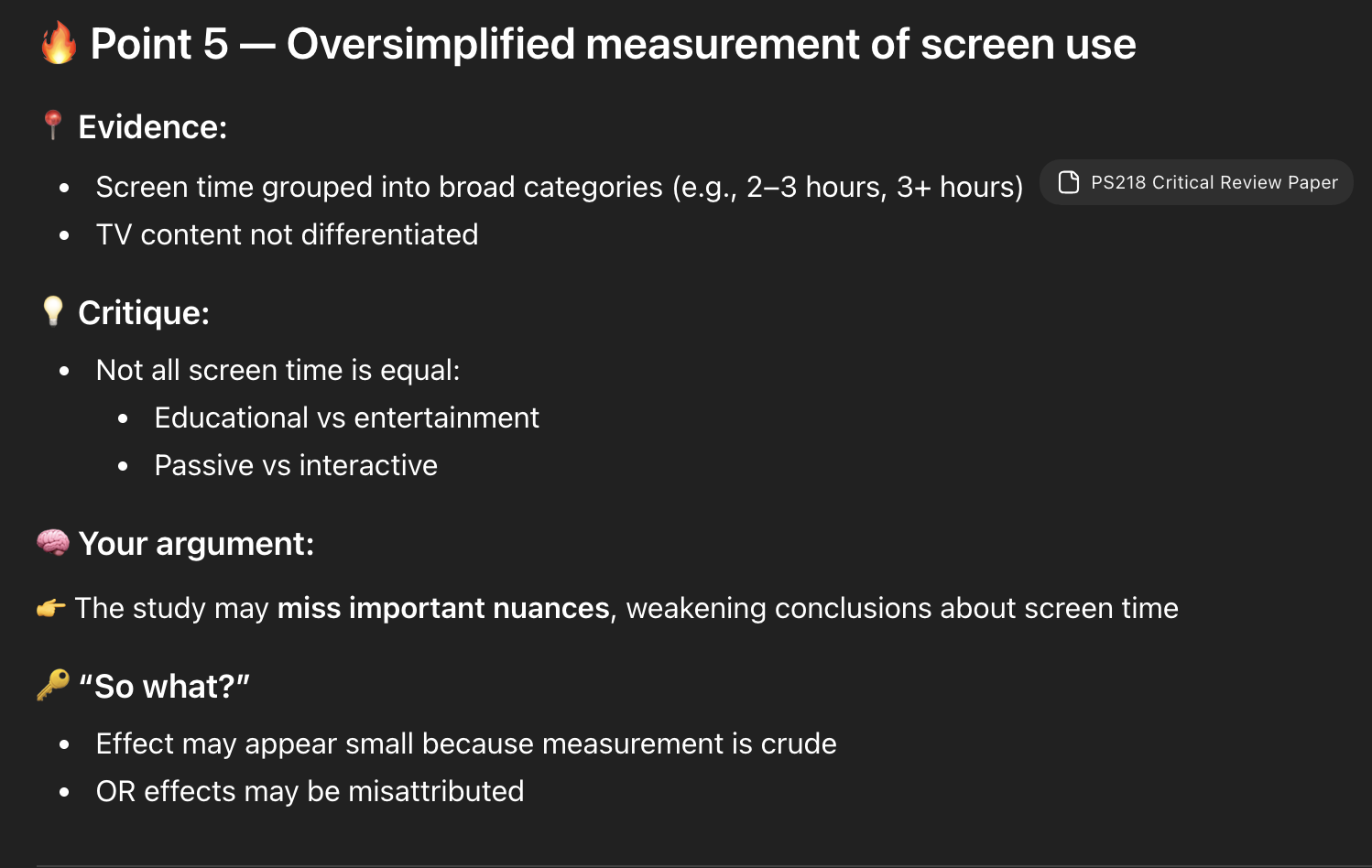
🔥 Paragraph 5 — Poor measurement of screen use
Big claim:
The study’s measurement of screen time lacks sufficient nuance
Sub points:
Broad time categories
No content differentiation
Different activities lumped
Conclusion:
→ True effects may be hidden or misrepresented
🔥 Paragraph 6 — Overstated conclusions
Big claim:
The study’s conclusions may overstate the importance of screen time
Sub points:
Authors acknowledge small effects
Environmental factors are stronger
Still suggest policy implications
Conclusion:
→ Screen time may be less meaningful than implied

Your paragraphs now clearly map to the question:
Small effect sizes → ❌ less meaningful
Environmental dominance → ❌ less meaningful
Causation issue → ❌ uncertain meaningfulness
Measurement bias → ❌ possibly inflated
Poor screen measurement → ❌ unclear
Overstated conclusions → ❌ exaggerated importance
Balancing the review
🔍 1. Issues in Previous Research (from the paper)
A. Over-reliance on TV as the ONLY measure of screen time
A major flaw is that earlier studies focused almost entirely on television viewing, ignoring other screen types.
Evidence:
“much of the extant screen research to date focuses on the influence of television on young children’s development, with fewer studies focussing on other types of screen use.”
👉 Why this is a problem:
Modern screen use ≠ just TV (phones, tablets, games)
Leads to outdated and incomplete conclusions
B. Inconsistent / conflicting findings across studies
The literature is messy — results don’t agree.
Evidence:
“the research to date is noted to not be well understood given the level of mixed findings in the past literature”
Examples:
Some studies → screen time predicts ADHD
Others → no effect, or even positive effects
👉 Problem:
Makes it hard to draw firm conclusions
Suggests methodological inconsistency
C. Narrow focus on ONLY externalising behaviour
A lot of studies only look at ADHD, hyperactivity, etc.
Evidence:
“Much of the evidence… has focussed on ADHD symptoms or attentional problems… as a measure of externalised behaviour specifically.”
👉 Problem:
Ignores:
Internalising behaviour (e.g., anxiety)
Prosocial behaviour
Gives an incomplete picture of development
D. Failure to control for environmental (confounding) factors
This is a BIG one.
Evidence:
“some studies do not account for the environmental factors that have been shown to influence children’s socio-emotional development”
👉 Problem:
You can’t isolate screen time effects
Factors like:
Income
Parenting
Home environment
may actually be driving results
E. Treating all screen activities as the same
Some studies lump everything together.
Evidence:
“Both studies summed the screen activities together to create a single screen time measure.”
👉 Problem:
Watching TV ≠ playing video games
Different activities may have different effects
F. Lack of research on younger children / limited scope
Evidence:
“whether this effect would also be observed in a younger sample is an area that still needs more attention”
👉 Problem:
Findings from older children don’t necessarily generalise
✅ 2. How THIS Paper Improves on These Issues
Now the positive bit 🔥 — this is what your paragraph should emphasise.
1. Moves beyond TV → includes multiple screen activities
Instead of just TV, the study includes:
Educational games
Video games
Mixed use
Evidence:
“the influence of both screen time and various screen activities (television, video or educational games)”
✅ Improvement:
More realistic + modern measurement of screen use
2. Separates screen TIME and screen TYPE
Unlike past research, it treats them as distinct variables.
Evidence:
“examines the associations between 5-year-olds’ screen use (both screen time and the type of activity)”
✅ Improvement:
Allows more precise conclusions
Avoids oversimplification
3. Controls for environmental factors (major strength)
This directly fixes a key flaw.
Evidence:
“after environmental factors are controlled for”
Also:
“accounting for influencing environmental factors using a young cohort”
✅ Improvement:
Stronger internal validity
Reduces confounding
4. Looks at multiple dimensions of socio-emotional development
Not just externalising behaviour.
Evidence:
“across three measures… (externalised, internalised, and prosocial behaviour)”
✅ Improvement:
More comprehensive and nuanced analysis
5. Uses a large, nationally representative sample
Evidence:
“9001 Irish 5-year-old children using a nationally representative birth cohort study”
✅ Improvement:
High external validity
More generalisable findings
6. Addresses inconsistencies in prior research directly
Evidence:
“These issues have resulted in a level of discrepancy… which the study reported below seeks to address.”
✅ Improvement:
The study is designed explicitly to fix gaps in the literature
🧠 3. How You Can Turn This Into a Paragraph
Here’s a ready-to-use paragraph (you can tweak wording if needed):
One strength of the current study lies in its methodological improvements on previous screen time research. Earlier literature has been criticised for relying heavily on television as the sole measure of screen use, despite the increasing diversity of digital media, with “much of the extant screen research to date [focusing] on the influence of television” . Additionally, prior findings have been inconsistent and difficult to interpret, with “mixed findings in the past literature” , partly due to methodological limitations such as failing to control for environmental factors and collapsing different screen activities into a single measure. The current study addresses these issues by examining both screen time and distinct types of screen activity, including television, video games, and educational games, allowing for a more nuanced analysis of screen use. Crucially, the study also controls for key environmental variables, analysing associations “after environmental factors are controlled for” , thereby improving internal validity. Furthermore, unlike much prior research, which focused primarily on externalising behaviours, this study incorporates internalised and prosocial outcomes, offering a more comprehensive understanding of socio-emotional development. Finally, the use of a large, nationally representative cohort strengthens the generalisability of the findings. Collectively, these methodological improvements allow the study to address key gaps in the literature and provide a more reliable and ecologically valid assessment of the relationship between screen use and early socio-emotional development.
Citing for the Introduction
🧠 THE 3 BEST SOURCES FOR YOUR INTRO
🔥 1. Domingues-Montanari (2017)
📄 Clinical and psychological effects of excessive screen time on children
💡 What it says:
Reviews evidence that excessive screen time is linked to developmental issues
Covers:
Emotional problems
Behavioural issues
Social difficulties
🎯 Why this is perfect:
👉 Establishes:
“Screen time is a concern”
🧠 How you’d use it:
There is growing concern that increased screen use in early childhood may negatively impact psychological and socio-emotional development (Domingues-Montanari, 2017).
🔥 3. Liu et al. (2021)
📄 Early childhood screen time as a predictor of emotional and behavioural problems
💡 What it says:
Screen time linked to:
Internalising behaviours
Externalising behaviours
BUT:
👉 Effects reduce when environmental factors included
🎯 Why this is perfect:
👉 Directly links to YOUR KEY ISSUE:
Screen time vs environment
🧠 How you’d use it:
Moreover, research suggests that while screen time may be associated with behavioural difficulties, these effects are often reduced when environmental variables such as parental and socio-economic factors are considered (Liu et al., 2021).
Twenge & Campbell (2018)
📄 Associations between screen time and lower psychological well-being among children and adolescents
💡 What it says:
Found:
👉 Higher screen time associated with lower psychological well-beingLinks screen use to:
Depression
Anxiety
Reduced well-being
🎯 Why this is PERFECT for your intro:
Still introduces:
👉 screen time = negative effectsBUT:
👉 Doesn’t overlap with your main paragraph argument about “no meaningful effect”
So now your intro shows:
One side: screen time is harmful
Other side: environment matters more
→ sets up debate cleanly
🧠 HOW YOUR 3 SOURCES NOW LOOK
✅ 1. Domingues-Montanari (2017)
👉Screen time linked to developmental issues
✅ 2. Twenge & Campbell (2018) (NEW)
👉Screen time linked to poorer well-being
✅ 3. Liu et al. (2021)
👉Effects reduce when the environment is considered
✍ UPDATED INTRO FLOW
The increasing prevalence of screen use in early childhood has raised concerns regarding its potential impact on children’s socio-emotional development. Research has suggested that excessive screen exposure may be associated with a range of psychological and behavioural difficulties (Domingues-Montanari, 2017), with further evidence linking higher levels of screen time to poorer psychological well-being in children and adolescents (Twenge & Campbell, 2018). However, emerging findings suggest that these associations may be more complex than initially assumed, with environmental and familial factors playing a significant role in shaping developmental outcomes (Liu et al., 2021).
Information on the papers that were used as citations in the introduction
Twenge & Campbell 2018
🧠 1. Main aims of the study
The study aimed to review and synthesise evidence on how screen time affects children’s physical, cognitive, and psychological development.
“This review summarises the most recent evidence on the effects of screen time on the physiological and psychological development of children.”
🧠 2. Author’s initial hypothesis
The paper does not explicitly state a formal hypothesis (because it is a review article, not an experiment).
However, the underlying assumption is:
👉 Excessive screen time has negative developmental effects on children.
🧠 3. Key research questions
Again, not explicitly stated, but implied questions include:
How does screen time affect:
Physical health?
Cognitive development?
Socio-emotional development?
Are different types of screen use associated with different outcomes?
What mechanisms explain these effects?
🧠 4. Key arguments made
The main argument is that excessive screen time is associated with a wide range of negative developmental outcomes.
“Screen time… has been negatively associated with the development of physical and cognitive abilities, and positively associated with obesity, sleep problems, depression and anxiety.”
🧠 5. What experiments did they conduct?
👉 None
This is a review paper, meaning:
It does not conduct its own experiments
It summarises findings from existing studies
🧠 6. HOW did the author conduct this study?
The author conducted a literature review, synthesising findings from multiple studies across different domains.
“This review discusses the positive and negative effects of screen time on the physiological and psychological development of children.”
🧠 7. Findings of the study
The review found consistent evidence that excessive screen time is linked to negative outcomes across multiple domains.
“Television viewing negatively affects the cognitive and socio-emotional development of children, and excessive screen time is associated with poorer mental health during adolescence.”
🧠 8. Summary of the discussion section
The discussion emphasises that:
Screen time has complex and multifaceted effects
Different types of screen use may have different impacts
Environmental and contextual factors matter
There is a need for updated guidelines and better research
“The threshold for a suitable level of screen usage is difficult to set because the effects of different types of screen time… are accumulative.”
🧠 9. Conclusions of the paper
The paper concludes that:
Excessive screen time is a significant risk factor for negative developmental outcomes
It should be limited and managed
More research is needed
“Further research is urgently required to more accurately determine the age-related clinical and psychological effects on health outcomes associated with excessive screen time.”
Quotes from this paper about the negative effects that screen time can cause:
“Across a diverse array of well-being measures, … psychological well-being was progressively lower from 1 h a day of screen time to 7 or more hours a day of screen time”.
Liu et al., 2021
🧠 1. Main aims of the study
The study aimed to investigate whether early childhood screen time predicts later emotional and behavioural problems using longitudinal data.
“This study sought to examine the effect of ST in early childhood on emotional and behavioural problems in children aged 4 years.”
🧠 2. Author’s initial hypothesis
The authors explicitly hypothesised that:
👉 Higher screen time in early childhood would increase the risk of later emotional and behavioural problems
(From the background section)
🧠 3. Key research questions
The study was investigating:
Does screen time in infancy/toddlerhood predict later:
Emotional problems?
Behavioural problems?
Does sustained screen time exposure have stronger effects than short-term exposure?
🧠 4. Key arguments made
The key argument is that screen time is an important developmental risk factor, especially when exposure starts early and continues over time.
“Higher ST exposure at early childhood is associated with later emotional and behavioural problems.”
🧠 5. What experiments did they conduct?
👉 No experimental manipulation (this is not a lab experiment)
Instead:
A longitudinal birth cohort study
Observational design tracking children over time
🧠 6. HOW did the author conduct this study?
They used a prospective longitudinal cohort design, collecting repeated measures of screen time and later behavioural outcomes.
“A total of 2492 children aged 4 years were enrolled… parents… completed a questionnaire… ST at each follow-up… Emotional and behavioral problems were assessed using the Strengths and Difficulties Questionnaire (SDQ).”
Key method details (good for your essay 🔥):
Screen time measured at:
0.5 years
2.5 years
4 years
Outcomes measured at age 4
Used SDQ (Strengths and Difficulties Questionnaire)
Controlled for confounders:
SES
parental education
smoking
etc.
🧠 7. Findings of the study
The study found that higher and sustained screen time predicts worse emotional and behavioural outcomes.
“ST at age 4 years was a risk factor for total difficulties, conduct problems, peer problems, hyperactivity, and prosocial behavior.”
Key findings you should use:
Early screen time (even at 6 months!) predicts later problems
Strongest effects when exposure is consistent over time
Associated with:
Hyperactivity
Conduct problems
Emotional symptoms
Peer problems
🧠 8. Discussion summary (succinct but strong)
The discussion argues that:
Screen time is a significant predictor of later psychological outcomes
Early childhood is a sensitive developmental period
Effects may occur through:
Attention disruption
Social learning (copying behaviour from screens)
Environmental factors also matter (e.g. parental education, smoking)
“High ST at 0.5, 2.5, and 4 years of age may be important predictors of the emotional and behavioral problems at 4 years of age.”
🧠 9. Conclusions of the paper
The authors conclude that:
Screen time is a risk factor for emotional and behavioural problems
Sustained exposure is particularly harmful
Screen time should be limited early in life
“Children with high ST exposure at an early age are prone to emotional and behavioral problems.”
Domingues-Montanari (2017)
🧠 1. Main aims of the study
The study aimed to review and synthesise evidence on how screen time affects children’s physical, cognitive, and psychological development.
“This review summarises the most recent evidence on the effects of screen time on the physiological and psychological development of children.”
🧠 2. Author’s initial hypothesis
The paper does not explicitly state a formal hypothesis (because it is a review article, not an experiment).
However, the underlying assumption is:
👉 Excessive screen time has negative developmental effects on children.
🧠 3. Key research questions
Again, not explicitly stated, but implied questions include:
How does screen time affect:
Physical health?
Cognitive development?
Socio-emotional development?
Are different types of screen use associated with different outcomes?
What mechanisms explain these effects?
🧠 4. Key arguments made
The main argument is that excessive screen time is associated with a wide range of negative developmental outcomes.
“Screen time… has been negatively associated with the development of physical and cognitive abilities, and positively associated with obesity, sleep problems, depression and anxiety.”
🧠 5. What experiments did they conduct?
👉 None
This is a review paper, meaning:
It does not conduct its own experiments
It summarises findings from existing studies
🧠 6. HOW did the author conduct this study?
The author conducted a literature review, synthesising findings from multiple studies across different domains.
“This review discusses the positive and negative effects of screen time on the physiological and psychological development of children.”
🧠 7. Findings of the study
The review found consistent evidence that excessive screen time is linked to negative outcomes across multiple domains.
“Television viewing negatively affects the cognitive and socio-emotional development of children, and excessive screen time is associated with poorer mental health during adolescence.”
🧠 8. Summary of the discussion section
The discussion emphasises that:
Screen time has complex and multifaceted effects
Different types of screen use may have different impacts
Environmental and contextual factors matter
There is a need for updated guidelines and better research
“The threshold for a suitable level of screen usage is difficult to set because the effects of different types of screen time… are accumulative.”
🧠 9. Conclusions of the paper
The paper concludes that:
Excessive screen time is a significant risk factor for negative developmental outcomes
It should be limited and managed
More research is needed
“Further research is urgently required to more accurately determine the age-related clinical and psychological effects on health outcomes associated with excessive screen time.”
Quotes for this paper about the issues that screen time can cause:
“In both cross-sectional and longitudinal analyses, TV viewing was positively correlated with changes in the frontopolar and medial prefrontal regions, the former of which contributes to intellectual functioning.”
“An analysis of Thai infants showed that increasing TV exposure from 6 to 18 months of age was associated with emotional reactivity, aggression and externalisation behaviours.”
“High TV viewing at 2–3 years old leads to an increased risk of peer victimisation during early school years.”
Citing for the main body
🔥 PARAGRAPH 1 — Small Effect Sizes (Statistical ≠ Meaningful)
✅ Use this paper:
Orben & Przybylski (2019)
Found:
Digital technology use has very small effect sizes on well-being
💡 Why it’s perfect:
Directly supports your argument that:
👉 effects can be statistically significant but practically trivial
🧠 How you’d use it:
This aligns with research by Orben and Przybylski (2019), who argue that associations between digital technology use and psychological outcomes are often statistically significant yet too small to be considered meaningful in real-world contexts.
🔥 PARAGRAPH 2 — Environmental Factors Dominate
✅ Use this paper:
Bronfenbrenner (Ecological Systems Theory)
Classic developmental theory:
👉 Child development shaped primarily by environment
💡 Why it’s perfect:
Directly backs your argument:
👉 environment > screen time
ALSO use:
Ferguson et al. (2017)
Found:
👉 Family environment stronger predictor than media use
🧠 How you’d use it:
This supports ecological models of development (Bronfenbrenner, 1979), which emphasise the primary role of environmental influences, and aligns with findings that family and social factors are stronger predictors of child outcomes than media exposure (Ferguson et al., 2017).
🔥 PARAGRAPH 3 — Causation Problem
✅ Use this paper:
Kross et al. (2013)
Found:
👉 Social media use predicted declines in wellbeing over time
BUT:
👉 Emphasised need for longitudinal data
EVEN BETTER:
Coyne et al. (2020)
Longitudinal study
Found:
👉 Screen time effects disappear over time
💡 Why this is strong:
Shows:
👉 Cross-sectional findings can be misleading
🧠 How you’d use it:
Longitudinal research has demonstrated that associations between screen use and psychological outcomes often diminish over time (Coyne et al., 2020), highlighting the limitations of cross-sectional designs in establishing causal relationships.
🔥 PARAGRAPH 4 — Measurement Bias (Parent Reports)
✅ Use this paper:
Parry et al. (2021)
Found:
👉 Self-reported digital use is highly inaccurate
ALSO:
Scharkow (2016)
Shows:
👉 People systematically misreport media use
💡 Why it’s perfect:
Direct hit on:
👉 parent-reported screen time problem
🧠 How you’d use it:
This concern is supported by research showing that self-reported measures of digital use are often inaccurate and biased (Parry et al., 2021; Scharkow, 2016), raising questions about the reliability of the findings.
🔥 PARAGRAPH 5 — Poor Measurement of Screen Use
✅ Use this paper:
Livingstone et al. (2015)
Argues:
👉 “Screen time” is too simplistic
👉 Content + context matter more
ALSO:
Przybylski & Weinstein (2017)
Found:
👉 Type of activity matters more than time
💡 Why it’s perfect:
Supports:
👉 “not all screen time is equal”
🧠 How you’d use it:
This reflects wider critiques in the literature that ‘screen time’ is an overly crude measure, failing to account for differences in content and context (Livingstone et al., 2015).
🔥 PARAGRAPH 6 — Overstated Conclusions
✅ Use this paper:
Kardefelt-Winther (2017) (IMPORTANT)
Argues:
👉 Media effects are often overstated
👉 Context matters more than exposure
ALSO:
Ferguson (2015)
Found:
👉 Media effects on behaviour are minimal
💡 Why this is elite:
Directly supports your:
👉 “they’re overinterpreting small effects”
🧠 How you’d use it:
This reflects broader concerns in the literature that the effects of screen use are often overstated, with evidence suggesting that such effects are minimal when contextual factors are considered (Kardefelt-Winther, 2017; Ferguson, 2015).