Pearson Chemistry Ch. 19-20
Ch. 19
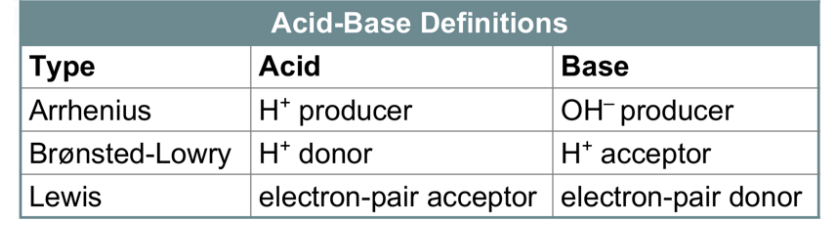
Acids donate H+ while bases accept H+.
acid + base → conjugate base + conjugate acid
H2SO4 + H2O → HSO-4 + H3O
Amphoteric substance- substance that can act as either an acid or a base, like water.
Lewis Acids and Bases - acid accepts pair of electrons while a base donates a pair.
Acid-Base Theories:
On the pH scale, acids range from 0-6, 7 is neutral, and 8-14 are bases
Ionization of water is reversible. Adding hydrogen ions or hydroxide ions to an aqueous solution is a stress on system that causes the equilibrium to shift towards the formation of water.
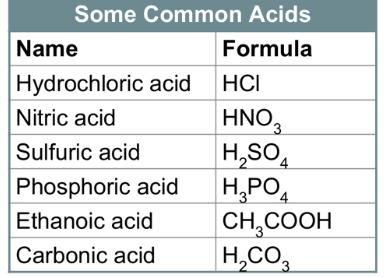
Strong acids are completely ionized in aqueous solutions
Weak acids ionize only slightly in aqueous solutions
The acid dissociation constant (Ka) is the ratio of the concentration of the dissociated form of an acid to the concentration of the undissociated form. Weak acids have small Ka values. Stronger acids have larger Ka values.
The lower the pKa, the stronger the acid
Weak bases react with water to form a conjugate acid of the base and hydroxide ions
Titration - the process of adding a measured amount of a solution of known concentration to a solution of unknown concentration. The solution of known concentration is the standard solution. Neutralization occurs when the number of moles of hydrogen ions is equal to the number of moles of hydroxide ions. The point neutralization occurs is the equivalence point.
Buffer - a solution in which the pH remains mostly constant when small amounts of acid or base is added. Weak acid and conjugate base or weak base and conjugate acid.
According to the Arrhenius Theory, acids are hydrogen-containing compounds that ionize to yield hydrogen ions (H+) in solution
Bases are compounds that ionize to yield hydroxide ions (OH-) in aqueous solutions
Only a hydrogen bonded to a very electronegative element can be released as an ion. These bonds are highly polar. Methane is an example of this.
The hydrogen ion cannot exist alone in a water solution. It combines with a water molecule to form (H3O+), hydronium ion.
Bronsted-Lowry Theory - describes the interaction between an acid and a base in terms of proton transfer. The transfer of an H+ ion or proton. This theory states that any compound that can transfer a proton to any other compound is an acid, and the compound that accepts the proton is a base.
Ch. 20
oxidized = reducing agent - lose of e-
reduced = oxidizing agent - gain of e-
oxidation - complete or partial loss of electrons or gain of oxygen.
Reduction - complete or partial gain of electrons or loss of oxygen
Reducing agent - substance that loses electrons
oxidizing agent - substance that accepts electrons
binary ionic compounds - the oxidation numbers of the atoms are equal to the ionic charges
molecular compounds - no ionic charges are associated
Rules for Assigning Oxidation Numbers:
The oxidation number of a monatomic ion is equal in magnitude and sign to ionic charge
The oxidation number of hydrogen in a compound is +1, except in metal hydrides, such as NaH, where it is -1
The oxidation number of oxygen in a compound is -2, except in peroxides, where it is -1, and in more electronegative fluorine, where it is positive.
The oxidation number of an atom in uncombined form is 0.
For any neutral compound, the sum of oxidation numbers in the compound is 0.
For a polyatomic ion, the sum of the oxidation numbers must equal the ionic charge of the ion.