Plant Nutrition (2.7-2.12)
Photosynthesis: process by which plants manufacture carbohydrates from raw materials using energy from light OR light energy trapped by chlorophyl is used to convert carbon dioxide and water into glucose and oxygen
The pigment chlorophyll (in chloroplasts) traps the sunlight and converts light energy into chemical energy, for the synthesis of carbohydrates
%%Carbon dioxide + Water → Glucose +Oxygen%%
- Carbon dioxide diffuses into the leaf through the stomata
- Water is taken up by the root from the soil and travels up the xylem to the leaves
Glucose produced is:
- Used as a source of energy for respiration
- Converted into starch for storage
- Converted into lipids as an energy source in seeds
- Cellulose in cell walls
- Converted into amino acids for protein synthesis when combined with other mineral ions
Testing for Photosynthesis
- Testing for starch in leaves shows whether photosynthesis has taken place and can be used to show the need for chlorophyll in photosynthesis.
- Leaves cannot be tested for glucose because it is quickly used or converted into other forms
Procedure
- Drop leaf in boiling water
- Kill cells and break down the cell membrane
- Soak in hot ethanol ito romove cholorophyl so color change can be seen clearly
- Dip leaf in boiling water to soften it
- Spread on white tile and add drops of iodine
- %%If photosynthesis has taken place the leaf will turn blue-black (positive test for starch)%%
Repeating this test with a partially white leaf
- The white areas dont contain chlorophyll and so will not photosynthesis
- %%Only areas with chlorophyll will stain blue-black while the white areas wont%%
The same test can be carried out to test the need for Light or Carbon dioxide for photosynthesis
Light
- Destarch the plant by placing it in a dark cupboard for 24 hour to make sure all the starch present in the leaves is used up
- Cover leaf partial with aluminium foil tand place in sunlight
- Carry out the starch test
- %%Area covered with aluminium will remain orange-brown since photosynthesis hasn’t take place%%
Carbon dioxide
- Destarch the plant the same way
- Tie a bag containing sodium hydroxide around a leaf of the plant. The sodium hydroxide absorbs the carbon dioxide
- Tie a bag with water as a control expirement
- Place the plant in bright light for a while (so light is not a limiting factor)
- Carry out the starch test
- %%Leaf covered with sodium hydroxide will remain orange-brown, leaf covered in water will turn blue-black%%
The rate for photosynthesis
%%The process of photosynthesis produces oxygen gas as a byproduct%%
As oxygen is released, bubbles can be seen leaving the cut end of the pondweed in water
Bubbles produced over a minute can be counted to determine the rate of photosynthesis
- %%The faster the photosynthesis rate, the more (oxygen) bubbles are created per minute%%
The experiment is more accurate if a test tube is inverted over the top of the pondweed for a longer period of time and the volume of oxygen collected is measured
Independent Variable: the variable you manipulate, control, or vary in an experimental study to explore its effects
- %%Make sure to keep all other variables constant to ensure a fair test%%
Control Variable: variable kept the same so it doesnt affect results
Dependent Variable: Variable that depends on other factors that are measured
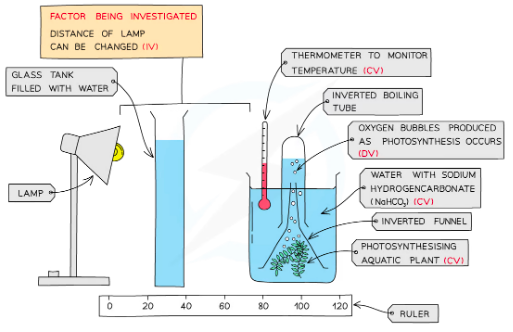
- Changing the distance between the lamp and the pondweed beaker to investigate the %%impact of light intensity:%%
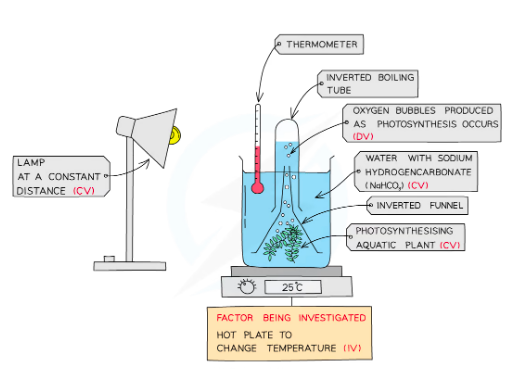
- %%Changing the temperature%% of water in the beaker to observe the effects of temperature change
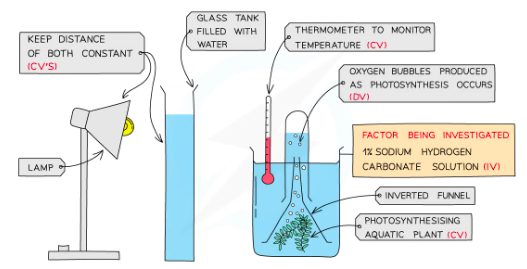
- Dissolving different amounts of %%sodium hydrogen carbonate%% in water in the beaker to investigate the effect of changing %%carbon dioxide concentration%%
- Sodium hydrogen carbonate absorbs carbon dioxide
- Other ways to measure amount of oxygen given off:
- An inverted measuring cylinder with graduations filled with water can be used to measure the volume of gas produced
- By attaching a syringe to the funnel with a delivery tube
Limiting Factor
Limiting Factor: Something present in the environment in such short supply that it restricts life processes
- When a plant is given unlimited sunlight, carbon dioxide, and water at a warm temperature, it will photosynthesise as fast as it can absorb and react these materials.
- Plants usually do not have unlimited supplies of their raw materials, so %%their rate of photosynthesis is limited by the factor lowest in supply (limiting factor)%%
There are three main factors which limit the rate of photosynthesis:
- Temperature
- Light intensity
- Carbon dioxide concentration
- Amount of water needed for photosynthesis is relatively small compared to the amount of water transpired by plants, so water wouldnt be a limiting factor
- Temperature
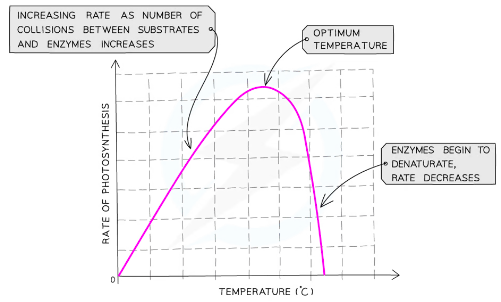
- Since %%photosynthesis is controlled by enzymes%% %%the rate of photosynthesis increases with temperature%%
- The trend continues up to a certain temperature (the optimum temperature when activity is highest) beyond which the enzymes begin to denature and the rate of reaction decreases
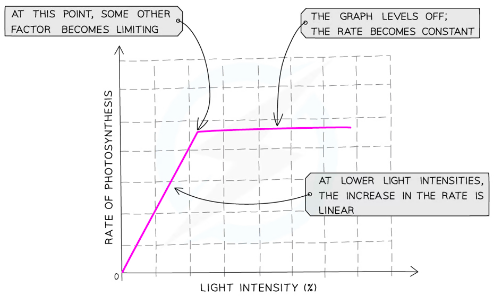
- Light Intensity
- %%The more light a plant receives, the faster the rate of photosynthesis%%
- The trend will continue UNTIL theres a shortage in another factor required for photosynthesis
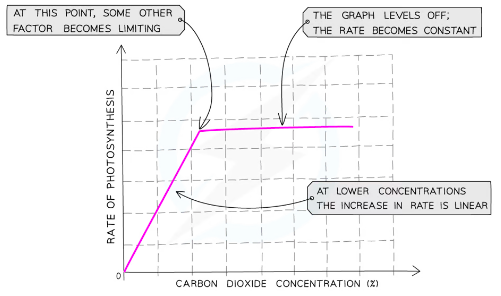
- Carbon Dioxide concentration
- %%The more carbon dioxide that is present, the faster the reaction can occur%%
- The trend will continue UNTIL theres a shortage in another factor required for photosynthesis
Gas Exchange
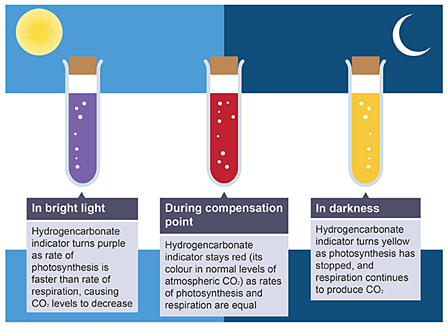
- Due to %%aerobic respiration,%% plants continuously take in oxygen and release carbon dioxide
- %%During daylight hours, plants undergo photosynthesis,%% which requires them to absorb carbon dioxide and release oxygen
- While plants do not photosynthesise at night (no sunlight) they still respire, meaning they take in oxygen and release carbon dioxide
- The plants photosynthesize at a faster rate than they respire during the day
- %%Net intake of carbon dioxide and a net output of oxygen%%
- A pH indicator, such as %%hydrogencarbonate%%, can be used to determine whether light affects net gas exchange in aquatic plants
- Carbon dioxide is acidic when dissolved in water
- Hydrogencarbonate indicator shows the carbon dioxide concentration in solution
Structure of a Leaf
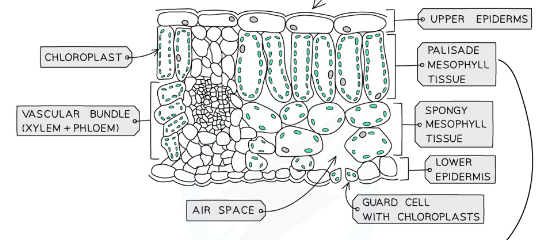
- Cuticle: Made of wax to prevent water from evaporating
- Upper epidermis: Thin and transparent to allow light to pass through
- No chloroplasts are present
- Acts as a barrier to disease organisms
- Palisade mesophyll:
- Main region for photosynthesis and so are pacled with chloroplasts to trap maximum light energy
- Receive CO2 by diffusion from air spaces in the spongy mesophyll
- Spongy mesophyll:
- Cells are more spherical and loosely packed contain chloroplasts, but not as many as in palisade cells
- Air spaces between cells allow gaseous exchange
- CO2 to the cells, O2 from the cells during photosynthesis
- Vascular Bundle:
- Made up of xylem and phloem
- Xylem vessels bring water and minerals to the leaf phloem vessels transport sugars and amino acids
- Lower epidermis:
- Acts as a protective layer
- Stomata are present to regulate the loss of water vapour (transpiration)
- Site of gaseous exchange into and out of the leaf
- Stomata:
- Each stomata is surrounded by a pair of guard cells
- Guard cells – control whether the stoma is open or closed
- Water vapour passes out during transpiration
- CO2 diffuses in and O2 diffuses out during photosynthesis
Adaptations of a leaf
| %%FEATURE%% | %%ADAPTATION%% |
|---|---|
| Large surface area | To absorb more light |
| Thin | Short distance for carbon dioxide to diffuse into leaf cells |
| Chlorophyll | Absorbs sunlight to transfer energy into chemicals |
| Network of veins | To support the leaf and transport water, mineral ions and sucrose (sugar) |
| Stomata | Allow carbon dioxide to diffuse into the leaf and oxygen to diffuse out |
| Epidermis is thin and transparent | To allow more light to reach the palisade cells |
| Thin cuticle made of wax | To protect the leaf from infection and prevent water loss without blocking out light |
| Palisade cell layer at top of leaf | To absorb more light and increase the rate of photosynthesis |
| Spongy layer | Air spaces allow gases to diffuse through the leaf |
| Palisade cells contain many chloroplasts | To absorb all the available ligh |
Minerals
- Photosynthesis produces carbohydrates (glucose)
- Besides carbohydrates (made by photosynthesis), plants contain proteins, lipids, and DNA.
- Without a source of certain elements the plant cannot synthesise biological molecules it needs
- %%Plants obtain these elements in the form of mineral ions actively absorbed from the soil by root hair cells%%
| Mineral ion | Needed for | Effects of deficiency |
|---|---|---|
| Magnesium | Making chlorophyll | Leaves turn yellow |
| Nitrate | Making amino acids for protein synthesis | Stunted growth |