Animalia: The Basal Phyla
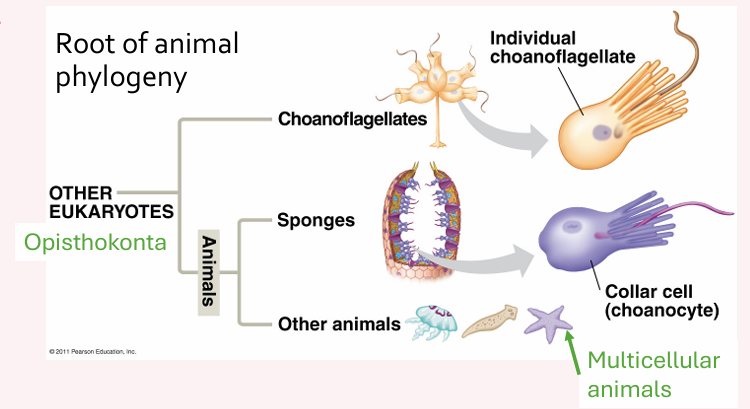
Eukarya: Opisthokonta
Key Basal Phyla: Porifera, Ctenophora, and Cnidaria
General Characteristics of Animalia
Cell Type: Eukaryotic and multicellular (aggregates).
Nutritional Mode: Chemoheterotrophic, deriving sustenance from ingestion.
Cellular Structure: Lacks cell walls; collagen holds cells together. Cell membranes are in direct contact with each other.
Mobility: Exhibits motility, characterized by active locomotion.
Reproductive Norm: Sexual reproduction predominates, whereby gametes arise through meiosis.
Phylogeny and Systematics
Visualizing Animal Phylogeny
Eukarya: Opisthokonta forms the root of animal phylogeny, branching into:
Choanoflagellates: Closest living relatives to animals.
Porifera (Sponges): Represent a lineage that does not exhibit true tissue complexity.
Other Animals: Including diverse lineages stemming from choanoflagellates.
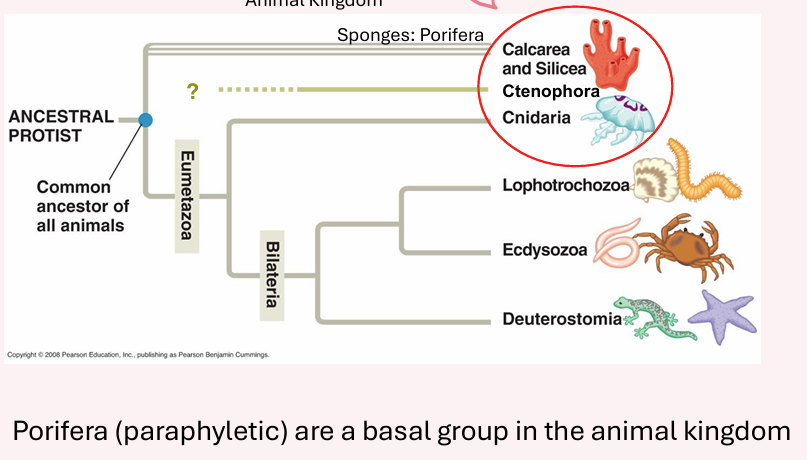
Common Ancestor: An ancestral protist is considered the common ancestor of all animals.
Major Groups and Basal Phyla
Porifera: Paraphyletic group identified as basal within the animal kingdom, further categorized into:
Calcarea: Sponges with calcium carbonate spicules.
Silicea: Sponges with silicon dioxide spicules.
Ctenophora: Also known as comb jellies, described as more complex than sponges.
Cnidaria: Consists of tissues and exhibits more organizational complexity.
Basal Phylum: Porifera (Parazoa)
Characterization:
Fundamental group based on the simplest body plan.
Lacks true tissues or organs; asymmetrical.
Size ranges from millimeters to meters.
Cell Specialization:
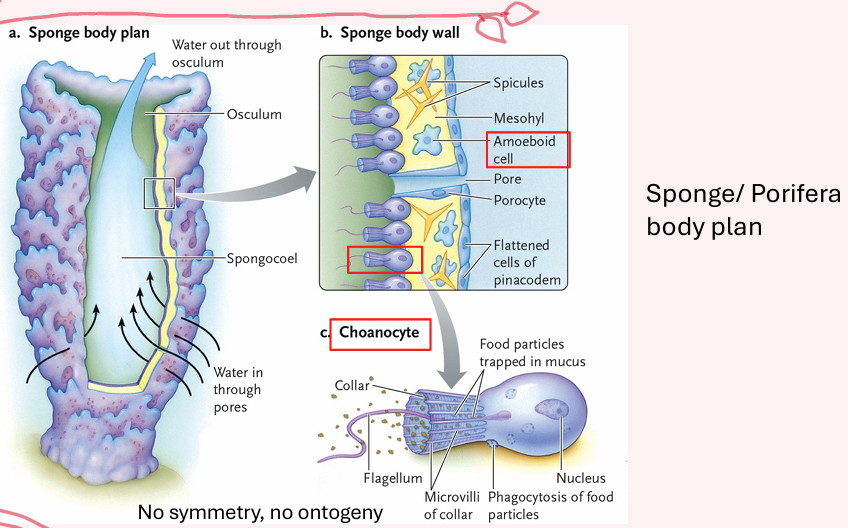
Choanocytes: Flagellated cells that facilitate water flow for feeding through phagocytosis.
Amoebocytes: Motile cells that transport nutrients between cells and aid in digestion.
Feeding Mechanism: Primarily marine suspension feeders, being sessile.
Sponge Body Plan
Structure:
Water is drawn in through the ostia (pores) and expelled through the osculum.
Internally structured with a spongocoel (the central cavity).
Makeup includes spicules and mesohyl containing amoeboid cells.
Examples of specialized cells include choanocytes for capturing food particles via phagocytosis.
Evolution of Multicellularity
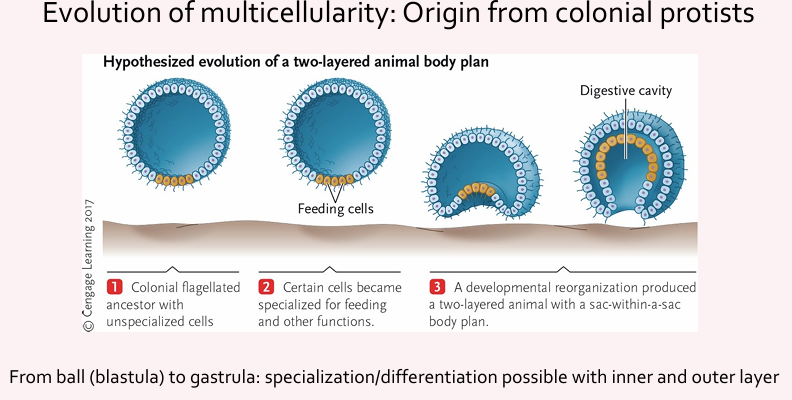
Origin: Emerged from colonial protists.
Development: Progressed from a ball formation (blastula) to a gastrula, allowing specialization and differentiation to occur in distinct cell layers (inner and outer).
Eumetazoa (True Metazoans)
Characterization:
Possess a tissue level of organization signifying the onset of true multicellularity.
Germ Layers:
Ectoderm: Produces outer covering and forms parts of the nervous system.
Endoderm: Forms the innermost layer lining the archenteron and gives rise to the digestive tract.
Basal Phylum: Ctenophora (Comb Jellies)
Characteristics:
Known for being more complex than poriferans with two germ layers (diploblastic).
Exhibits radial symmetry and a complete gut with both mouth and anus.
Lifestyle: Marine organisms, feeding on plankton from surface to deep ocean habitat.
Notable for their tentacles equipped with cilia forming combs.
Basal Phylum: Cnidaria
Structure and Organization
Characteristics:
Exhibits diploblastic development with distinct ectoderm (epidermis) and endoderm (gastrodermis).
Contains specialized feeding cells known as cnidocytes.
Displays an incomplete gut with only a mouth, facilitating both intra- and extracellular digestion.
Organisms within this group exhibit radial symmetry and exist in two body forms: polyp and medusa.
Metagenesis: An alternation of body forms between the polyp and medusa forms.
Cnidarian Body Plans
Medusa and Polyp Forms:
Medusa: Free-swimming with umbrella-shaped body.
Polyp: Sessile form, typically attached to substrates.
Tissue Layers:
Epidermis: Outer layer.
Gastrodermis: Inner lining surrounding the gastrovascular cavity.
Notable Examples:
Cnidaria Classes: Hydrozoa, Scyphozoa, Cubozoa, and Anthozoa (corals).
Important Cnidaria Classes
Hydrozoa: Demonstrates metagenesis, where one phase can be reduced or absent.
Scyphozoa and Cubozoa: Primarily free-swimming jellyfish with effective predatory capabilities and toxic properties.
Anthozoa (Corals):
Exhibit a sessile lifestyle devoid of a medusa stage; notable for calcium carbonate skeleton formation.
Thrives in shallow waters and often reliant on symbiotic relationships with dinoflagellate algae for nutrition through photosynthesis.
Importance of coral reefs in marine ecosystems and challenges posed by global climate change, including coral bleaching phenomena.
Research Implication: Invasive microbes have been shown to assist corals amidst global warming but may reduce their growth rate.
Summary of Key Points
Key Basal Phyla: Includes Porifera, Ctenophora, and Cnidaria.
Porifera: Exhibits no symmetry, the absence of ontogeny, and lacks a tissue organization; characterized by the presence of choanocytes.
Ctenophora: Features radial symmetry, a complete digestive system, and is diploblastic.
Cnidaria: Also diploblastic with radial symmetry, possessing an incomplete digestive system supported by specialized cnidocytes; classes include Hydrozoa, Scyphozoa, Cubozoa, and Anthozoa (corals).