Problem Solving and Creativity
Definition (#f7aeae)
Important (#edcae9)
Extra (#fffe9d)
Problem-Solving:
Problem solving: An effort to overcome obstacles obstructing the path to a solution.
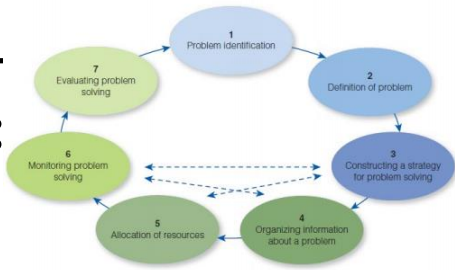
Problem solving cycle:
Problem identification: Do we actually have a problem?
Problem definition and representation: What exactly is our problem?
Strategy formulation: How can we solve the problem?
Analysis: Breaking down the complex problem into manageable elements.
Synthesis: Putting together various elements to arrange them into something useful.
Divergent: Try to generate different possible alternative solutions to a problem.
Convergent: To narrow down the multiple possibilities to converge on a single best answer.
Organization of information: How do the various pieces of information in the problem fit together?
Resource allocation: How much time, effort, and money should I put into this problem?
Monitoring: Am I on track as I proceed to solve the problem?
Evaluation: Did I solve the problem correctly?
Studies show that expert problem solvers tend to devote more of their mental resources to global (big-picture ) planning than do novice problem solvers.
Novices tend to allocate more time to local (detail- oriented) planning than do experts.
Types of problems:
Well-structured problems.
Ill-structured probelms.
Well-structured problem is a problem that has:
A clear starting point.
A clearly defined goal.
Known rules, constraints, and operations. You know what actions are allowed and what the limits are.
A correct, checkable answer. There is usually one best solution or a small set of clearly correct solutions.
Main types of errors when trying to solve well-structured problems.
Inadvertently moving backward: They revert to a state that is further from the end goal.
Making illegal moves: A move that is not permitted according to the terms of the problem.
Not realizing the nature of the next legal move: They become “stuck” - not knowing what to do next.
The human brain doesn’t specialize in high-speed computations of numerous possible combinations.
The limits of our working memory prohibit us from considering more than just a few possible operations at 1 time.
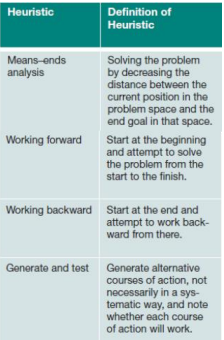
We use heuristics.
Heuristics: Mental short cuts.
Problem Representation:
Ex: Tower of Hanoi, Tower of London task.
Previous 2 problems are isomorphic.
Isomorphic: Their formal structure is the same, and only their content differs.
The 2 string problem:
There are no clear, readily available paths to a solution.
Problem solvers have difficulty constructing appropriate mental representations for modeling these problems and their solutions .
Such problems are called ill-Structured Problems.
Expert problem solvers:
Expertise is superiors kills or achievement reflecting a well-developed and well-organized knowledge base.
Differences between experts and novices:
Schemas: Have large, rich schemas of declarative knowledge and procedural knowledge about problem solving strategies relevant to a given domain.
Organization of knowledge: Have well-organized, highly interconnected units of knowledge in schemas.
Work direction: Work forward from given information to implement strategies for finding unknown information (novice work backwards focusing on the unknown to find strategies).
Monitoring: Carefully monitor own problem-solving strategies.
Efficiency: When there are time constraints experts will solve problem faster. Show highly efficient problems solving.
Accuracy of solution: Show high accuracy in reaching solutions.
Handling contradictory information: Show flexibility in adapting to a more appropriate strategy.
Long term memory:
An expert frequently has to hold large amounts of informatin in memory to perform a task.
Answer is in their Long term Working Memory in their area of expertise.
Long-term working memory retains memories in a stable form (unlike short-term working memory) but can be accessed only with adequate retrieval cues.
How to use LTM as working memory:
Chunking and templates: Experts rapidly encode information into meaningful chunks or "templates" from their long-term memory.
Meaningful encoding: Instead of trying to store raw information, experts associate it with existing knowledge.
Structured retrieval: The encoded information can be retrieved by activating cues (first or last) that are linked to the knowledge from long-term memory.
Supplementary associations: Experts can create additional associations between chunks based on their knowledge, further integrating the new information into a coherent memory representation.
The two-stage model of expertise acquisition:
Stage 1:
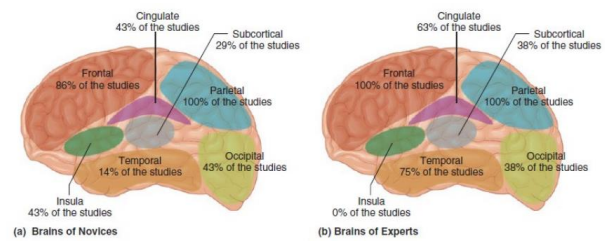
Novice training: When learning, novices show a decrease in brain activation in regions typically associated with working memory.
This happens because they have not yet developed the necessary knowledge structures (chunks and templates) to use LT-WM effectively.
Stage 2:
Expertise development: With practice, experts develop these structures. This leads to a shift in brain activation, showing patterns consistent with long-term memory tasks and functional reorganization.
They are now using long-term memory to support their working memory, leading to improved performance on tasks in that domain.
Creativity:
The process of producing something that is both original and worthwhile.
Conventional wisdom suggests that highly creative individuals also have creative lifestyles. These lifestyles are characterized by flexibility, non stereotyped behaviors, and non conforming attitudes.
Characteristics of creative people:
Divergent production: Creative individuals often have high scores on assessments of creativity.
Ex: Torrance Tests of Creative Thinking.
Measure the diversity, quantity, and appropriateness of responses to open-ended questions.
Other researchers have focused on creativity as cognitive process by studying problem solving and insight.
Personality and motivation play important roles in creativity.
Often underlying creativity are flexible beliefs and broadly accepting attitudes toward other cultures, races, and religious creeds.
Some investigators have focused on the importance of motivation in creative productivity.
Creative individuals tend to be more open to new experiences, self-confident, self-accepting, impulsive, ambitious, dominant and hostile than less creative individuals. They also are less conventional.
Creative individuals tended to have moderately supportive but often strict and relatively chilly early family lives.
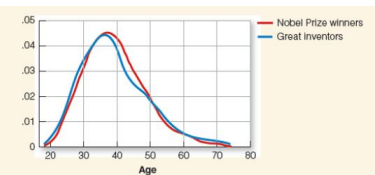
Age & creativity:
On average, the best work will occur roughly around the age of 40 years.
Remember that creative contributions can be made even late in career
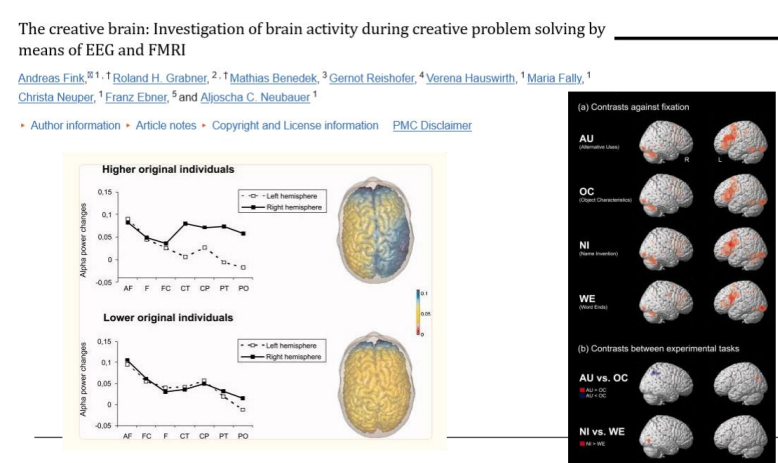
Neuroscience of creativity:
The prefrontal regions are especially active during the creative process, regardless of whether the creative thought is effortful or spontaneous.
Selective thinning of cortical areas seems to correlate with intelligence and creativity.
In particular, thinning of the left frontal lobe, lingual, cuneus, angular, inferior parietal, and fusiform gyri is connected with high scores on creativity measures.