Unit 1 Exam
Structure of water and Hydrogen bonds
Water is composed of 2 main elements, Oxygen, and Hydrogen In a 1:2 ratio
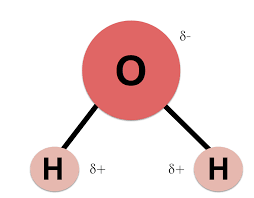 The bond type is covalent between the Hydrogen and Oxygen atoms because they share electrons
- The bond between oxygen and hydrogen is polar because oxygen has a high electronegativity than Hydrogen
- This leads to an unequal sharing of electrons and causes 2 different poles to form
- Oxygen is the negative side and Hydrogen is the positive side
Hydrogen bonds and water properties
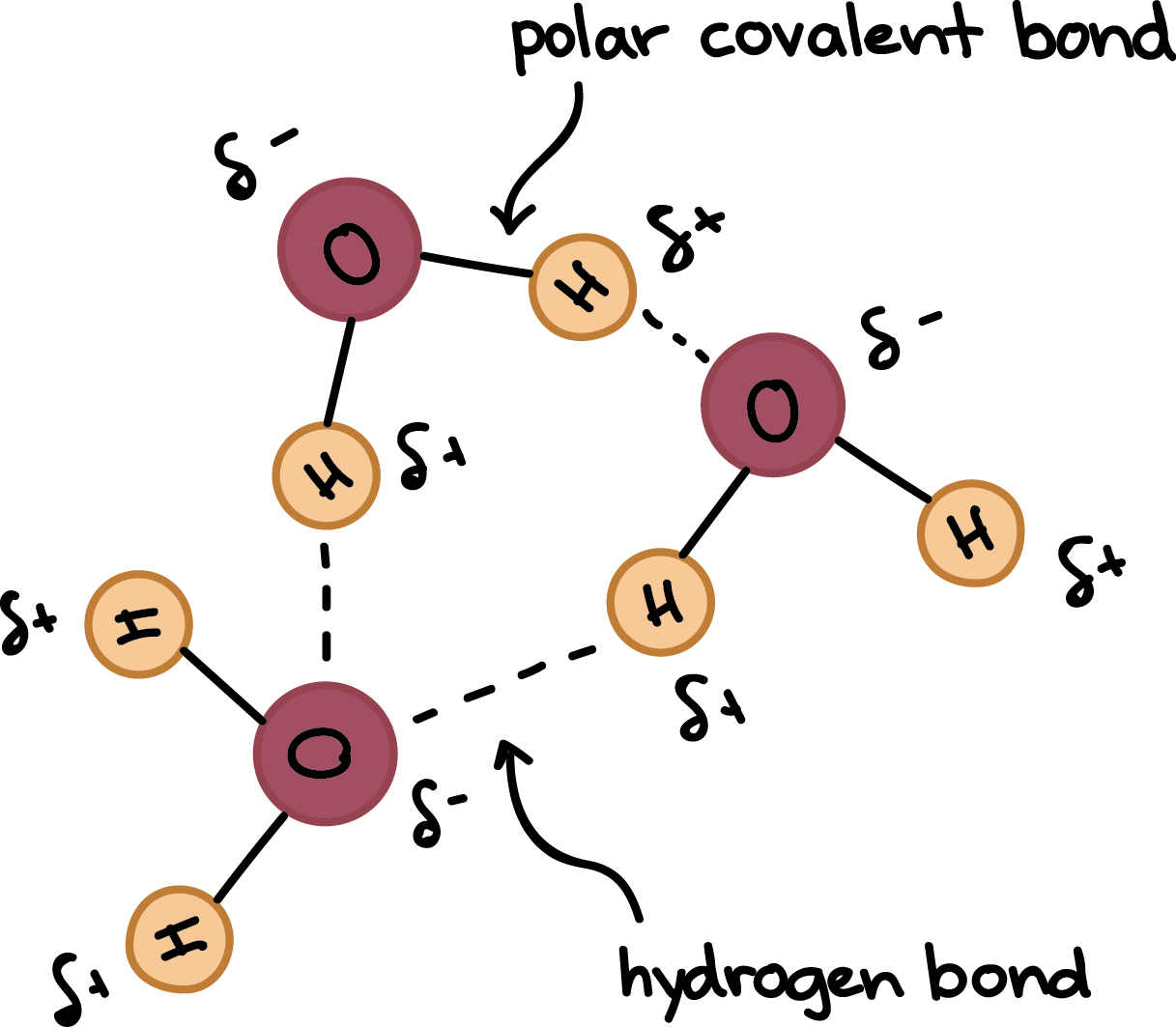
- Hydrogen bonds are weak bond interactions between the negative and positive regions of two separate molecules
- Water forms hydrogen bonds with other water molecules or with other charged molecules
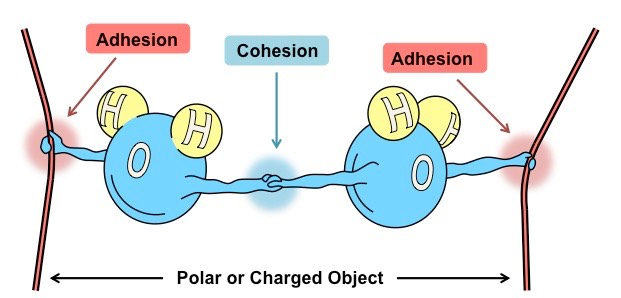
- Cohesion - When two of the same molecules form a hydrogen bond together (water collecting in drops)
- Adhesion - when two different molecules form hydrogen bonds with each other.
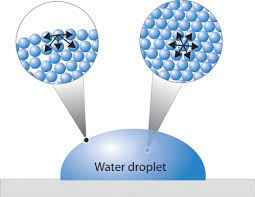
- Hydrogen bonds between water molecules lead to surface tension
- The increased hydrogen bonding forces between water molecules at the surface
- Water has a high solvency
- Important because 70% of all living things are made of water, this allows cells easy access to nutrients.
- Water makes a hydration shell around solutes
- hydrogen bonds in ice are more “ordered” forming a hexagonal shape with a hole in the middle, making ice less dense.
- If ice was denser than water then aquatic life would freeze in winter
- Waters cohesive properteies allow it to resist temputure change.
- allows fish to stay in water on a hot day
- Water can absorb large quantities of heat
- Because each water molecule can make two hydregn bonds each that makes it harder to increase their motion
- The more water vapor in the air the more heat the air can absorb
- Large bodies of water absorb heat from warmer air and realease heat to cooler air
- Heat is absorbed when hydrogen bonds break and realesed when the form
- \
- Capillary action - adhesion and cohesion working together
- water moving up a plants roots
- Hydrophobic - dosen’t mix with water nonpolar
- Hydrophilic- mixs with water polar
- Colloid Fat suspended in water
Acids and Bases
- On the Ph scale acids are below 7
- On the PH scale acids are above 7
- Acid is any substance that increases the H+ concdntration of a soulution
- Base- any substance that reduces the H+ concentration of a solution
- Buffers resist changes in concentration of H+ and OH- in a solution '
- Ocean acidifiction is when the co2 from the atmosphere is absorbed by the ocean and taken in to creat carbonic acid
- The PH of a solution is notated as : pH = -log [H+]
- each Ph jump is 1*10^1
Macromolecule basics
All living things are made of these 4 classes of macromolecules
Carbohydrates
- Includes Sugars polymers
- Monomer: Monosaccharides
- Glucose (C6H12O6)
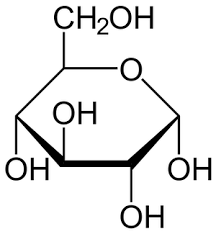
- Characterized by location of the carbonyl
- The number of carbons in the skeletons
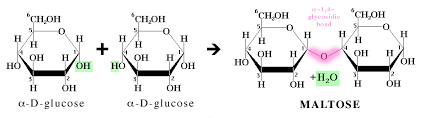
- Bond: Glycosidic link
- Polymer: disaccharide Polysacarhids
- \
Lipids
Proteins
Nucleic Acids
- Macromolecules are large molecules composed of thousands of Covalently bonded atoms
- Macromolecules are made of monomers that make polymers
- Dehydration/condensation reaction - when two monomers are joined together through the loss of water
- Hydrolysis - a reaction that disassembles monomers through the addition of water
- \