#2 Systems of Linear Equations
Systems and Their Solutions
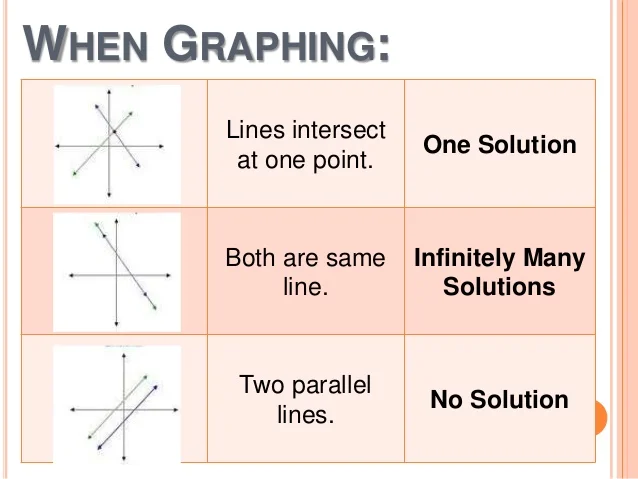
Systems are two or more equations (sometimes 3) graphed in the same coordinate plane. Even without a graph present, it is still possible to determine an outcome by comparing the slopes and y-intercepts of the equations.
- Remember, if two equations have the same slope, they’re parallel, meaning they have NO solution
- If two equations have diff slopes, but the same y-int, then they’re perpendicular and have ONE solution
- If the two equations share the same slope AND y-int, they’re the same line and therefore have INFINITE solutions
 Methods For Solving Linear Solutions
Substitution
- ex. 2y+3x=9 and 6x-y=-2
- Pick one equation and isolate x or y; y=6x+2
- In the other equation, replace the variable w/ the expression it equals; 2(6x+2)+3x=9
- Solve this new one variable equation; 12x+4+3x=9 > 15x+4=9 > 15x=5 > x=1/3
- Substitute the value found in step 3 into one of the original equations; 6(1/3)-y=-2 > 2-y=-2 > -y=-4 > y=4
Elimination
- ex. y=4x-4 and 8x=3y+11
- Rewrite the equations w/ like terms stacked on top of each other; 4x-y=4 and 8x-3y=11
- If necessary, multiply 1 or both equations to make the coefficients (# in front of x/y) of one of the variables (x, y, etc) the same with an opposite sign; -2(4x-y=4) > -8x+2y=-8 and 8x-3y=11
- Add equations together; -1y=3
- Solve resulting equation; y=-3
- Substitute value from 4 into one original equation; 8x=3(-3)+11 > 8x=-9+11 > 8x=2 > x=2/8 (1/4)
Algebraic Methods and Other Possible Outcomes
If your math produces a result that is:
- Always true (0=0); infinite solutions
- Never true (o=b); no solutions
Line Type and Shading
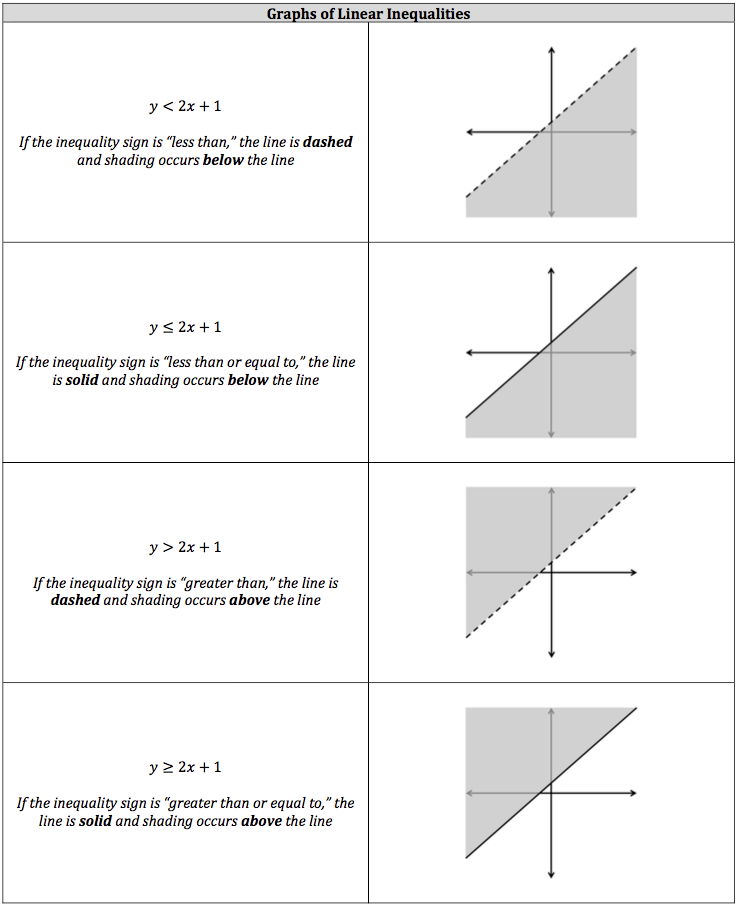
When it comes to inequalities, learning how to properly graph will save you from a lot of confusion and time consuming mistakes. With linear equations, the slope and y-int are the only things needed to look out for, but when it comes to inequalities, the type of line and shading are two more things you have to worry about, so here are the basic rules.
- < symbol; when y is less than, you have a DASHED line that’s shaded BELOW
- less than or equal to; SOLID line and shaded BELOW
- \ > symbol; DASHED line, shaded ABOVE
- greater than or equal to; SOLID line, shaded ABOVE
Methods For Solving Systems of Equations
Graphing Method
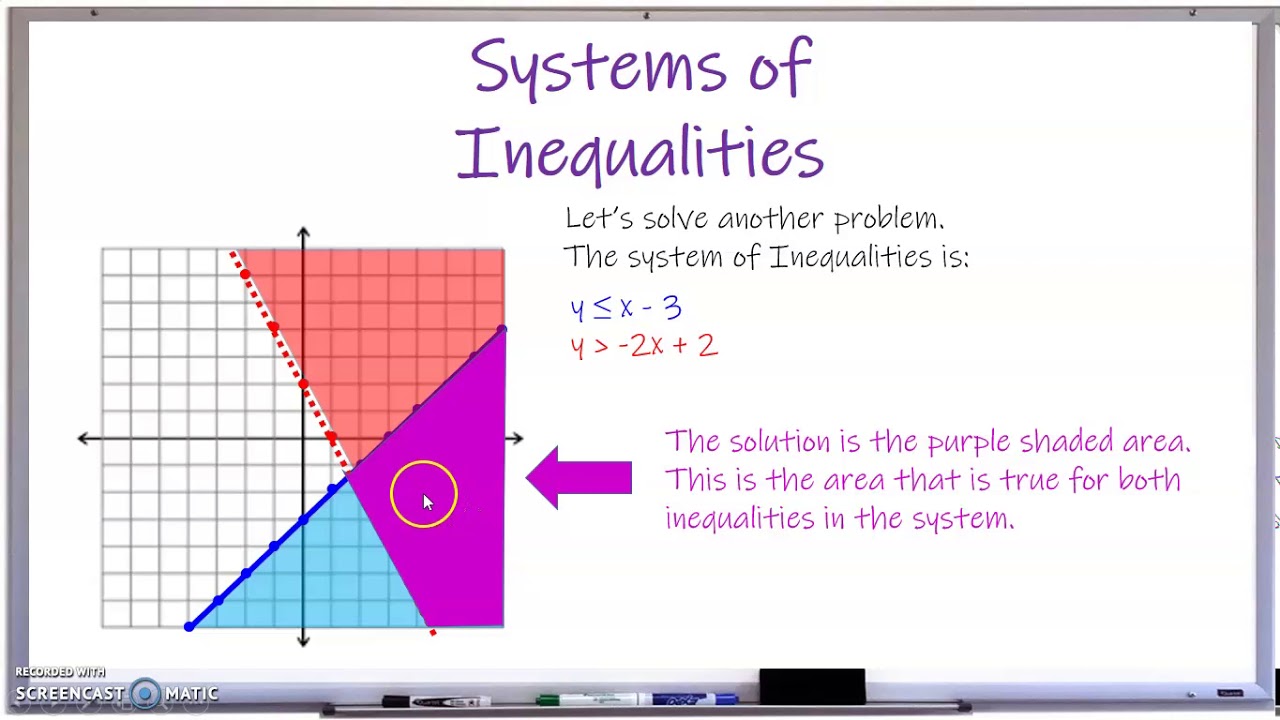
Once you place the correct line and shading of your two (or more) equations, there will often be an overlapping shaded area. This area is the solution set of a system and holds points that make the system true.
NITAS Method
Most students have likely never heard of NITAS, but have definitely used it before in their academic career. NITAS is simply plugging in each answer choice into the system to determine which answer satisfies the inequalities, a method that everyone has used at some point in their life.