2.3A Metallic Bonding
Characteristics of Metals
Small number of valence electrons
Low ionization energy, are prone to losing electrons
High melting and boiling points
Metallic Bonding
Metals in their elemental state have no other element to accept their electrons and form an ionic compound.
Their electrons are held loosely by the metal’s nucleus and tend to “wander off”, becoming delocalized.
Metal atoms losing valence electrons become positive ions. The delocalized electrons are free to travel throughout the positive ion lattice, and are not associated with one particular metal nucleus.
Metallic Bond
the electrostatic attraction between a lattice of cations and delocalized electrons. It is an array of positive ions in a sea of electrons. “Electron Sea Theory”
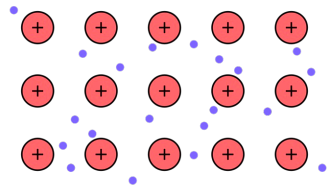
The strength of a metallic bond depends on...
1. the charge of the ions
2. the radius of the metal ion
Metallic bond strength decreases down a group because the ionic radius increases.
Explaining Metallic Properties
Good Electrical Conductivity
Many mobile delocalized electrons are present. They can move through the metal structure in response to an applied voltage.
Good Thermal Conductivity
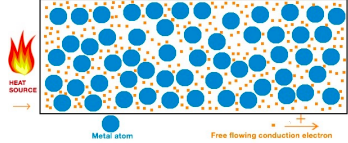
Delocalized electrons and closely packed ions allow for efficient energy transfer.
 Malleable, can be shaped under pressure; Ductile, can be drawn into threads
Movement of delocalized electrons is non-directional and random throughout the cation lattice. The metallic bond remains intact while conformation changes under applied pressure.
High Melting Point
Large amounts of energy are required to break strong metallic bonds and separate atoms.
Shiny Lustrous Appearance
Delocalized electrons in metal crystal structure reflect light