Polar vs Nonpolar Notes
1. Nonpolar Bonds
Nonpolar covalent bonds occur when electrons are shared equally between two atoms. This typically happens when the atoms have similar or identical electronegativities.
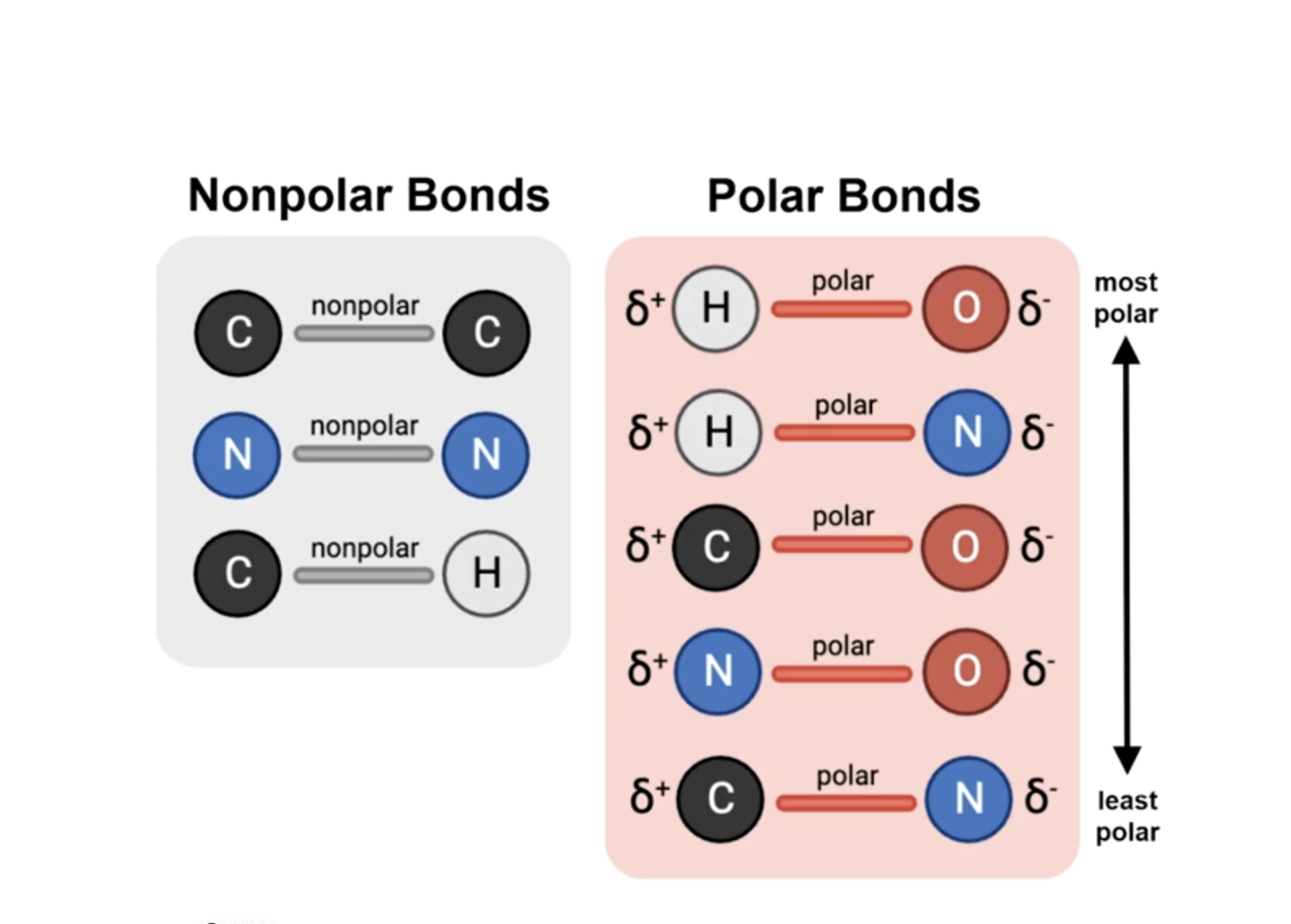
Identical Atoms: Bonds between the same element are always nonpolar because there is no difference in electronegativity.
(Carbon-Carbon)
(Nitrogen-Nitrogen)
Carbon-Hydrogen () Bonds: Although these are different elements, their electronegativities are close enough that the bond is considered nonpolar in biological contexts. This is a critical building block for hydrophobic molecules like lipids.
2. Polar Bonds
Polar covalent bonds occur when electrons are shared unequally due to a significant difference in electronegativity. One atom pulls the electrons closer to its nucleus.
Partial Charges:
(Partial Negative): The more electronegative atom that pulls electrons toward itself (e.g., Oxygen, Nitrogen).
(Partial Positive): The less electronegative atom that "loses" the tug-of-war for electrons (e.g., Hydrogen, Carbon).
3. Polarity Gradient
The degree of polarity depends on the specific atoms involved. Based on the electronegativity differences, the polarity of common biological bonds ranks as follows:
(Highest Polarity): Oxygen is highly electronegative, creating a very strong dipole. This bond is central to the properties of water.
: Nitrogen is less electronegative than Oxygen, but still significantly more so than Hydrogen.
: Oxygen pulls electrons away from Carbon.
: While both are electronegative, Oxygen is more so than Nitrogen.
(Lowest Polarity listed): Nitrogen is more electronegative than Carbon, but the difference is smaller than in the bonds above.
4. Key Relationships to Remember
Oxygen () is the most electronegative of these four elements ().
Nitrogen () is the second most electronegative.
Carbon () and Hydrogen () have very similar electronegativities, making their bond nonpolar.
Bonds involving Oxygen or Nitrogen bonded to Hydrogen or Carbon are almost always polar.