2 what was margaret of anjous role in the developing conflict
How Important Were the Actions of Margaret of Anjou in the Development of the Conflict?
Background and Motivation
After the Battle of St Albans, Margaret of Anjou became convinced that the Duke of York was a threat to her son’s future and that he had to be destroyed to secure Prince Edward’s inheritance. She could not rely on her husband, King Henry VI, due to his weakness and poor mental health. Her previous allies, Suffolk and Somerset, had both been killed, leaving leadership of the Lancastrian party to her. Determined to protect her son’s position, Margaret took on this responsibility without hesitation.
Margaret’s Rise to Power
The Duke of York’s second protectorate ended in February 1456 when King Henry VI recovered sufficiently to resume government. This time, however, the King ensured York remained close to him, acknowledging him as his chief councillor—something York had long desired. Warwick also benefited from royal support in securing the captaincy of Calais, which had refused him entry due to unpaid wages. With the King’s backing, Warwick gained admittance—an event that would have disastrous consequences for the Lancastrians. York’s position appeared strong, but Margaret’s distrust of him soon threatened his authority.
Establishing a Power Base
In April 1456, Margaret and Prince Edward left London, a city she believed was unsympathetic to her cause, and moved to the Midlands, the heart of Lancastrian support. At Kenilworth, she began building her own power base, finding allies among York’s and the Nevilles’ enemies. A household was established for Prince Edward, staffed by trusted figures such as Wiltshire and Beaumont. The Queen was joined by the Duke of Exeter and the Earl of Devon, both opponents of York, as well as the new Somerset, Northumberland, and Clifford, who held York responsible for their fathers’ deaths.
In August 1456, Henry VI joined Margaret at Kenilworth, allowing her to exert control over him and influence royal appointments. Her supporters replaced York’s men in key positions—for example, her private chancellor, Laurence Booth, became Keeper of the Privy Seal in September 1456. The King’s move from Westminster to Kenilworth shifted the balance of power decisively in Margaret’s favour, effectively placing the Queen in control of government.
Consolidating Power
By autumn 1456, Margaret continued strengthening her position by appointing loyal followers to major offices. The Bishop of Winchester became Chancellor, and the Earl of Shrewsbury was appointed Treasurer. Despite her increased control, her power base, like York’s, remained narrow as most nobles avoided taking sides.
Margaret sought to win over neutral nobles. The Earls of Shrewsbury and Pembroke, who had supported York’s protectorate, were persuaded to join the Lancastrian cause. This was achieved partly through strategic marriages—Shrewsbury’s heir married the Duke of Buckingham’s daughter, while Buckingham’s son, Sir Henry Stafford, married Margaret Beaufort. These alliances drew Buckingham into the Queen’s camp, a shift finalized by Warwick’s controversial behaviour in 1458.
Conflict with Warwick and Preparations for War
Margaret tightened her control over the Exchequer, reducing funds sent to Calais and making it difficult for Warwick to pay his garrison. Warwick resorted to piracy, attacking foreign merchant ships, which boosted his popularity but embarrassed the government. Margaret demanded his resignation and summoned him to London to answer for his attacks on the Hansa fleet. While in London, Warwick was attacked by royal guards but escaped to Calais, claiming there had been an assassination attempt against him. Buckingham, shocked by Warwick’s defiance of royal authority, finally aligned himself with the Queen’s faction.
With Buckingham’s support, Margaret was strong enough to prepare for war against York. She convinced Henry VI that York was plotting to usurp the throne, leading to York being charged with treason. By 1459, Margaret had regained control of government, expanded her following, and weakened her opponents—placing her in a position to launch open conflict.
Evaluation: Margaret’s Role in the Outbreak of War
Margaret of Anjou played a central role in escalating tensions that led to renewed hostilities in 1459. Her determination to defend her son’s rights, assert control over government, and oppose York’s influence significantly contributed to the outbreak of the Wars of the Roses’ next phase. Her actions revitalized the Lancastrian cause and transformed political rivalry into open warfare.
Q1: Why did Margaret of Anjou view the Duke of York as a threat following the Battle of St Albans?
Q2: How did Margaret’s relocation to the Midlands in 1456 strengthen her political position?
Q3: In what ways did Margaret consolidate her authority between 1456 and 1458?
Q4: How did Margaret’s conflict with Warwick contribute to the breakdown of royal authority?
Q5: To what extent were Margaret’s actions responsible for the renewal of armed conflict in 1459?
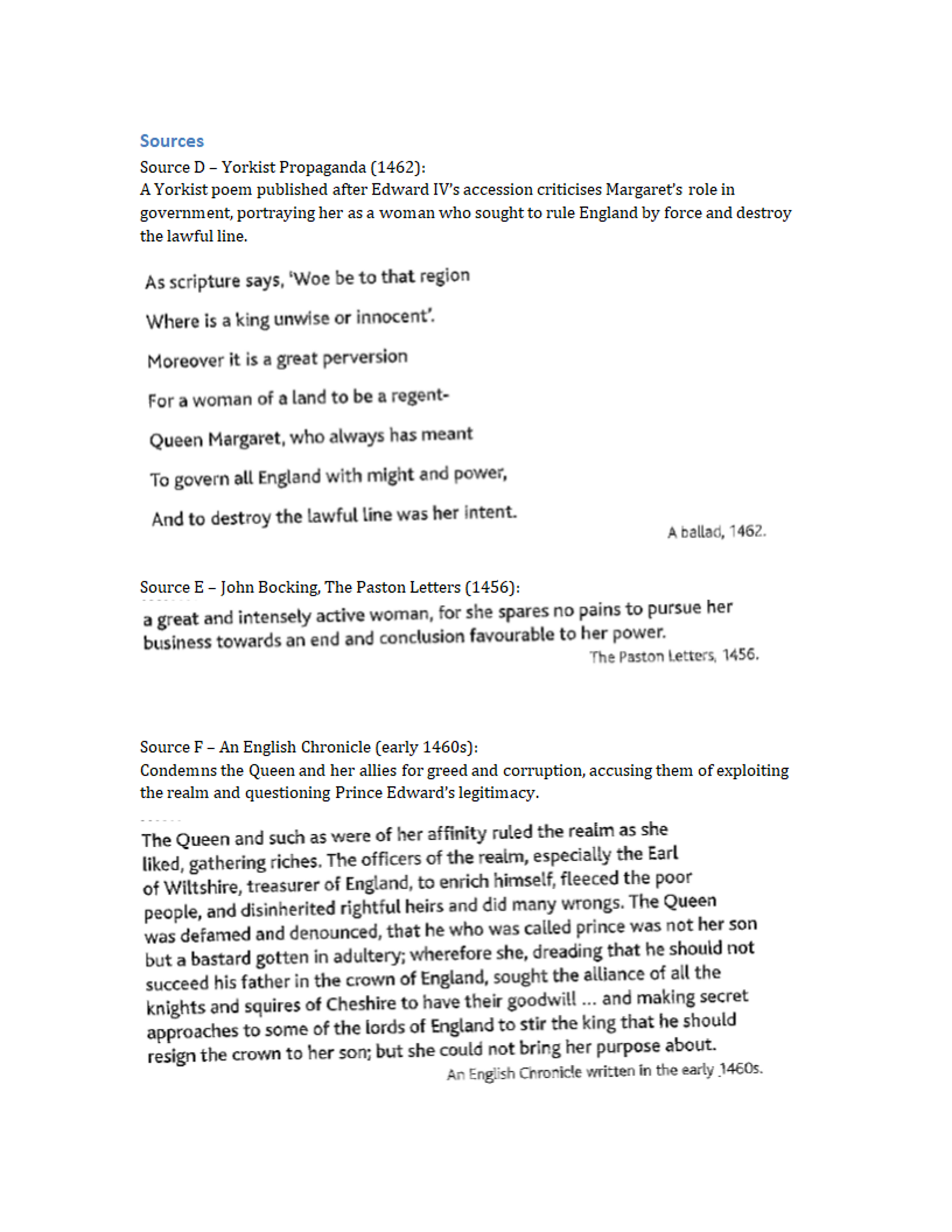
Do these sources show that Margaret helped to cause the conflict?