Burger
Burger 2009 Replicating Milgram - Contemporary Study
Aim
To replicate Milgram's experiment in an ethical way
Sample
123 Americans
Males & females
Procedures
Base Condition:
- Rigged learner and teacher
- Predetermined recorded sounds
- Some prods
- Immediate debrief
Model refusal Condition:
- a second confederate pretends to be a second teacher. This teacher delivers the shocks, with the naïve participant watching. At 90V the confederate teacher turns to the naïve participant and says “I don’t know about this.” He refuses to go on and the experimenter tells the naïve participant to take over delivering the shocks.
Burger used questionnaires to measure individual differences that might be factors in obedience:
- Interpersonal Reactivity Index is a 28-question test that measures empathy - how sensitive you are to other people's feelings
- Desirability of Control Scale is a 20-question test that measures locus of control - how important is it for you to be in control of events in your life.
Results
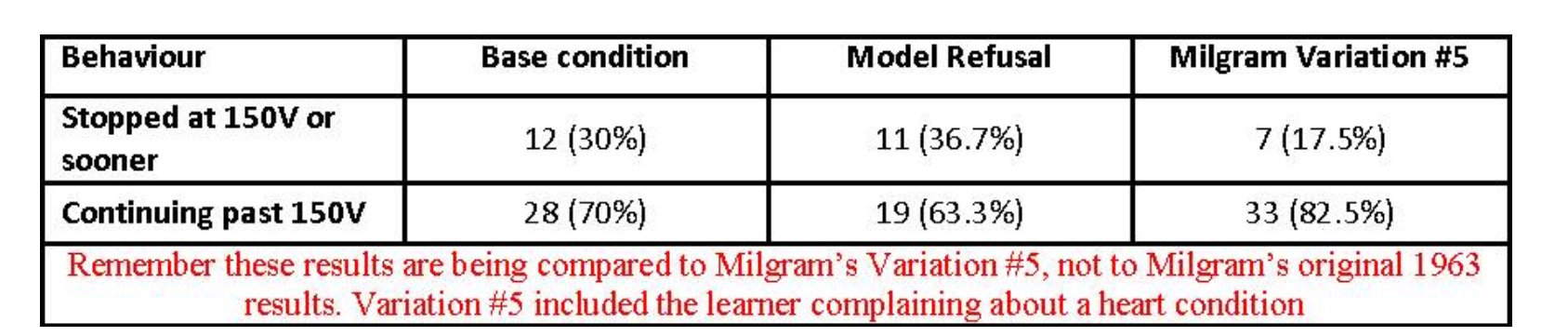
- Burger also compared men and women but didn’t find a difference in obedience. Women were slightly less likely to obey in the “model refusal” condition but this was not statistically significant.
- Empathy did not make a significant difference to obedience. However, in the base condition, those who stopped at 150V or sooner did have a significantly higher locus of control (but this was not the case in the “model refusal” condition).
Conclusions
- Burger concludes that Milgram’s results still stand half a century later. People are still influenced by situational factors to obey an authority figure, even if it goes against their moral values.
- The “model refusal” results were not very different from the base condition. This is odd because Social Impact Theory suggests the impact of the authority figure would be lessened if divided between two teachers rather than focused on one.
- However, locus of control did make a bit of a difference, suggesting some people resist the agentic state. However, this disappeared in the “model refusal” condition and Burger doesn’t have a definite explanation for that.
Generalisability
- Burger’s sample of 70 people is larger than Milgram’s sample of 40. It covers a wider age range (Milgram recruited 20-50 year olds, Burger 20-81 year olds) and two thirds of Burger’s sample were women, whereas Milgram’s were all male.
- Burger also excluded a lot of people from his final sample; for example people with emotional issues or some education in Psychology. This may have affected the results and Milgram used a wider range of types of people.
Reliability
- Burger followed Milgram’s script wherever possible and used the same confederates every time.
- By filming the whole thing, Burger adds to the inter-rater reliability because other people can view his participants’ behaviour and judge obedience for themselves.
Applications
- The study demonstrates how obedience to authority works and this can be used to increase obedience in settings like schools, workplaces and prisons. Authority figures should wear symbols of authority (uniforms) and justify their authority with reference to a “greater good”.
- Testing people for locus of control might identify those most likely to be disobedient – people with a strong need to be in control are less likely to take orders.
- Social Impact Theory suggests strategies for increasing the pressure on these people to be obedient.
Validity
- Milgram’s study was criticised for lacking ecological validity because the task is artificial – in real life, teachers are not asked to deliver electric shocks to learners. This criticism still applies to Burger’s study.
- participants were paid fully in advance
- However, stopping the study at 150V may be invalid.
Ethics
- Burger screened out participants who were likely to be distressed by the study. The Experimenter was a trained clinical psychologist who could identify signs of distress and would stop the experiment if anyone seemed to be disturbed by what was happening.
- Burger deceived his participants just as Milgram had done – the shocks weren’t real, the learner’s cries were a tape recording, the learner and second teacher were confederates. He did not get informed consent (as with Milgram, this was advertised as a memory study), although he did debrief participants afterwards. The BPS Ethical Guidelines say participants must not be distressed; even though no one was reduced to tears, the procedure was surely distressing for at least some participants.