Topic 6 - Organic Chemistry
Functional groups
A homologous series has three distinctive characteristics:
All members contain the same functional group that is responsible for the characteristic chemical reactions of that molecule
All members have the same general formula
Each subsequent compound differs by a CH2 unit
Common homologous series
Series | Suffix/Prefix | Example |
Alkanes | -ane | Propane |
Branched alkanes | Alkyl- | Metylpropane |
Alkenes | -ene | Propene |
Halogenoalkanes | Fluoro/Chloro/Bromo/Iodo | Chloroethane |
Alcohols | -ol | Ethanol |
Aldehydes | -al | Ethanal |
Ketones | -one | Propanone |
Carboxylic acids | -oic acid | Ethanoic acid |
Esters | Alkyl -oate | Ethyl ethanoate |
Amine |
Empirical, Molecular and Structural formulae
Organic chemistry is the study of carbon compounds. An organic compound contains carbon bonded to other elements.
General formula - Algebraic formula that describes classes of organic molecules
Empirical formula - Expresses relative numbers for each type of atom in the simplest whole number ratio
Molecular formula - Indicates the actual numbers of atoms of each element in a molecule
Structural formula - Illustrates how atoms are arranged, showing which atoms are bonded together.
Skeletal formula - Displays the bonding framework omitting all carbon atoms and attached hydrogen atoms.
Displayed formula - Shows the precise arrangement of all atoms and the bonds between them
Naming
Use the following steps to name a compound:
Identify the longest continuous carbon chain
Recognise the functional groups
Number the carbon atoms based off of location of functional group (functional group needs lowest possible number)
Include numbers and prefixes for any side chains
Apply any multiples necessary
Isomerism
Isomers are molecules with the same molecular formula but different arrangements of atoms
Structural isomers - These molecules have the same atoms but different connections
Stereoisomers - Connected in the same way but have different spatial arrangements of atoms
Structural isomers can be divided into three sub-types: Chain isomers, positional isomers, and functional group isomers.
Chain isomers - Differ in carbon skeleton arrangement (straight vs branched chain)
Positional isomers - The functional group is attached at dif carbon atoms
Functional group isomers - The atoms form different functional groups
Types and Mechanisms
When a covalent bond breaks it undergoes one of two processes: heterolytic or homolytic fission
Heterolytic fission → Involves uneven cleavage of the shared electron pair with the bond, one atom retains both bonding electrons becoming an anion, the other atom loses both electrons becoming a carbocation
Homolytic fission → Involves even cleavage of the shared pair of electrons within the bond. Each atom retains one electron from the bonding pair forming two neutral radicals with unpaired electrons. Radicals are very reactive due to their unpaired electrons.
When drawing curly arrows the arrow should initiate at the bond or lone electron pair indicating where the electrons started.
Classifying reactions
Addition - The joining of two or more molecules to form a larger molecule
Elimination - A small group of atoms detaches from a larger molecule
Substitution - One atom or group is replaced by another
Hydrolysis - A molecule splits by incorporating H+ and OH- from water
Oxidation - Loss of electrons
Reduction - Gain of electrons
Polymerisation - Joining of many simple molecules to form a giant molecule.
Classifying reagents
Nucleophiles - Electron pair donors. They contain lone pairs or negative charges and can donates those electrons during reactions
Electrophiles - Electron pair acceptor. They are electron deficient and can accept electron pairs during reactions.
Radicals - Species with one or more unpaired electrons. Their unpaired electron makes them highly reactive
Alkanes
Alkanes are saturated hydrocarbons meaning they only contain carbon and hydrogen atoms and are fully saturated with hydrogen so only have single bonds. They have the general formula CnH2n+2. Each carbon atom forms four single bonds
Cycloalkanes are a type of alkane in which the C atoms form a ring, their general formula is CnH2n (the same as alkenes) but they are saturated
Free radical substitution mechanism
Photochemical halogenation of alkanes follows a three step mechanism. In photochemical reactions UV light must be present to provide the activation energy
Initiation - UV light produces reactive radicals
Propagation - Radicals react in a chain reaction
Termination - Radicals join to form stable molecules
Issues: 1. With an excess of halogen, additional substitution reactions can occur
The propagating radical can substitute at any position along a carbon chain which leads to the production of various positional isomers
Fuels from crude oils
Crude oil is a complex mixture of hydrocarbons. The main components are alkanes. The varying lengths of alkanes result in a broad range of boiling points in crude oil. This range is crucial for the separation of crude oil into different components by fractional distillation
Fractional distillation involves heating crude oil to about 350 C causing it to vaporise and then allowing the vapourised components to condense at different temperatures. Various hydrocarbon components have different boiling points related to their chain length. Fractions with higher boiling points condense first, while heavier residues remain at the bottom
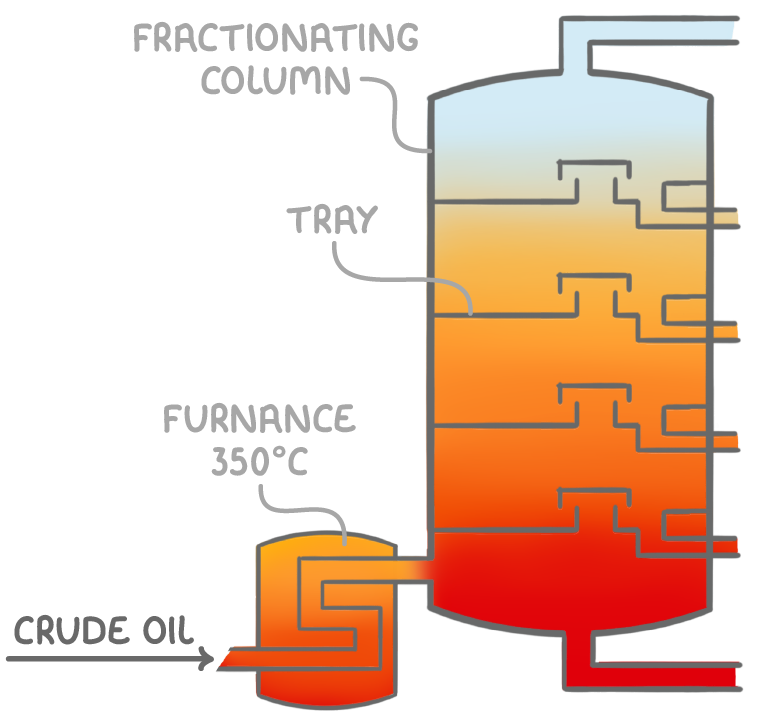
As the hot vapours rise through the column, they cool down. When the vapour temperature drops below the boiling point of a hydrocarbon it condenses from gas to liquid
The smallest hydrocarbons do not condense at all and remain gases at the top.
Boiling point increases progressively down the column as alkane chain length increases
Viscosity - Viscosity increases as you move down the column. Very light distillates flow freely but heavier fractions have higher viscosities
Flammability - Flammability decreases down the fractioning column. Light gases and short-chain hydrocarbons at the top ignite readily, making them excellent fuels due to their high flammability and volatility. Long chain hydrocarbons are less suitable as fuels as they are hard to combust
Because short-chain hydrocarbons are more efficient as fuels, less useful fractions are converted into smaller, more valuable molecules through cracking
Cracking involves breaking the C-C bond to form smaller alkanes and alkenes. The alkenes it produces are useful in manufacturing plastics and polymers. There are two types of cracking
Thermal cracking - Operates at very high temperature and pressure (1,000 C and 70atm), generates a high yield of alkenes
Catalytic cracking - uses a zeolite catalyst and has moderate temp (450) and pressure. Primarily produces aromatic hydrocarbons and fuels for vehicles
Reforming is a process used to convert less desirable straight-chain alkanes into more valuable branched, cyclic an aromatic hydrocarbons. Requires a platinum catalyst, high temperatures of 450 - 520 C , and moderate pressures (10-40atm)
Combustion and air pollution
Alkanes serve as efficient fuels, releasing a significant amount of energy when burnt.
Complete combustion → When there is enough oxygen, alkanes combust completely forming carbon dioxide and water vapour.
Incomplete combustion → When oxygen is limited, they undergo incomplete combustion, leading to the formation of carbon monoxide and water vapour. Incomplete combustion may also lead to the production of solid carbon (soot) and the release of unburnt hydrocarbons into the atmosphere.
Pollutant | When is it produced | Effects |
Carbon monoxide | During incomplete combustion | Inhibits oxygen transportation within the body |
Nitrogen oxides | When atmospheric nitrogen and oxygen react at high temperatures and pressures | Global dimming when react with unburnt hydrocarbons Acid rain - forms nitric acid when dissolves in rain |
Sulphur dioxide | Oxidising sulphur impurities in some fossils fuels | Acid rain - Dissolves into clouds and oxidises into sulphuric acid |
Catalytic converters:
Catalytic converters are installed on a vehicle exhaust system to remove pollutants.
Made with metals such as platinum, rhodium and palladium, these metals catalyse the conversion of harmful compounds into less harmful substances. They oxidised carbon, carbon monoxide, and unburnt hydrocarbons into CO2 and H2O, while reducing nitrogen oxides to nitrogen and oxygen gases.
Biofuels are a renewable energy source derived from organic matter over relatively short periods. Bioethanol is an alcohol produced by fermenting sugars from crops, biodiesel is refined from renewable fats and oils, biogas is generated through the decomposition of organic waste matter. Biofuels are often considered carbon neutral because when burned they release CO2 that was recently absorbed by the plant which creates a short term carbon cycle, however CO2 is emitted during fuel refinement and transportation.
Alkenes
Alkenes are a type of hydrocarbon containing a carbon-carbon double bond. Their general formula is CnH2n. Their double bond makes them unsaturated, enabling them to participate in addition reaction.
Cyclic alkenes have two fewer hydrogen atoms compared to acyclic alkenes with an equivalent number of carbon atoms.
A double bond consists of a sigma bond and a pi bond. A sigma bond is a strong bond formed by the head-on overlap of carbon s orbitals
A pi bond is created by the sideways overlap of adjacent p orbitals. The presence of the pi bond restricts rotation around the C=C bond as rotation would disrupt the parallel overlap of the p orbitals
E/Z isomerism
Stereoisomers are compounds that have the same molecular formula and connectivity but differ in their three dimensional arrangements of atoms.
Z- isomer → Groups of interest are on the same side of the double bond
E-isomer → Groups of interest are positioned across from each other on opposite sides of the double bond
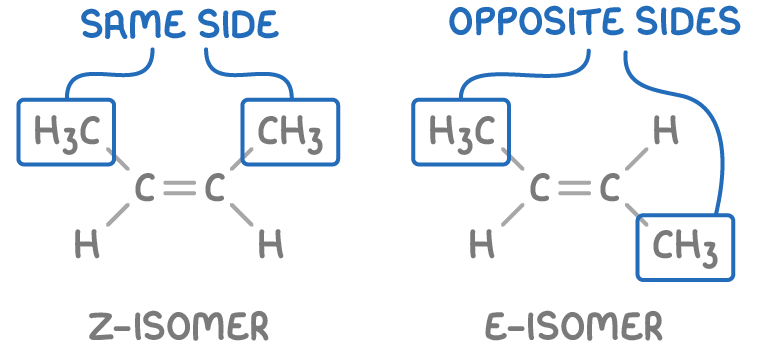
How to assign E-Z configuration:
Priority rank - the group with the highest atomic number receives the highest priority
Label the isomer with the highest priority across the C=C bond as the E-isomer
Chemical reactions of alkenes
Electrophilic addition - The pi bond of the C=C double bond breaks and atoms or groups add across the carbon atoms. The C=C double bond is rich in electrons making it a target for electrophiles.
Addition of hydrogen - Alkenes react with hydrogen gas in the presence of a nickel catalyst at 150 C, forming alkanes. The addition of hydrogen can be used to manufacture margarine.
Addition of halogens - Electrophilic addition reaction to form dihalogenoalkanes.
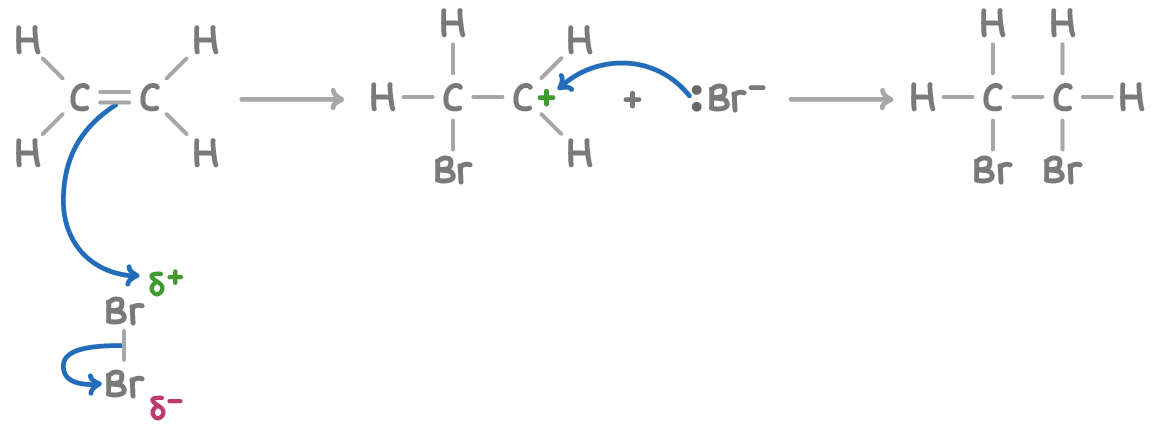
The reaction of bromine with alkenes is a useful test for C=C bonds. Bromine water reacts with bromine via electrophilic addition which removes the orange colour.
Hydration - Used to form alcohols under the influence of phosphoric acid catalyst, alkenes react with steam at 300 C and 60-70 atm
Addition of hydrogen halides - Hydrogen halides add across the C=C double bond in an electrophilic addition. In symmetrical alkenes the double bonded carbons are identical leading to a single product however in unsymmetrical alkenes with two different carbon groups, hydrogen halides can form two positional isomers.
The major product can be predicted by carbocation stability - the major halogenoalkane product forms via the most stable carbocation intermediate
Tertiary carbocations are the most stable, tertiary carbocations have three alkyl groups attached to the central carbon
Oxidation - When alkenes react with cold, dilute acidified potassium manganate they undergo oxidation. The pale purple solution changes to colourless as the permanganate ions are reduced to manganese ions
In this reaction each atom in C=C double bond gains an OH group and forms a diol.
Addition polymers from alkenes
The carbon-carbon double bond found in alkenes can open up allowing alkene molecules to join end-to-end forming long chains called polymers.
How to deal with waste plastics:
Landfill disposal of waste plastics
Reusing waste plastics - recycle them or turned back into monomers
Burning waste plastics - can be used to generate electricity
Biodegradable polymers are designed to decompose naturally, these organisms break down quickly because organisms can digest them. Can be made from renewable raw materials like starch or from oil fractions
Halogenoalkanes
A halogenoalkane is a type of chemical compound where one or more hydrogen atoms in an alkane have replaced by halogen atom.
Halogenoalkanes with substituted halogen atom can be categorised based on groups attached to the carbon with the halogen
Primary - Halogen is attached to a carbon that is attached to one or fewer alkyl groups
Secondary - The halogen is attached to a carbon atom connected to two alkyl groups
Tertiary - The halogen is attached to a carbon atom connected to three alkyl groups.
In halogenoalkanes the carbon-halogen bond is polar because halogen atoms have a higher electronegativity than carbon. This causes an uneven distribution of electrons, making the carbon atom partially positively charged and the halogen atom partially negatively charged.
Hydrolysis of a halogenoalkane is a reaction where the carbon-halogen bond breaks in the presence of water, forming an alcohol and a hydrogen halide.
The reactivity of halogenoalkanes also depends on whether they are primary, secondary or tertiary. The general trend in reactivity is tertiary > secondary > primary. Tertiary form the most stable carbocations and primary for the least stable.
Reactions of halogenoalkanes
Nucleophilic substitution - A nucleophile can react with a polar molecule like a halogenoalkane by “kicking out” the halogen functional group and taking its place. The nucleophile donates its lone pair of electrons to the carbon atom forming a new covalent bond and the original bond between the carbon and the halogen breaks heterolytically
Undergoing nucleophilic substitution with aqueous hydroxide ions will form alcohols
Cyanide - When refluxed with ethanolic potassium cyanide the cyanide ion acts as the nucleophile, displacing the halogen to form a nitrile product
Ammonia - When heated under pressure with excess concentrated ethanolic ammonia, they undergo nucleophilic substitution to form primary amines. Initially, ammonia replaces the halogen then subsequently abstracts a hydrogen from the intermediate amine, yielding the final amine product alongside the salt ammonium bromide.
If a halogenoalkane is heated under reflux with an alkali like potassium hydroxide dissolved in ethanol, an elimination reaction occurs to form an alkene.
Halogenoalkanes treated with hydroxide can undergo either substitution or elimination depending on the choice of solvent. Substitution is favoured in aqueous solution but elimination is favoured in ethanolic solution.
Physical and chemical properties of alcohols
Alcohols contain a hydroxyl functional group bonded to a carbon atom. The general formula for alcohols is CnH2n+1OH.
Alcohols are categorised into three types based on the carbon atom to which the hydroxyl group is attached
Primary - The carbon that the -OH group is attached to is only bonded to one alkyl group
Secondary - The carbon that the -OH group is attached to is only bonded to two alkyl groups
Tertiary - The carbon that the -OH group is attached to is bonded to three alkyl groups
The bond between oxygen and hydrogen in the hydroxyl group is polar. As a result the hydrogen atom gains a partial positive charge while the oxygen atom gains a partial negative charge. These partial charges are able to form hydrogen bonds with water molecules.
Solubility : Alcohols with small carbon chains dissolve in water because the hydroxyl group forms strong hydrogen bonds with water molecules.
Volatility : The ability of alcohol molecules to hydrogen bond with each other leads to lower volatility because hydrogen bonds between molecules require more energy to break during the change of state.
Alcohols combust completely when burned in an excess of oxygen breaking all C-C and C-H bonds. This results in the production of carbon dioxide and water, along with the release of heat energy.
Oxidation of alcohols - Oxidation of alcohols can be performed by using a potassium dichromate solution acidified with dilute sulfuric acid. The solution changes colour from orange to green as the reaction proceeds due to the reduction of dichromate ions to chromium ions.
Primary alcohols are oxidised to aldehydes and then to carboxylic acids
Secondary alcohols are oxidised to ketones
Tertiary alcohols do not oxidise under these conditions
Aldehydes and ketones are characterised by the presence of a carbonyl functional group, but differ in structure. Aldehydes have a hydrogen atom and an alkyl group attached to the carbonyl carbon, Ketone have two alkyl groups attached to the carbonyl carbon. They can be distinguished by using Fehling’s solution or Benedict’s solution:
Both Fehling’s and Benedict’s solutions are alkaline and contain blue aqueous Cu2+ ions
When warmed, aldehydes reduce the blue Cu2+ ions to form a brick red Cu2O precipitate.
Ketones do not react with either solution - the mixture remains blue with no colour change observed.
Alcohols can undergo substitution reactions to form halogenoalkanes using various reagents. Chloroalkanes can be prepared from alcohols by reacting them with phosphorus pentachloride or concentrated HCl.
Reaction with PCl5 - Chloroalkanes, HCl and phosphoryl chloride are produced
Reaction with HCl - Tertiary chloroalkanes can be synthesised from tertiary alcohols
Bromoalkanes can be synthesised from alcohols by reacting them with hydrogen bromide
Iodoalkanes can be prepared from alcohols by reacting them with phosphorus triiodide
Dehydration of alcohols, an elimination reaction facilitated by a concentrated phosphoric acid catalyst results in the formation of alkenes through the elimination of water.
Organic techniques
Reflux- A technique used to heat reactions involving volatile, flammable organic compounds:
Many organic compounds have low boiling points and heating in an open vessel causes evaporation before reactions can take place
Anti-bumping granules are added to prevent violent boiling
The condenser has cold water flowing through it, which condenses evaporated organic vapours back into liquid returning them to the reaction vessel.
Distillation - Used to heat separate mixtures based on differences in boiling point. The components in the mixture evaporate in order of their increasing boiling points
Extraction can be used to remove impurities - when water is added to a mixture of the organic liquid and an organic solvent in a separating funnel. The organic liquid product dissolves in the organic layer while water soluble impurities dissolve in the aqueous layer. The layers are then drained off separately
Drying - Traces of water dissolved in organic product can be removed during drying agents such as anhydrous magnesium sulphate or anhydrous calcium chloride
Filtration - After drying the solid drying agent is removed by filtering the mixture
The boiling point of an organic liquid is a valuable indicator of it purity. Pure substances boil at precise temperatures, while impure substances boil over a range of temperatures.