Disease Prevention
Health promotion and disease prevention programs are programs that focus on helping people become and stay healthy. Health promotion is a means of getting people to pay attention to their own behaviors and what they are doing to their bodies, and it encourages them to make changes in what they do with the goal of reducing the risk of developing chronic diseases. Disease prevention, on the other hand, focuses on strategies for preventing and reducing the risk of developing chronic illnesses and diseases.
Disease Prevention
According to the CDC, chronic diseases and certain medical conditions (such as heart disease, stroke, cancer, type 2 diabetes, obesity, and arthritis) are some of the most common and expensive—yet preventable—of all health problems.
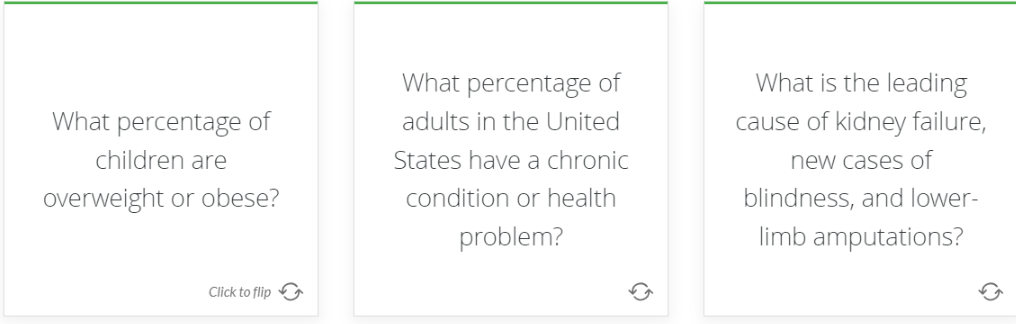
Nearly 50% of all adults in the United States (around 117 million people) have at least one chronic illness or health problem, and approximately 25% have two or more.
Obesity has become one of the most serious problems related to health. Recently, more than 33% of all people in the United States were obese, which means that about seventy-eight million people were obese. Around 20% of all individuals between the ages of two and nineteen were obese. These numbers do not include those people who were overweight without being obese, even though being overweight also significantly increases the chance of getting serious diseases or chronic medical conditions.
Obesity is one of the leading causes of diabetes, and diabetes is the leading cause of kidney failure, new cases of blindness, and lower-limb amputations (not counting amputations that were the result of injury).
Chronic diseases cause approximately 70% of all deaths in the United States, and heart disease and cancer cause almost 48% (when the totals are added together) of all deaths in the United States.
Health-Risk Behaviors and Chronic Diseases
Health-risk behaviors are any unhealthy behaviors over which you have control and which you can change. There are four health-risk behaviors that cause the most suffering, illness, and premature death:
Not getting enough physical activity or exercise (being sedentary)
Not eating right (having poor nutrition)
Using tobacco (including cigarettes, smokeless tobacco, etc.)
Drinking too much alcohol

Articulate Content Library
More than half (approximately 52%) of people in the United States who are eighteen years old or older do not get the recommended amount of physical activity. Additionally, 76% do not get the recommended amount of physical activity for strengthening their muscles.
Primarily because of lifestyle choices, almost half (approximately 47%) of all adults in the United States have at least one major risk factor for suffering a stroke or suffering from heart disease; those risk factors include high blood pressure that is not controlled, high "bad" cholesterol levels that are not controlled, and/or smoking (or using tobacco products). In addition, around 90% of all people in the United States get too much sodium in their diets, and sodium increases the risk of developing hypertension or high blood pressure.
Based on a survey, approximately 38% of all adults and 36% of all adolescents who were surveyed said that they did not eat at least one serving of fruit each day. Additionally, 23% of the adults and 38% of the adolescents surveyed said that they did not eat at least one serving of vegetables each day.

Articulate Content Library
Approximately one in every five adults (or more than forty-two million) said that they smoked cigarettes. This is important because tobacco and cigarette smoking contribute to around 480,000 deaths every year. In the United States, more than 3,200 people who are under age eighteen smoke their first cigarette on any given day, and an additional 2,100 people who had smoked just occasionally begin smoking regularly and every day.

Articulate Content Library
Alcohol consumption is another controllable risk factor that contributes to chronic diseases and death. As a matter of fact, in the United States, drinking too much alcohol contributes to around 88,000 deaths every year, and more than half of those deaths are caused by binge drinking (which is drinking several alcoholic beverages in a short period of time). In the United States, around thirty-eight million adults say that they binge drink, on average, four times a month. Those binge drinkers say that they have an average of eight drinks in a single sitting. Despite these facts, most binge drinkers are not alcoholics or otherwise dependent on alcohol.

Articulate Content Library
There is another group where chronic illnesses and conditions are becoming much more common, and that group is children. Nearly one-third of all children (those under age eighteen) are overweight or obese, and being overweight or obese increases the risk of chronic illnesses and diseases. Among African American and Hispanic children, the numbers of overweight and obese children are even higher.
The best way to improve the quality of life, overall health, and prosperity of people in the United States is to focus more on prevention. Approximately 70% of all deaths in the United States are the result of chronic diseases (such as cancer and heart disease), and nearly half of all adults have at least one chronic illness (many of which are preventable).
When the focus is placed on preventing diseases and illnesses before they occur, people will be happier, healthier, and more productive. Preventing illnesses and diseases also reduces the costs of healthcare, and that is another benefit. Here are a few other ways preventing chronic illnesses and diseases benefits society in general:
When children are healthy, they do better in school, and doing better in school increases the chance of graduating and being a productive member of society.
When adults are healthy, they are more productive at work.
When senior citizens are healthy, they can remain independent for longer.
"So, whether you eat or drink, or whatever you do, do all to the glory of God." —1 Corinthians 10:31 (ESV)