India - Migration
Maybe write some answers to explain 4 mark questions
Development of Megacities
More than two-thirds (69 percent) of India’s 1.21 billion people live in rural areas, according to the 2011 Census of India, but the country is rapidly urbanising.
Flow Line Population Map
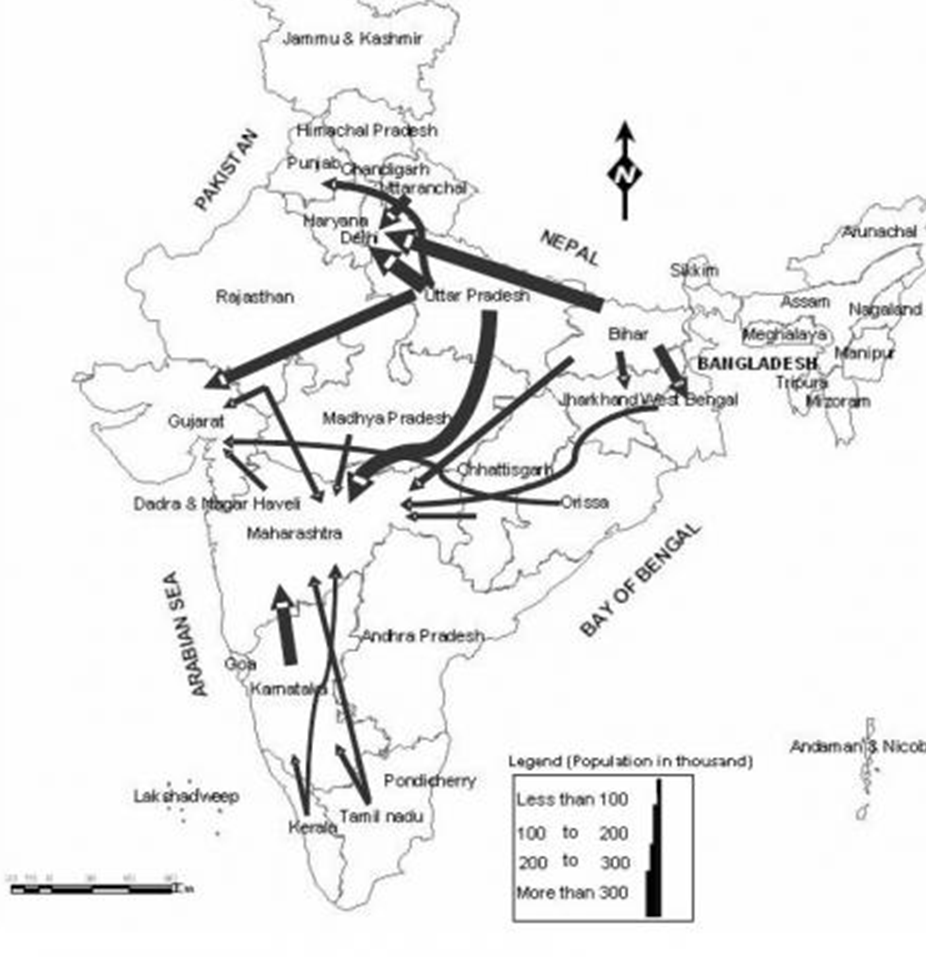
Most lines are pointing to Maharashtra — Mumbai is located to the coast of here (massive pull factor)
The cities of Mumbai, Delhi, and Kolkata are all among the world’s top ten most populous urban areas, and India has 25 of the 100 fastest-growing cities worldwide. A significant source o this growth is rural-to-urban migration, as an increasing number of people do not find sufficient economic opportunities in rural areas and move instead to towns and cities.
Fertility Rate in India

In the past, megacities such as Mumbai also grew due to ‘natural increase’ (the difference between birth and death rates) as many migrants were young and of child bearing age. However, the fertility rate (the amount of children a woman has, on average, in her lifetime) in India has been steadily decreasing, especially in urban areas and since 2010 has been around, or slightly less than 2010. In the city, children are more expensive to have and look after, and are not needed to work the land. In the past, the fertility rate in India was higher, as more people lived in the countryside where children helped support parents in agricultural work, amongst other factors.

Despite India’s impressive rates of economic growth over the past three decades, vast numbers of Indians are unable to secure a meaningful livelihood, particularly in the countryside. While wage and education gaps between rural and urban Indians are declining, rural India is still characterised by difficult farming conditions and a chronic lack of employment. The cities of Mumbai, Dehli, and Kolkata are the largest destinations for internal migrants in India whilst the poorest rural states like Bihar and Uttar Pradesh are the largest sources of migrants.
Whilst natural increase has played a significant role in the population growth of Indian megacities, the most important factor in explaining the growth of Indian cities is rapid urbanisation driven by economic development, which creates opportunities for jobs and services, attracting people from rural areas. Additionally, the influence of transnational corporations and improvements in infrastructure play significant roles in this urban expansion.
Impact of Globalisation
FDI net inflows (% of GDP) - India
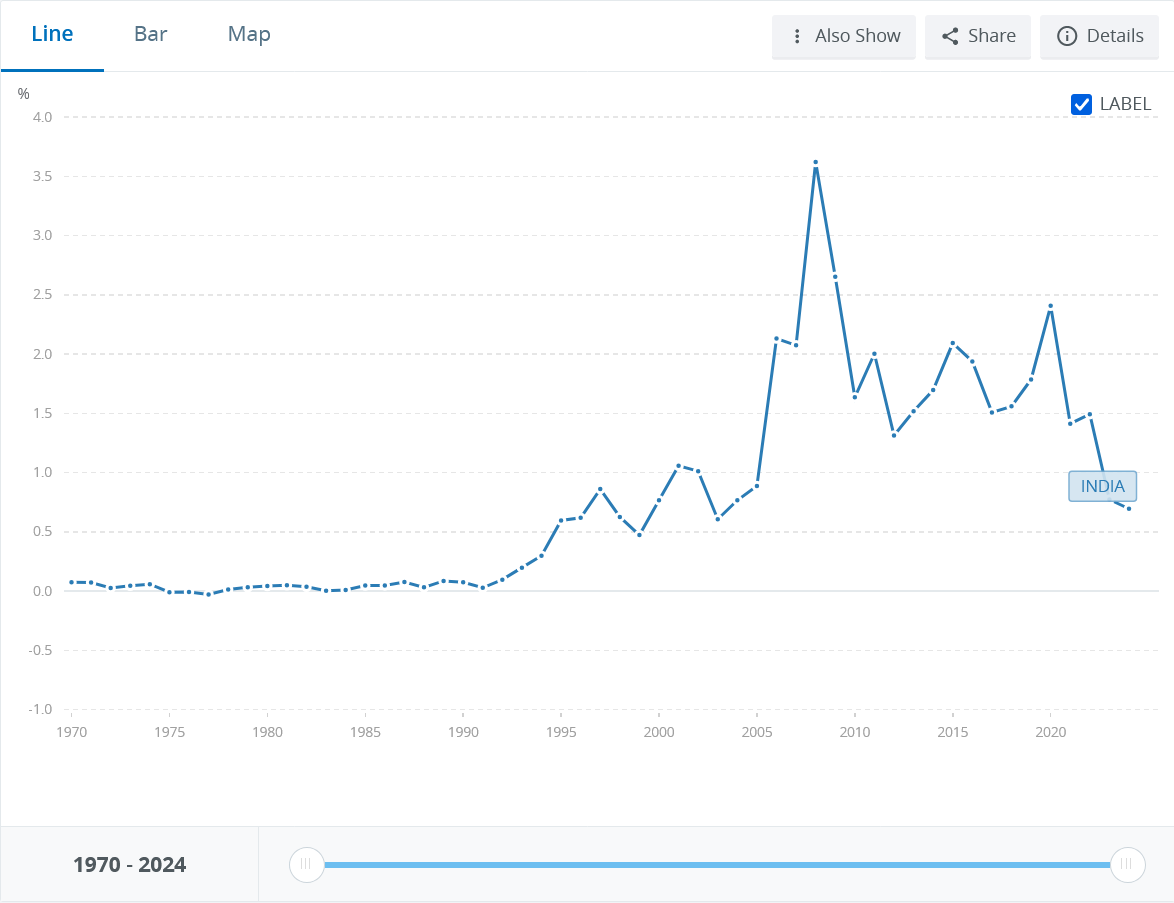
Globalisation has significantly influenced demographic changes in these megacities through:
Foreign Investment: Economic reforms in the 1990s opened markets, attracting foreign direct investment. This has led to job creation and urban migration.
Outsourcing Hub: Cities like Bengaluru have become global outsourcing centres, drawing skilled workers from across the country and abroad.
Attractions of the City
Urban Pull Factors
While agricultural changes push people from rural areas, economic opportunities in cities exert an equally powerful pull. Industrial growth and expanding service sectors create a gravitational force drawing rural migrants toward urban centres.
More Opportunity
People move to the city to find work.

From extensive industry, construction and factories, to the explosive growth in information technology, retail, hospitality, and financial services that has generated millions of jobs concentrated primarily in urban centres, urban India offers a large range of job opportunities. People migrate in hope of getting a higher wage and improving their quality of life.
India’s industrial policy has historically concentrated manufacturing in urban and peri-urban areas. These industrial clusters — from the textile mills of Mumbai to the automotive factories around Chennai — create thousands of jobs that attract rural workers seeking steady employment.
Better Infrastructure
Better infrastructure such as healthcare, education, and transport, pulls people.

Improved connectivity across India has made migrating to the city easier, whilst access to essential services to support a family such as access to specialised hospitals, home to medical professionals largely absent from rural areas, are offered in the city. Urban schools typically offer better facilities, more qualified teachers, and a wider range of subjects and extracurricular activities.
Media exposure, education, and increased awareness of urban lifestyles have fundamentally altered to aspirations of rural Indians, particularly the younger generation. From television to social media, urban lifestyle is advertised as more attractive, offering not only economic opportunity, but social freedom and consumer choices. This has been driven by globalisation’s encouragement of consumerism to maximise profit margins.
Rural Push Factors
The changing face of Indian agriculture has become a powerful driver pushing rural populations toward urban centres. This transition represents not just a geographical shift but a profound economic and societal transformation.
Land Fragmentation
Bihar is India’s least developed state. It is one of the examples of a region that has experienced land fragmentation.

India’s inheritance laws have traditionally divided land equally among male heirs, resulting in increasingly fragmented landholdings across generations. Since liberalising in 1991, smaller farms have struggled to compete with an influx of corporate mega farms like those in America. Today, many farmers work plots too small to be economically viable or to justify investment in modern farming technologies.
This fragmentation creates a cycle of diminishing returns. Small, scattered landholdings are difficult to irrigate efficiently, less likely to attract agricultural extension services, and provide limited collateral for formal loans. The resulting economic pressure forces many small landholders to sell their properties and migrate to cities, where they hope to find more stable income opportunities.
Mechanisation of Agriculture
Vast improvements in mechanical equipment has reduced the need for workers.

Traditional Indian farming once required substantial human labour for everything from ploughing fields to harvesting crops. However, the increasing mechanisation of agriculture has dramatically reduced this demand. Modern equipment like tractors, combined harvesters, and automated irrigation systems now accomplish in hours what once took days with manual labour.
This technological revolution has created a surplus rural workforce — farmers and agricultural labourers who find themselves without sufficient work in their villages. A single tractor can replace dozens of workers, while mechanical harvesters make large teams of seasonal labourers unnecessary. For many rural families, this technological progress has paradoxically led to economic instability, pushing them to seek alternative livelihoods in urban areas.
Fewer Obstacles?
Some of this is included in the pull factors, but the improvement of transport links alongside the introduction of online banking and phone technology has reduced the amount of obstacles in migrating to and integrating into a city.
Dharavi Slum Case Study — Social and Environmental Challenges in Mumbai
Dharavi is the largest slum area in Mumbai. Around 1 million people live in an area roughly 1 square mile. Dharavi has severe problems with public health. Water access derives from public standpipes stationed throughout the slum. Additionally, with the limited lavatories they have, they are extremely filthy and broken down to the point of being unsafe. Mahim Creek is a local river that is widely used by local residents for urination and defecation, causing the spread of contagious diseases. Due to the air pollutants, diseases such as lung cancer, tuberculosis, and asthma are common among residents.
Background
Growing Wealth since 1991

Globalisation has attracted vast amounts of FDI into urban India, as the region opened new markets after reducing regulation in the 1990s, increasing the disparity between the push factors of the rural countryside and the pull factors of the urban city. This drove a significant influx in rural-to-urban migration as people sought better opportunities.
Also with economic liberalisation in 1991 came an increase in wealth inequality; rich people in the country have gotten far richer as they capitalised on foreign investment into a growing private sector. As they accumulated wealth, they occupied better areas, whilst wealth inequality grew significantly, seeing the growing population of urban poor forced into informal settlements.
Housing Pressure

Migration and slums are inextricably linked, as labour demand in cities and the resulting rural-to-urban migration creates greater pressures to accommodate more people. Housing in cities such as Mumbai is amongst the most expensive in the world, and local governments often do not provide low-cost housing for the urban poor, and rapid population growth has led to a shortage of what is available, resulting in overcrowded living conditions. In 2011, 68 million Indians lived in slums, comprising one-quarter of the population of India’s biggest cities.
Dharavi
Dharavi is the largest slum area in Mumbai. It holds 1 million people in an area roughly 1mi2.

Founded in 1884 during the British colonial era, it developed due to the migration of rural Indians to urban Mumbai and has a thriving informal economy, producing goods like leather and pottery, with an estimated annual turnover exceeding $1 billion.
Social Challenges
Lack of Water Infrastructure

Dharavi has severe problems with public health. Water access derives from public standpipes stationed throughout the slum. Additionally, with the limited lavatories they have, they are extremely filthy and broken down to the point of being unsafe.
Mahim Creek is a local river that is widely used by local residents for urination and defecation, causing the spread of contagious diseases. Due to the air pollutants, diseases such as lung cancer, tuberculosis, and asthma are common among residents.
Children play in open sewers, and there is approximately 1 toilet per 1440 people to share, hence many inhabitants turn to the river as a substitute. Dharavi also has poor drainage systems, and the annual monsoons bring seasonal diseases.
Detrimental Health Risks

Overall, the health and hygiene conditions in Dharavi are perilous. As a result, the life expectancy in Dharavi is 7 years lower than the national Indian average, 4000 cases of various types of disease are reported everyday such as diarrhoea, malaria, and tuberculosis, and the hospitals treat 3000 patients a day, many of whom are children.
Beyond sewage, there is also now heavy metals and toxic chemicals present in surrounding water, as there is no network to remove these. This can lead to serious health conditions, as chemicals such as mercury or DDT get into people’s systems.
Environmental Challenges
Water Pollution

A significant portion of households in Dharavi suffers from contaminated water. Open sewers often run alongside water pipes, leading to the risk of sewage contamination. The lack of clean water contributes to waterborne diseases, with high incidences of illnesses like diphtheria and typhoid.
Waste Management Issues

Mumbai generates approximately 7,500 metric tonnes of waste daily. Dharavi, being densely populated, faces severe waste management challenges. There is no comprehensive waste collection system, leading to littering and unsanitary conditions.
This results in sewage and toxic chemicals, such as mercury, getting into rivers and surrounding water networks, harming local ecosystems.
Waste Management Support
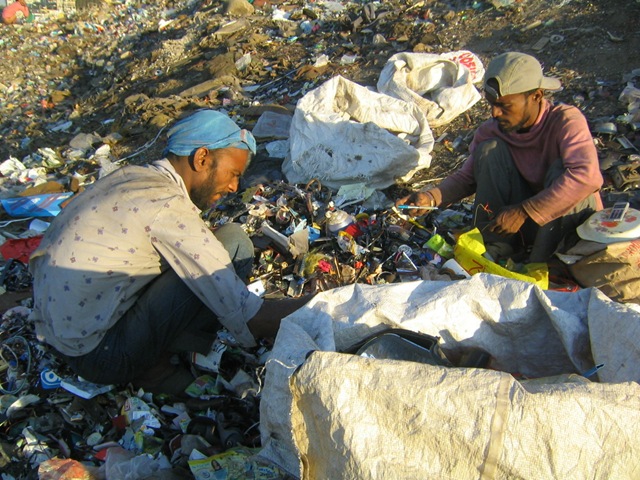
In an attempt to mitigate this problem, Laxmi and several others form the recycling clan of Dharavi, and they are all part of Acorn Foundation (India), Mumbai, a registered charity trust affiliated to ACORN International/Association of Community Organizations for Reform Now.
Hundreds of children, women and men collect dry waste from the streets, beaches and garbage dumps every day. They bring the waste to Dharavi, where it is sorted, segregated and then sold by the kilo to scrap dealers at various godowns. This waste can get them anywhere between 10 rupees per kilo for e-waste, to 12 rupees per kilo for plastic bottles, or 20 rupees per kilo per metals like copper from circuit boards.