Defining Expatriates and Novels
Expatriate
• An expatriate is someone working outside their home country.
o Ex, [Latin] “out”
o Patros, [Greek] “father”
▪ Patriotes, [Greek], “someone devoted to his country”
About Novels
• A novel is a longer piece of narrative fiction that is often published as a book and written in prose.
o Novus, [Latin] “new”
Deconstructing Noli Me Tangere
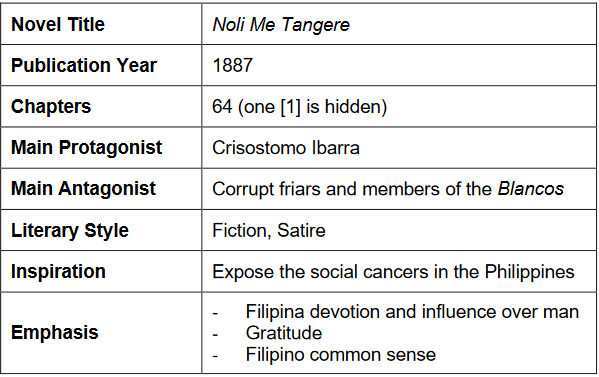
o The title Noli Me Tangere is a Latin phrase which means "Touch me not." This has been the common
translation known by many, but only a few know its origin. The Latin phrase was explained by Rizal as a
response by Jesus after Mary Magdalene had touched him, as mentioned in the Bible (David, n.d.). Literally
translated as "Don't touch me," it can also be translated as "Don't cling to me."
o Noli Me Tangere is originally published in 1887 in Europe. It took all of Rizal's money, time, and effort to
do this. It was supposed to be a collection of stories made by him and his Ilustrado friends that would
provide a window to the slice-of-life tales in the Philippines, as well as the social conditions and injustices
that were happening back then. But, due to their constant partying and gambling, Rizal himself was
offended and took the responsibility himself to write the book (Fernandez, Luna, & Payumo, 2014).
o The novel has 63 known chapters, but some modern-day books used in junior high schools feature a copy
of the novel with an extra hidden chapter explaining the origin of Elias (Rizal, 1887). This is in part of Rizal
writing the chapter but left unmarked because he didn't know where to place it in the established
continuum of Noli Me Tangere.
o A protagonist is a character that plays a pivotal part in the story regardless of their role, but many interpret
it as the "good guys" in the story. There are several protagonists in Noli Me Tangere, but the novel revolves
around Crisostomo Ibarra, an Ilustrado who studied abroad and went back home to live his life in the
GE1804
04 Handout 2 *Property of STI
student.feedback@sti.edu Page 2 of 2
country. As the novel progresses, he was slowly learning of the twisted and horrible tragedies that befell
his loved ones.
o An antagonist is a character that provides conflict to the story. This is usually attributed to the villains of
the story. In Noli Me Tangere, there are various antagonists with varying degrees of villainy. The ones that
stand out, however, are the corrupt friars -- mainly the Dominicans and the Franciscans -- and the
members of the Blancos, which are the top three (3) members of the Spanish casta system.
o A story's literary style, or genre, is the element that drives a story. It can be based on reality or in a
completely made-up world. Noli Me Tangere, as a novel, is considered both as a fiction and satire.
• Fiction is a genre that describes a story that isn't found or based on reality. Fictional stories are
the ones that can be a completely made-up world, scenarios, and people, or it can be based on
real ones with made-up elements mixed in between. Most TV dramas are fictional in nature. Noli
Me Tangere is a fictional novel because it takes some real-life places in the country, but Rizal
added a few fictional places and people to represent the small barrios and slice-of-life activities.
• A satire is a genre that uses exaggeration, humor, irony, or ridicule to expose human stupidity or
vices. This is an excellent genre to use if the story revolves around politics or major issues. Noli Me
Tangere satirizes the Roman Catholic church, the Colonial government, and the Peninsulares.
The Reasons Why Noli was Written
• Disprove accusations made by Spaniards to Filipinos
• Express the true social conditions of the country
• Express the plight of the Filipinos
• Expose the wrongdoings of the friars
The Effects
• Established the Filipino national identity and consciousness
• Indirectly influenced the Philippine Revolution
• Openly expressed the wrongdoings of friars
The Controversies
• Rizal was accused as a German spy
• The novel was “heretical”, “impious”, and “scandalous”
• The Calamba Land Dispute
• The Trials of the Rizal Law