Biopsychology
chapter 3
Biopsychology: the biological mechanisms that underlie behavior.
Genetics
Nervous System Structure + Endocrine system and how they interact
Life-span development
Evolutionary Psychology: focuses on how universal patterns of behavior and cognitive processes have evolved over time.
Behavioral Geneticists: study how individual differences arise, in the present, through the interaction of genes and the environment.
PET scans: creates pictures of the living, active, brain.
CT scans: taking a number of x-rays of a particular section of a person’s body or brain.
tumor or atrophy in the brain
MRI: uses a strong magnetic field to jostle unsettled hydrogen atoms, which then settle on different densities and make a picture.
fMRI (functional Magnetic Resonance Imaging): shows changes in brain activity over time by tracking blood flow and oxygen levels.
Better accuracy + more detail than a PET scan
Electroencephalography (EEG): using caps with nodes, modern EEG research can study the precise timing of overall brain activities.
~
Genetics:
Why do two people with the same disease have different outcomes?
Predispositions to disease (depression, anxiety, heart disease, etc.)
Charles Darwin—the most adaptable species survives
Chromosome: long string of genetic information known as DNA
DNA: all the pairings of the chromosomes; communicate with each other
Allele: specific version of a gene
Gene: sequence of DNA that controls/partially controls physical characteristics known traits
Genotype: genetic makeup (cannot see). Where they communicate.
Phenotype: observable characteristics (hair, eyes, skin).
Mutations: sudden, permanent change in a gene. Can happen at ANY time. 😥
can be good
lactose tolerance is a mutation
OLD THOUGHT:::::: Range of Reaction: our genes set the boundaries within which we can operate, and our environment interacts with the genes to determine where where in that range we fall.
You have support, you succeed. You don’t, you fail.
Genetic Environmental Correlation: if certain individuals are exposed to something in their environment, it influences the expression of our genes.
T.V. show
Epigenetics: study of gene-environment interactions
ex: How the same genotype leads to different phenotypes.
Range of Reaction: our genes set the boundaries within which we can operate, and our environment interacts with the genes to determine where in that range we will fall.
Neuron Structure
TATO’S BOOK
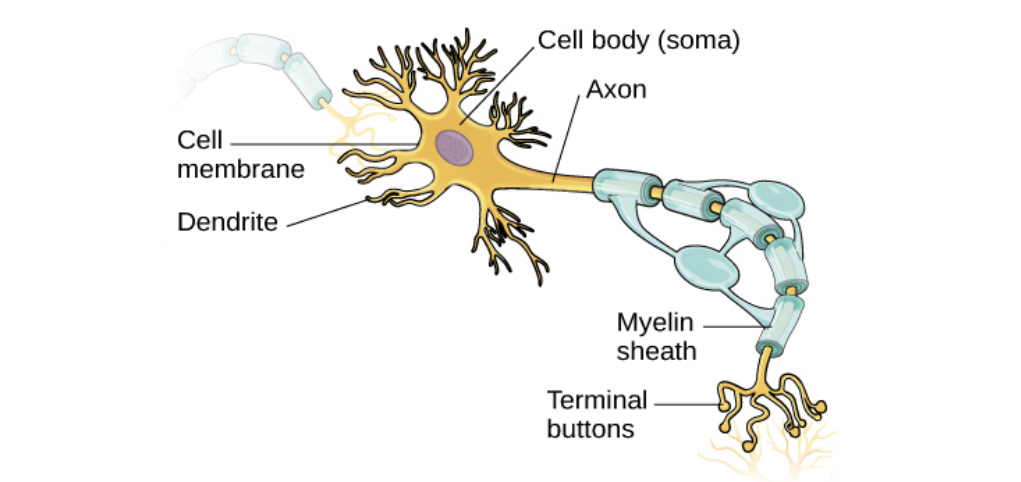
Terminal Buttons contain synaptic vessels.
Synaptic Vessels: storage sites for chemical messengers called neurotransmitters.
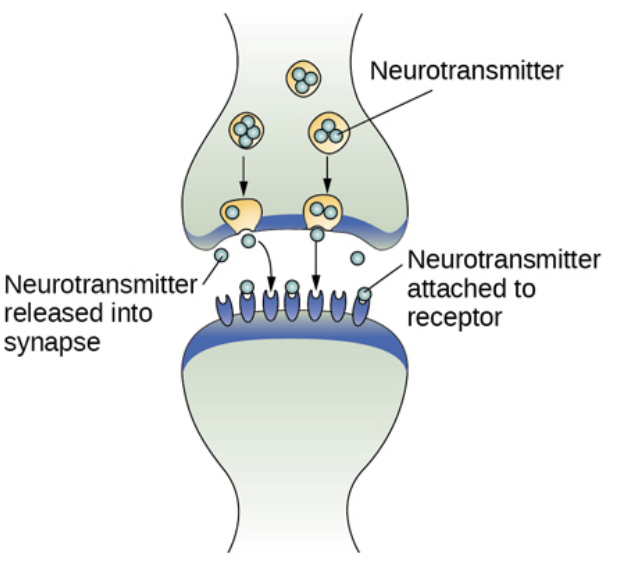
Neurotransmitters: finite, reabsorbable; chemical message of the nervous system
Synapse: the space between the terminal button of one neuron and the dendrite of another neuron.
There can be not enough transmitters produced—bc they are made of proteins
They could be unbalanced
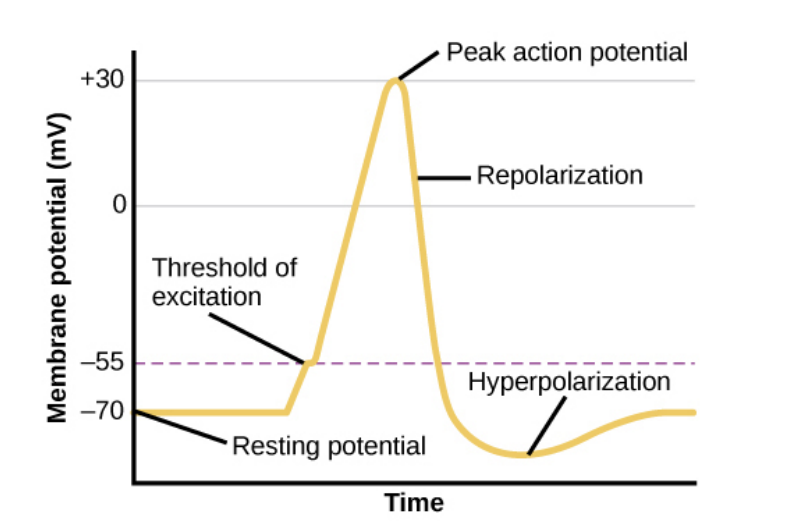
Depolarization: membrane potential becomes less negative making the neuron more likely to fire (excitation).
Hyperpolarization: membrane potential
Threshold of excitation: serotonin kick, beta endorphin; a level to indicate the neurons becoming active.
Action Potential: the electrical signal that typically moves from the cell body down the axon to the axon terminals. (Positive spike). All-or-none phenomenon.
when the action potential arrives at the terminal button, the synaptic vesicles release their neurotransmitters into the synaptic cleft.
Once the signal is delivered, excess neurotransmitters in the synaptic cleft drift away, are broken down into inactive fragments, or are reabsorbed in a process known as reuptake.
Reuptake: when the neurotransmitter gets pumped back into the neuron that released it, in order to clear the synapse.
Neuronal Membrane:
Membrane Potential: the difference in charge between intra- and extracellular fluids (ex: cytoplasm); provides energy for the signal.
i) The electrical signals that passes through the neuron depends and differs depending on if it’s in intra- or extracellular fluids. The neuronal membrane keeps intra- and extracellular fluids separate.
Resting Potential: when the neuron membrane’s potential is held in a state of readiness between signals.
Biological Perspective: studying the physiological causes of behavior that psychological disorders like depression and schizophrenia are associated with imbalances in one or more neurotransmitter systems.
Acetylcholine: muscle action and memory
Beta-endorphin: pain and pleasure
Dopamine: mood, sleep, and learning
Norepinephrine: Heart, intestines, and alertness.
Serotonin: mood and sleep
Gamma-aminobutyric acid (GABA): brain function and sleep
Glutamate: increase in learning, memory
DRUGS
Psychotropic medication: drugs that treat psychiatric symptoms by restoring neurotransmitter balance.
Agonist—drug that mimics or strengthens the effect of a neurotransmitter
Depression
Antagonist—drug that blocks or impedes the normal activity of a given neurotransmitter
Schizophrenia (hyperactivity; too much dopamine)
Nervous System
TATO’S BOOK
Nervous System: glial cells and neurons.
Glial Cells: support, protect, nourish neurons; transport nutrients and waste products, and mediate immune responses.
~
How does a neurotransmitter “know” which receptor to bind to?
The neurotransmitter and the receptor have 3.2 • Cells of the Nervous System 79 what is referred to as a lock-and-key relationship—specific neurotransmitters fit specific receptors similar to how a key fits a lock. The neurotransmitter binds to any receptor that it fits.
~
Endocrine System: series of glands that produce chemical substances known as hormones.
neither part of the CNS or PNS
uses chemical signaling
a) Central Nervous System (CNS)— brain and spinal cord
Brain: billion of interconnected neurons and glia, bilateral, lobes that interact
uses electrical signaling
Neuroplasticity: how the nervous system can change and adapt
Lateralization: concept that each hemisphere of the brain is associated with specialized functions
left side controls the right side of the body, Right side controls the left side of the body
Corpus Callosum: middle between the two hemispheres. connects them. bunch of neurons and communicators
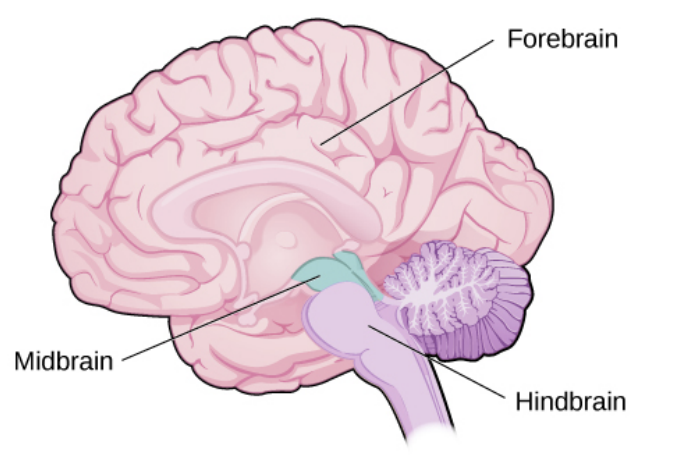
Forebrain, Midbrain, and Hindbrain
Forebrain: largest part of the brain.
Cerebral cortex—higher level process (the surface of the brain/what we see)
Thalamus—sensory relay
Hypothalamus—regulates sexual motivation. Maintains homeostasis via regulation of hormones (it produces the hormones that regulate everything; body temp, hunger, heart rate, mood). Acts as an interface between the nervous and endocrine system.
Pituitary Gland—produces key hormones that regulate fluid levels in the body, and messenger hormones. Of which direct the activity of other glands in the endocrine system. Controls other hormone glands
Limbic System—collection of structures involved in processing emotion and memory
Midbrain: comprised of structures located deep within the brain, between the forebrain and the hindbrain.
Reticular formation: regulates sleep/wake cycle, arousal, alertness, and motor activity.
Substantia nigra + Ventral tegmental area (VTA): have cell bodies that produce neurotransmitter dopamine; critical for movement functions.
degradation of these = Parkinson’s disease
Hindbrain: back of the head; almost extension of spinal cord.
Medulla: controls the automatic processes of the autonomic nervous system: breathing, blood pressure, and heart rate.
Pons: connects the hindbrain to the rest of brain. regulates brain activity during sleep.
Cerebellum: receives messages from muscles, tendons, joints, and structures in our ear to control balance, coordination, movement, and motor skills.
Functional Memory Processing; ADHD issue that i have :P
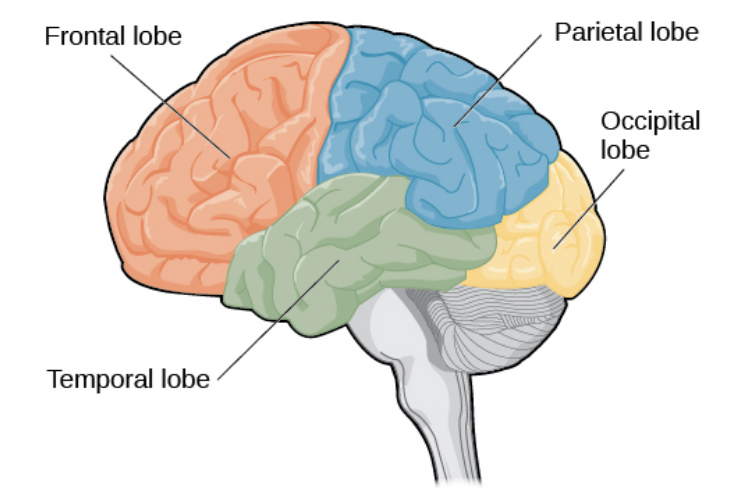
Frontal lobe: responsible for executive function, (planning, organization, judgement, attention, reasoning), motor control, emotion, and language.
motor cortex strip (control motor)
prefrontal cortex: higher level cognitive functions
Broca’s area: language (left hemisphere)
Phineas Gage: a hot iron rod exploded through his face (frontal lobe) at a railroad construction site. He was lying in a pool of his own blood and there was his brain matter on the ground, but he was conscious and able to get up, walk, and speak.
his personality changed (with the damage to his impulse control/frontal lobe damage)
Parietal Lobe: right behind the frontal lobe, and it processes information regarding the body’s senses.
somatosensory cortex
Temporal Lobe: the side of the head (migraine area :P), associated with hearing, memory, emotion, and some aspects of language.
auditory cortex: auditory processing information
Wernicke’s area: speech comprehension
ppl with damage to this can speak, but not understand
Occipital Lobe: back of brain, visual processing/interpretation
Spinal Cord: delivers messages to and from the brain
has its own system of reflexes
merges with the brain stem and ends just below the ribs
Limbic System: involved in processing both emotion and memory. Sense of smell bc smells triggers memory.
b) Peripheral Nervous System — PNS
Somatic: relays sensory and motor information to and from the CNS
Automatic: controls our internal organs and glands and can be divided into Sympathetic and Parasympathetic
Sympathetic: involves stress-related activities; fight or flight
Parasympathetic: routine, day-to-day operations of the body under relaxed conditions
Your body should always be resting and relaxing
peeing at night and not being able to stop