Chemistry 1B: week 1 notes
Class 2
Chapter 8: Reaction Rates and Equilibrium
Learning Objectives
Understand energy and entropy: Use these concepts to predict the spontaneity of processes and reactions.
Calculate reaction rates: Learn how to calculate reaction rates from experimental data.
Explain molecular collisions: Use the concept of molecular collisions to explain reaction characteristics.
Energy diagrams: Represent and interpret the energy relationships for reactions through energy diagrams.
Influencing factors: Explain how factors such as reactant concentrations, temperature, and catalysts influence reaction rates.
Establishing equilibrium: Relate experimental observations to the establishment of equilibrium.
Equilibrium expressions: Write equilibrium expressions based on reaction equations, and perform calculations using these expressions.
Le Châtelier's principle: Use this principle to predict the influence of changes in concentration and temperature on the position of equilibrium for reactions.
8.1 Spontaneous and Nonspontaneous Processes
Spontaneous process: A process that occurs naturally without apparent external influence or stimulus.
Nonspontaneous process: A process that occurs only as a result of some external influence or stimulus.
8.2 Energetic Processes
Exergonic process: A process that releases energy, with the energy appearing on the right side of the reaction equations.
Endergonic process: A process that absorbs energy, with the energy appearing on the left side of the reaction equations.
Entropy (S): A measure of disorder or randomness in a system; higher entropy indicates a more disordered system.
8.3 Influence of Energy and Entropy Changes on Spontaneity
A process is spontaneous if:
Energy decreases and entropy increases, or
A significant entropy increase accompanies a small energy increase.
Examples:
Ice melts spontaneously at 20°C (entropy increases, energy decreases).
Water freezes spontaneously at 0°C (entropy decreases but is compensated with energy decrease).
Stable substance: A substance that does not undergo spontaneous change under the surrounding conditions. An example is ice stability at -10°C, which melts at 20°C.
8.4 Reaction Rates
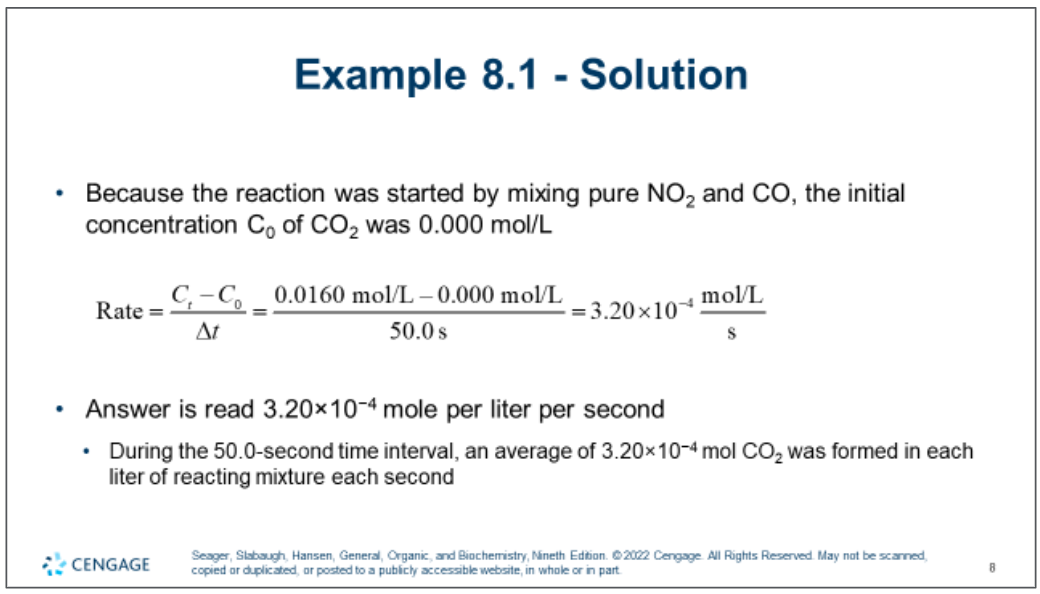
Reaction Rate: The speed of a reaction, defined as: = (C0 -Ct) over t where
represents the change in concentration of a reactant or product,
represents the time interval during which this change occurs.
The change in concentration is calculated by subtracting the initial concentration (C0Ct).
Example: Gases NO 2 and CO react as follows: NO2 (g) + CO(g) →NO(g) + CO2 (g)
• Calculate the average rate of the reaction if pure NO 2 and CO are mixed and after 50.0 seconds the concentration of CO 2 is found to be 0.0160 mol/L
8.6 Molecular Collisions
Reaction Mechanism: The series of steps detailing how reactants transform into products.
Assumptions:
Reactant particles must collide for reactions to happen.
Collisions require a minimum total energy to be effective.
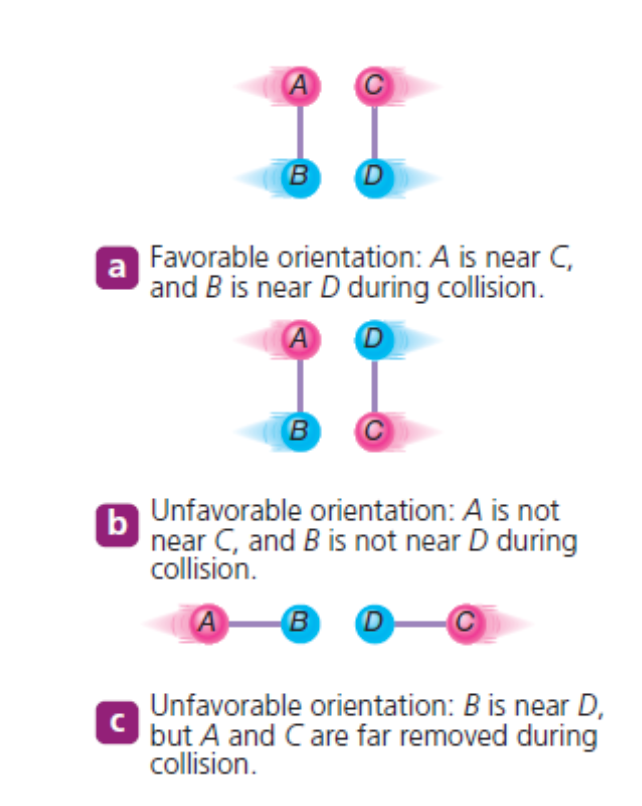
Colliding particles must be appropriately oriented for a reaction to occur.
8.7 Collisions
Molecules generally cannot react without contact.
During collisions, bonds may break, atoms can exchange, and new bonds can form.
Temperature effects: Atoms vibrate and stretch their bonds even at temperatures above absolute zero.
8.8 Internal Energy
Internal energy relates to molecular vibrations and increases through collisions.
Additional heat affects kinetic and internal energies, enhancing molecular interactions.
8.9 Molecular Orientation
In Reactions
First orientation principle: Collisions can happen without specific orientations in certain reactions (e.g., reactions between ions).
Example: Reaction between and CO3^{2-}to form solidCaCO3 shows that orientation does not significantly affect reaction rates.
Second orientation principle: Orientation effects are important in asymmetric molecules where proper alignment during collisions is crucial for reaction facilitation.
8.10 Energy Diagrams
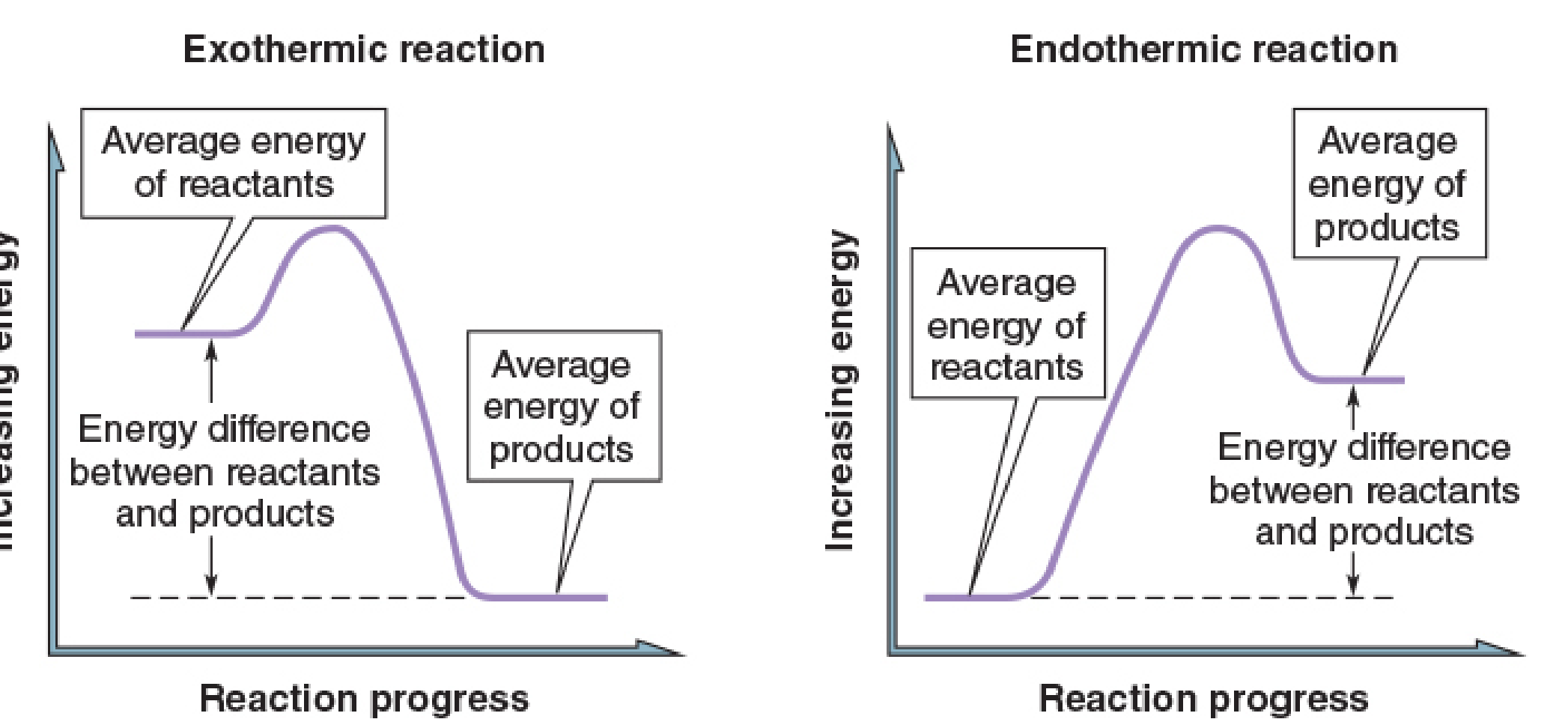
Energy diagrams: Graphically illustrate the energy changes of a reaction versus reaction progress.
Exothermic reactions: Release energy; products have lesser energy than reactants.
Endothermic reactions: Absorb energy; products acquire more energy than reactants.
8.11 Activation Energy
Activation energy (E_a): The initial energy required to initiate a reaction.
Once the activation energy is met, reactions continue without additional energy input.
It also describes the energy needed to break bonds in reactants, initiating the reaction process.
8.12 Factors That Influence Reaction Rates
Key Factors:
Concentration of reactants: Higher concentration increases chances of effective collisions.
Nature of reactants: Differences in reaction speed based on physical states and molecular characteristics - what needs to happend for reaction to acure. Physical states (gases, liquids, or solids), molecular sizes, and bond polarity
Example: Iron rusts slower as only surface atoms react with oxygen; fine iron increases effective surface area, enhancing rusting rate.
Temperature of reactants: Higher temperatures raise molecular speeds and collision frequencies, doubling reaction rates approximately with every 10°C increase.
Presence of catalysts: Substances that accelerate reactions without being consumed; can lower activation energy. (Homogeneous catalyst: Substance that is distributed uniformly throughout the reaction mixture, Heterogeneous catalyst: Substance used in the form of solids with large surface areas on)
which the reactions take place
Effective Collision: Collision that causes a reaction to occur between the colliding molecules
• desired chemical reaction between the reactants
• With the right amount of energy
• With the right orientation
8.13 Chemical Equilibrium
Definition: A state where the forward and reverse reaction rates are equal, resulting in constant concentrations of reactants and products.
Equilibrium concentrations: The unchanging concentrations of reactants and products at equilibrium condition.
8.14 The Position of Equilibrium
The relative amounts of reactants and products indicate the position of equilibrium:
Right position: Higher concentration of products.
Left position: Higher concentration of reactants.
8.15 Mathematical Representation of Equilibrium
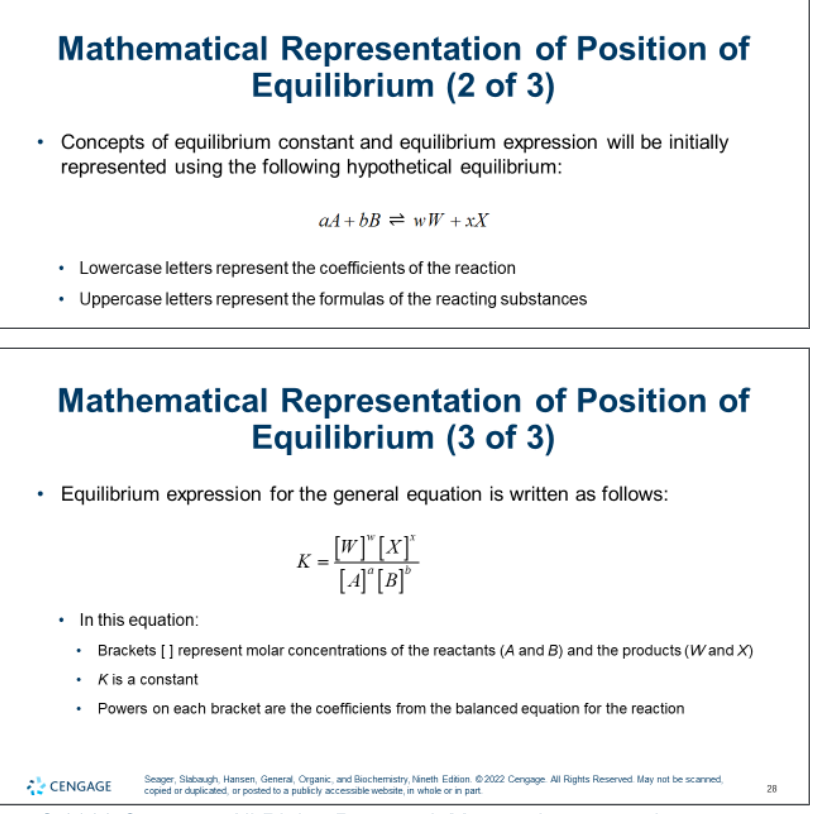
Equilibrium constant (K): A numerical expression correlating reactant and product concentrations at equilibrium. (big - right, strong acid, small - left, weak acid)
for a general reaction.
Equilibrium expression: Relates the equilibrium constant and reactant and
product equilibrium concentrations
8.16 Factors that Influence Equilibrium Position
Le Châtelier's Principle
Position of an equilibrium shifts in response to changes made in factors of the
equilibriumPredicts a shift away from the side to which something is added and toward the side from which something is removed
Change Effects:
If reactants are added, equilibrium moves right (toward products).
If products are added, equilibrium moves left (toward reactants).
Temperature Changes:
In endothermic reactions, heat functions as a reactant; adding heat shifts equilibrium right.
In exothermic reactions, heat acts as a product; adding heat shifts equilibrium left.
Catalysts: Affect the speed of reaching equilibrium but do not shift the position.
8.17 Practical Examples of Le Châtelier's Principle
Equilibrium response can be evaluated during various changes (e.g., temperature or concentration adjustments) in chemical reactions, confirming the principle's practical implications.
Class 3
Chapter 9: Acids, Bases, and Salts
Learning Objectives
Reaction Equations: Write reaction equations that illustrate Brønsted acid-base behavior and identify Brønsted acids and bases from written reaction equations.
Self-Ionization Calculations: Do calculations using the concept of the self-ionization of water.
pH Calculations: Do calculations using the pH concept.
Understanding Acids and Bases: Demonstrate an understanding of the terms weak and strong as applied to acids and bases.
Titration Analysis: Do calculations related to the analysis of acids and bases by titration.
Buffer Mechanism: Explain how buffers work, and write equations to illustrate their action.
The Brønsted Theory
Brønsted Acid: Any hydrogen-containing substance capable of donating a proton (H+) to another substance.
Brønsted Base: Any substance capable of accepting a proton (H+) from another substance.
Example: In the reaction between HNO2 and H2O, HNO2 acts as a Brønsted acid by donating a proton to H2O, which acts as a Brønsted base by accepting the proton.
Conjugate Acids and Bases
Conjugate Base: The species that remains when a Brønsted acid donates a proton.
Example: The base formed NO2⁻ when HNO2 acts as a Brønsted acid.
Conjugate Acid: The acid formed H3O⁺ when H2O acts as a Brønsted base.
Conjugate Acid-Base Pair: A Brønsted acid (HNO2) and its conjugate base (NO2⁻); a Brønsted base (H2O) and its conjugate acid (H3O⁺).
Examples in Brønsted Acids and Bases
An example illustrates identifying Brønsted acids, bases, and conjugate pairs in a given reaction equation.
Self-Ionization of Water
Pure Water Composition: Contains H2O molecules and small but equal amounts of H3O⁺ and OH⁻ ions.
Self-Ionization: The process whereby pure water behaves as both an acid and a base, leading to proton transfer between water molecules.
Result: Formation of H3O⁺ and OH⁻ ions.
Neutral Condition: In pure water, the concentrations of H3O⁺ and OH⁻ are both 1.0×10⁻⁷ M, indicating neutrality.
Equilibrium Expression of Self-Ionization
Equilibrium expression:
This shows the constant for the ion product of water, where can be calculated as: .
Classification of Solutions:
Acidic Solution: When [H3O⁺] > [OH⁻], pH < 7.
Basic Solution: When [OH⁻] > [H3O⁺], pH > 7.
The pH Concept
Definition: The pH is defined as the negative logarithm of the molar concentration of H⁺ (H3O⁺) in a solution, expressed mathematically as:
.
pH Calculation Examples
Example Reactions:
For [H⁺] = 1 × 10⁻⁷ mol/L, pH = 7.
For [H⁺] = 1 × 10⁻¹¹ mol/L, pH ≈ 11.
Determine H⁺ and OH⁻ Molar Concentrations: Using a pH value of 11.0 to find corresponding concentrations.
Strength of Acids and Bases
Classification:
Strong Acids and Bases: Dissociate completely in solution.
Weak Acids and Bases: Partially dissociate in solution.
Table 9.7: Lists various common strong and weak acids with their formulas and dissociation characteristics.
Acid Dissociation Constant (Ka)
Definition: The equilibrium constant for the dissociation of an acid; represented as L.
General Reaction: For a dissociation reaction of an acid HB:
When [H⁺] is expressed as [H3O⁺], the equation simplifies to:
Types of Acids
Monoprotic Acid: Donates one proton (H+) per molecule.
Diprotic Acid: Donates two protons per molecule.
Triprotic Acid: Donates three protons per molecule.
Common Bases
Weak Base Example: Ammonia (NH3).
Strong Bases: Hydroxides of Group 1 and Group 2 metals (e.g., NaOH, KOH, Mg(OH)2, Ca(OH)2).
Titration Analysis
Purpose: To determine the concentration of an unknown acid or base in a solution.
Titration Procedure: Involves adding a solution of known concentration to an unknown solution.
Equivalence Point: The point when the unknown has fully reacted with the known solution, often indicated by a color change due to an indicator.
Titration Calculations
Knowledge of stoichiometry and the molarity equation: is applied.
Buffers
Definition: Solutions that resist changes in pH upon the addition of acids or bases.
Example: A mixture of acetic acid and sodium acetate can serve as a buffer.
Any added acids (H+) react with the anion, while added bases (OH−) react with the weak acid.
Henderson-Hasselbalch Equation
The pH of a buffer can be calculated using:
Where [B⁻] = molar concentration of the salt and [HB] = molar concentration of weak acid.
Example Calculations for Buffers
Example: Calculate the pH of a buffer with 0.10 moles of acetic acid and sodium acetate per liter.
Additional Tables and Figures
Various figures and tables provide visual representation and detailed values for acids, bases, and their dissociation constants, including indicative titrations and buffer behaviors throughout range values of pH.