Genetic Engineering + Cloning
Genetic Engineering
Vectors are things that are used to transfer DNA into a cell. There are two types: plasmids + viruses.
Plasmids: small, circular molecules of DNA that can be transferred between bacteria.
Viruses: insert DNA into the organisms they infect.
How genetic engineering works…
- The DNA you want to insert (e.g. the gene for human insulin) is cut out with a %%restriction enzyme%%. The vector DNA is then cut open using the same restriction enzyme.
- The vector DNA and the DNA you’re inserting are joined together with ligase enzymes to produce recombinant DNA.
- The recombinant DNA is inserted into other cells (e.g. bacteria).
- These cells can now use the gene you inserted to make the protein wanted (e.g. bacteria containing the gene for human insulin).
Transgenic: an organism containing genes transferred from another species.
Benefits to Genetic Engineering
- Faster and more efficient way of getting the same results as selective breeding.
- Improves crop yields/crop quality. This may help reduce hunger globally.
- Introduces herbicide resistance, which leads to fewer herbicides being used, as weeds are quickly and selectively killed.
- Insect and pest resistance can be developed and inserted into the plants. The plant produces toxins, which would discourage insects from eating the crop.
- Sterile insects could be created such as a mosquito. They would breed, which would lead to infertile offspring. This may help with spread of diseases, such as malaria, dengue fever and the Zika virus.
Risks of Genetic Engineering
- Transfer of the selected gene into other species. What benefits one plant may harm another.
- Some people believe it is not ethical to interfere with nature in this way.
- GM crop seeds are often more expensive and so people in developing countries cannot afford them.
- GM crops could be harmful, for example toxins from the crops have been detected in some people’s blood.
- GM crops could cause allergic reactions in people.
- Pollen produced by the plants could be toxic and harm insects that transfer it between plants.
Cloning - producing genetically identical organisms
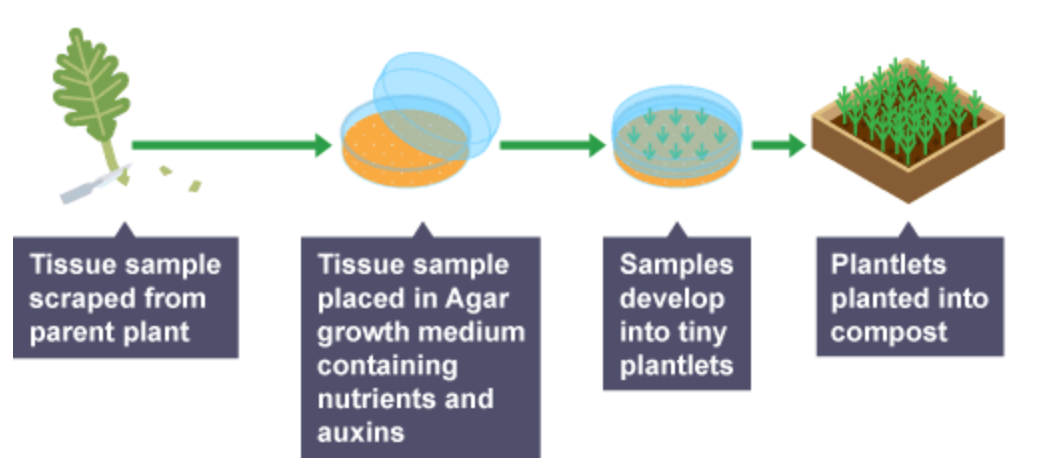
Micropropagation - used to clone plants
- A plant with desirable characteristics is selected to be cloned.
- Explants (small pieces) are taken from the tip of the stems and the side shoots of the plant.
- The explants are sterilised to kill any microorganisms.
- The explants are grown in vitro (in a petri dish containing a nutrient medium with growth hormones in it).
- Cells in the explant divide and grow into a small plant.
- The small plants are taken out of the medium, planted in soil, and are put in greenhouses to develop into genetically identically plants with the desired characteristic.
 Cloning in Mammals - done by transplanting a cell nucleus
- Nucleus of an egg cell is removed from the mammal, creating a enucleated egg cell.
- Nucleus of an ordinary diploid body cell is removed and inserted into the enucleated egg cell.
- The cell is stimulated by an electric shock so it starts dividing by mitosis.
- The dividing cell is implanted into the uterus of another sheep to develop until it is born.
- The result is an animal that is genetically identical to the animal the diploid nucleus came from.