KAND Lecture 2
Chapter 1: Knowledge Graphs
Data and knowledge are often available in tabular form.
Information is not only in the rows and columns but also in the column headers and table names.
Knowledge graphs allow for a more explicit representation of information.
In a knowledge graph, things are represented as nodes, and attributes or relations are represented as edges.
The explicit representation in knowledge graphs allows for a better understanding of the data and hidden knowledge.
Labels in knowledge graphs can represent additional information about the nodes and edges.
Knowledge graphs provide a way to make implicit information explicit and facilitate inferencing.
Chapter 2.1: Introduction
Knowledge graphs allow for the representation of information in a more explicit and structured way.
However, knowledge graphs represented as circles and arrows still require interpretation by machines.
A more formal and machine-readable representation is needed.
Chapter 2.2: Formal Systems and Logics
Formal systems, also known as logics, provide a structured way of describing things.
A logic consists of three elements: syntax, semantics, and calculus.
Syntax defines the rules for constructing valid sentences (legal expression) in the logic.
Semantics defines the meaning of the sentences.
Calculus determines how new information can be derived from the sentences.
Chapter 2.3: Arithmetic Logic
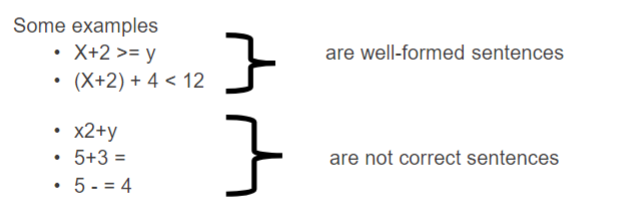
It involves statements such as "x + 2 >= y".
Arithmetic logic has a defined syntax, semantics, and calculus.
Conclusion Chapter 2
Understanding formal systems and logics is essential for designing and working with knowledge graphs.
RDF is an example of a formalism that can be analyzed and improved upon.
The study of formal systems helps in developing a better understanding of their properties and potential improvements.
Chapter 3: One Sentence
Syntax
Syntax determines which statements are well formed
Well formed sentence consists of 2 terms with a comparator between them
Terms can be natural numbers, order variables, or complex terms
Complex terms are operators applied to 2 terms
Valid Sentences
Example: x plus 2 is greater than or equal to y
x plus 2 is a complex term
y is a term (variable)
Fits the description of a well formed sentence
Invalid Sentences
Example: x plus x times 2 plus y
No comparator, does not fit the form of a well formed sentence
Example: 5 plus 3 is nothing
Does not fit the form of a well formed sentence
Example: 5 minus equals 4
Does not fit the form of a well formed sentence
Ambiguity
The syntax described is unambiguous
Example: 7 plus 3 plus 5 equals 2 x minus 3 is not well formed
A new syntax could be developed to allow such expressions
Semantics
Semantics is defined by mapping symbols to an external world
In arithmetic, truth is defined based on assignments for variables
Assignments are functions that assign natural numbers to variables
Sentences can be checked for truth with respect to a specific assignment
Chapter 4: Introduction to Interpretation and Models
Interpretation and assignment as models for sentences and formulas
Definition: An interpretation or assignment is a model for a formula if the interpretation of that formula is true
Example: The assignments x goes to 7 and y goes to 1 is a model for a certain sentence
Chapter 2: Different Types of Sentences
Some sentences can be true in some worlds and not true in other worlds
Example: The sentence x plus 2 is smaller than x plus 3 can be true in some worlds and not true in others
Some sentences are always true or always false
Example: The sentence x plus 2 is smaller than x plus 3 is always true
Example: The sentence 3 is larger than 5 is always false
Chapter 3: Entailments
Entailment is deriving one formula from a set of other formulas
Definition of entailment: A formula f entails another formula g if, for all variable assignments that make f true, g is also true
Example: Deriving the formula x is smaller than 10 from the formula x plus y is smaller than 6
Chapter 4: Models and Entailment
Rephrasing the definition of entailment using the concept of models
Definition: f entails g if g is true in all models of f, where models are all assignments that make f true
Example: Showing that x plus y smaller than 6 entails x is smaller than 10 using models
Chapter 5: Arithmetic as Logic
Arithmetic can be seen as a logic with syntax and semantics
Syntax refers to the structure and rules of formulas
Semantics refers to the meaning and interpretation of formulas
Chapter 6: Interactive Exercise
Using Mentimeter to engage the audience in a question and answer session
Chapter 3: Set Of Things
Logic with Syntax and Semantics
There are 3 assignments given for the function x + 2 < y
The assignments are:
x = 5, y = 7
x = 2, y = 7
x = 7, y = 2
The goal is to determine which assignment is a model for the function
Concepts and Syntax
Concepts are abstractions or generalizations from experience
Concepts can be represented by strings
A set of concept names is defined as C
Axioms are legal sentences in the logic
Axioms are of the form "c1 subclass of c2"
Only subclass statements are allowed in this logic
The logic is called LCH (Logic of Concept Hierarchies)
Knowledge Base and Inference
A set of axioms is called a knowledge base
A simple example knowledge base is given: "Lion subclass of mammals" and "Mammals subclass of animals"
The goal is to derive the inference "Lion subclass of animals"
Semantics and Models
Semantics is defined by mapping sentences to an external model
Set theory is used as the external model for this logic
A universe is defined as a set of arbitrary objects
Assignments map concepts to subsets of the universe
An axiom is true with respect to an assignment if the interpretation of the concept on the left is a subset of the interpretation of the concept on the right
An assignment is a model for an axiom if the axiom is true with respect to the assignment
An axiom is entailed by a knowledge base if it is true in all models of the knowledge base
Example Knowledge Base
A new knowledge base is given with three axioms:
Lions subclass of mammals
Mammals subclass of animals
Lions subclass of animals
Two assignment functions are defined:
Assignment 1: Lions are the first two objects, mammals are the first three objects, and animals are the first four objects
Assignment 2: Lions are objects a and b, mammals are objects a and c, and animals are objects a, b, and c
The question is whether Assignment 1 is a model for the knowledge base
Chapter 4: Possible Interpretation Assignment
Approach to determining if an assignment is a model for a knowledge base
Intuitive way
More structured way
Definition of an assignment being a model for a knowledge base
An assignment is a model for a knowledge base if it is a model for all its axioms
Definition of an assignment being a model for an axiom
An axiom is true with respect to an assignment if the interpretation of the left side is a subset of the interpretation of the right side
Testing if the first assignment is a model for the knowledge base
Checking if the assignment is a model for each axiom in the knowledge base
Checking the first axiom: "lions are a subclass of animals"
Checking if the interpretation of "lions" (12) is a subset of the interpretation of "mammals" (123)
Result: 1212 is a subset of 123, so the first axiom is true with respect to the assignment
Checking the second axiom: "mammals are a subclass of animals"
Checking if the interpretation of "mammals" (123) is a subset of the interpretation of "animals" (1234)
Result: 123 is a subset of 1234, so the second axiom is true with respect to the assignment
Checking the third axiom: "lions are a subclass of animals"
Checking if the interpretation of "lions" (12) is a subset of the interpretation of "animals" (1234)
Result: 12 is a subset of 1234, so the third axiom is true with respect to the assignment
Conclusion: The first assignment is a model for the knowledge base
Testing if the second assignment is a model for the knowledge base
Checking if the assignment is a model for each axiom in the knowledge base
Checking the first axiom: "lions are a subclass of mammals"
Checking if the interpretation of "lions" (AB) is a subset of the interpretation of "mammals" (AC)
Result: AB is not a subset of AC, so the first axiom is not true with respect to the assignment
Conclusion: The second assignment is not a model for the knowledge base
Importance of finding a model that holds regardless of the specific objects used
Example of a knowledge base with two axioms and an assignment
Axioms: "a is a subclass of b" and "b is a subclass of c"
Assignment: Universe consists of a, b, c, small a, small b, small c
Interpretation of large a is small a
Interpretation of b is empty set
Interpretation of c is small c
Question: Is this assignment a model for the knowledge base?
Determining if the assignment is a model for the knowledge base
Checking if the interpretation of "b" is empty
Result: The interpretation of "b" is empty, so the assignment is not a model for the knowledge base
Conclusion: The assignment is not a model for the knowledge base
Chapter 5: Model Checking
The goal is to check if a given interpretation is a model for a knowledge base
Two models need to be checked: the first one and the second one
For the first model, we need to check if the interpretation of Large a is a subset of the interpretation of Large b
The interpretation of Large a is a
The interpretation of Large b is empty
Is a a subset of b? No
The second model is true because the empty set is a subset of sets that contain c
The interpretation is not the middle model of the first axiom, so it's not a model for the entire knowledge space
Chapter 5.1: Axioms, Assignments, Models, and Entailments
There is no correct axiom
The goal is not to determine which axioms are correct given the interpretation
There can be an infinite number of axioms that are true in the assignment
Chapter 5.2: Propositional Logic
Propositional logic is a formal system for declarative sentences that can be true or false
It allows reasoning about various scenarios
Propositions can be abstracted to a set of declarative statements
The form of the argument matters more than the specific content
Proposition logic can be used to reason about different scenarios with the same structure
Chapter 6: Right Hand Side
The validity of arguments is determined by their logical form, not their content
Propositional logic is a formal language that allows for reasoning
Propositional logic has syntax and semantics
Syntax includes propositional variables and connectives (and, or, either or, not, implies, if and only if)
Valid sentences in propositional logic can be defined using an inductive definition
Legal sentences include declarative sentences (p, q, r) and formulas built from proposition variables
Formulas can be negated (not p) and negated multiple times (not not p)
Formulas can be combined using conjunction (phi and psi) and disjunction (phi or psi)
Different syntaxes or serializations can be used to write down legal sentences
Prefix notation and infix notation are two common ways to write down legal sentences
Prefix notation is easier for machines to parse, while infix notation is easier for humans to read
There is a clear translation between the two notations
The lecture will continue after a break
Chapter 1: Introduction
Semantics in propositional logic
Determining truth using truth tables
Similarity to mappings in arithmetic
Chapter 2: Truth Tables
Truth tables used to determine semantics
Truth values of formulas in propositional logic
Two values: 1 or 0, true or false
Determining truth value of composite formulas by analyzing components
Chapter 3: Truth Table for "Not"
Truth table for "not" operator
Two cases: true or false
"Not phi" is false if phi is true, true if phi is false
Chapter 4: Truth Table for "Conjunction"
Truth table for "conjunction" operator
Four cases: phi and psi can be true or false
"Phi and psi" is true only if both phi and psi are true
Chapter 5: Finite Number of Worlds
Finite number of worlds in propositional logic
Only true and false values
Enumerating all possible assignments
Chapter 6: Evaluation and Assignments
Assignments in truth tables
Calculating truth values for complex formulas
Formula with n variables has 2^n lines in truth table
Calculating truth values for each complex formula in a valuation
Chapter 6: Thing On Right
Two formulas are semantically equivalent if they have identical notions in the truth table.
Example: p implies q and not p or q are semantically equivalent.
In every possible world, they have the same truth value.
A tautology is a formula that is always true regardless of the values of p and q.
Example: p or not q is a tautology.
A contradiction is a formula that can never be true.
Example: p and not p is a contradiction.
Checking semantic entailment involves finding the lines in the truth table where the premises are true and checking if psi is also true in those lines.
Chapter 7: Counterexamples and Invalid Reasoning
If even one valuation makes all premises true and the consequence false, the conclusion is not valid
Counterexamples invalidate the conclusion
Chapter 8: The Right Side
Triples and Knowledge Graphs
Triples are the core concept of building knowledge graphs
Triples consist of a thing, a relation, and another thing
Triples can also be called triplets or triples, but the preferred term is triples
Triples provide a machine-readable way of representing relationships between things
Triples have a formal syntax used in the web of data
Simple Grounded Graphs
Simple knowledge graphs are the first step towards RDF
Vocabulary (v) consists of things we want to talk about
Predicates are relations between elements in the vocabulary
Triples connect two items from the vocabulary with predicates
Two ways to define triples: product of p times p or inductive definition
Valid sentences in a knowledge graph follow the defined axioms
Semantics of Knowledge Graphs
Semantics of knowledge graphs are defined by grounding the assignments to graph objects
Semantics are defined with respect to a graph of true things in the world
Assign values to triples based on their intended meaning
Interpretation assigns elements of the domain to words in the vocabulary
Interpretation Function
Interpretation function assigns an element of the domain to each word in the vocabulary
Similar to assigning lions and mammals in previous examples
Main Ideas:
Introduction to Axioms and Interpretations
Axioms are triples that represent relations between concepts in a knowledge base.
Interpretations map concepts to elements in the domain.
A function p checks if a relation exists between two concepts.
A model is an interpretation that satisfies the relation between concepts.
Models and Knowledge Bases
An interpretation is a model of a knowledge base if it satisfies all the triples.
A triple is entailed by a knowledge base if it is true in all models.
Example Knowledge Base and Interpretations
A knowledge base with two triples: Netherlands isNamed Netherlands, and Netherlands hasCapital Amsterdam.
Interpretations map concepts to elements in the domain.
Different interpretations can have different sets of interpretations for the relation p.
Determining Models of a Knowledge Base
To determine if an interpretation is a model of a knowledge base, check if it satisfies all the axioms.
Check if the relation holds between the concepts in each axiom.
Chapter 9: Simple Knowledge Graphs
Simple knowledge graphs entail a set of triples
The subgraph of the knowledge graph determines what can be done
Can calculate true things and easily extend the knowledge graph