ESCI 111 Week 1 -2
Cliff Atkins
Dene carroll
Lecture 1
Earth system comonents
Solid earth - rocks under our feet
Atmosphere
Biosphere - everything living
All interconnected
What is earth science?
Study of the earth - geology
Earth structure, composition and processes srt into a historical context
Understand what happens in the past so we can understand the future
Need to think about “deep time” - millions and hundreds of millions of years
100,000 years between warm and cold climates in warm climate
Geography
Underlying processes and linkages in earths systems
Flows of energy amd matter
Human-environment interactions
(our impact on the earth landscape)
Natural environment presents both opportunities and threats for cultural development
The only reason of a harbour in wellington is because of the fault lines - hazard and opportunities
Geography and geology (geoscience) are interchangeable - need to understand both to study earth systems
Minerals in a smartphone - everything comes from the ground, we need this stuff for modern technology
Need to know how to find and extract in a sustainable way
MODULES
- Earth through time
Earth systems, deep time, rocks fossils, evolution of life
- Earth structure and hazards
Earth structure, plate tectonics, earthquakes, volcanos, tsunamis
- Climate and environment
Lecture 2
The earth system - the planets life support system
A complex set of feedbacks - mechanism that amplify or dampen an affect
A stable equilibrium
The earth system ensures the climate issuitable for a contum of life
The system has changed the planet so it is easier to live on earth
System - different correlated parts that function as a whole
Reservour - part of the system, aslo called sphere
Flux - flow of energy or materials between reservoirs
Equilibrium - system unchanging in time more or lsee
Perturbation - temporary desterbiance to the system
Forcing - long term, influence on the system bringing about a disturbance
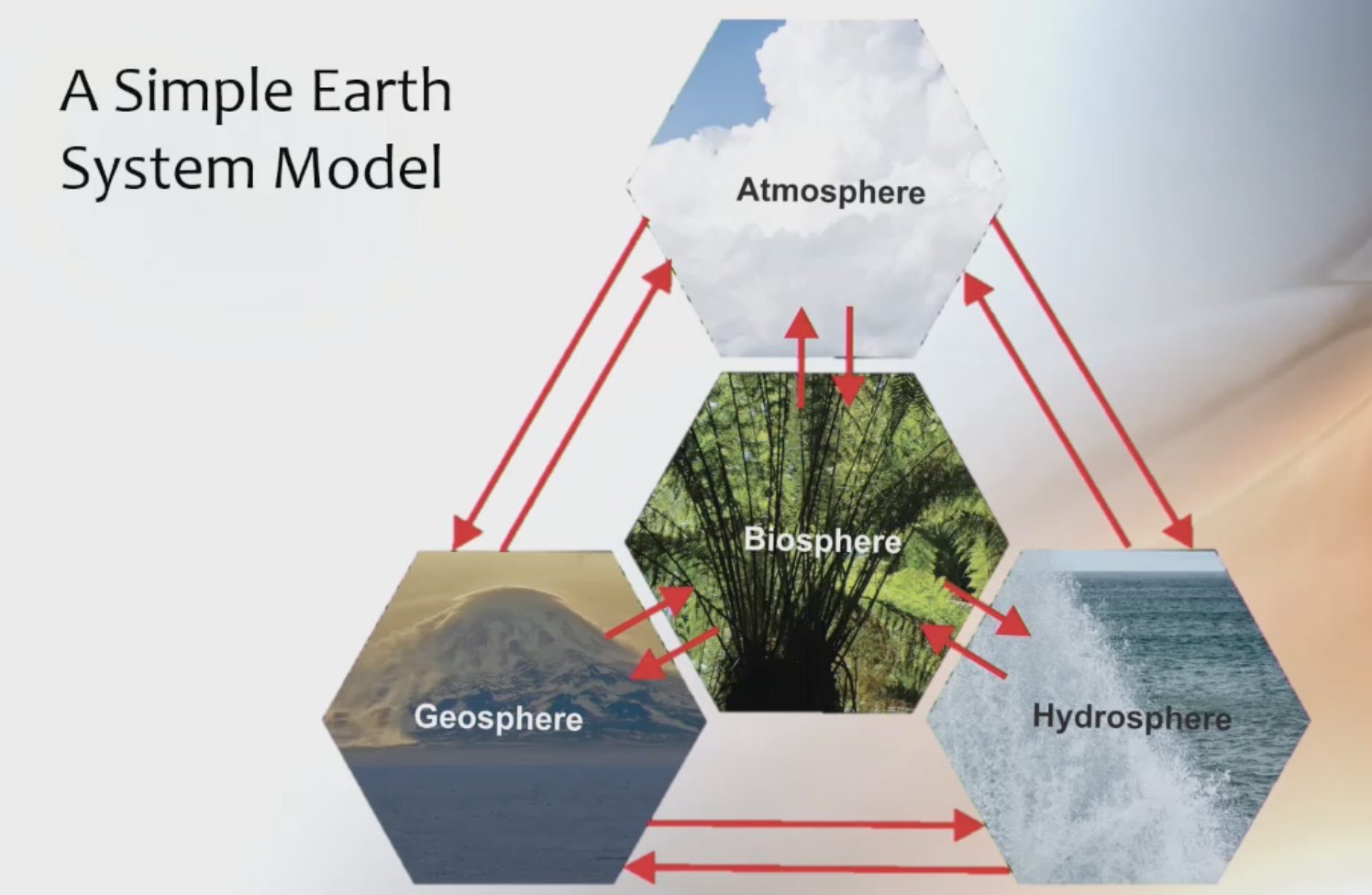
Red linse repressed fluxes between resivours
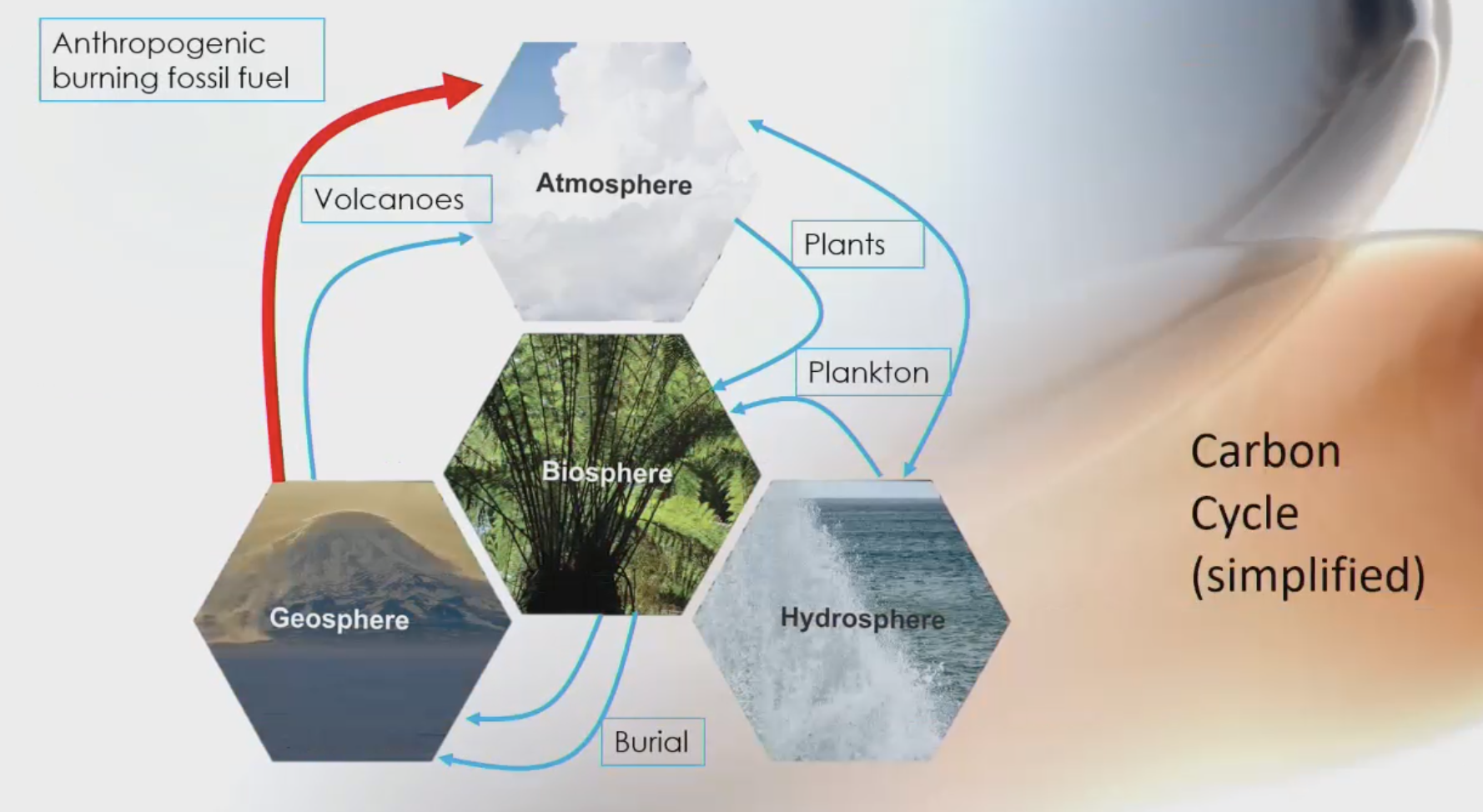
Flux of materials
Carbon cycle
The earth system - james lovelock in the 70s did work for NASA released that earthis unique he came the hypothist that presented the earth as a single super living organism
See that planet as a homeostatic self organizing amd self regulating but thought of as a machine - not as a living thing
The earth system works to maintain the planets climate in a stable equilibrium tat will contine living life
Unstable situation are always wanting to change
Perturbation is enough to shift the system but not permanently
Forcing is when you push enough to have a new stable situation
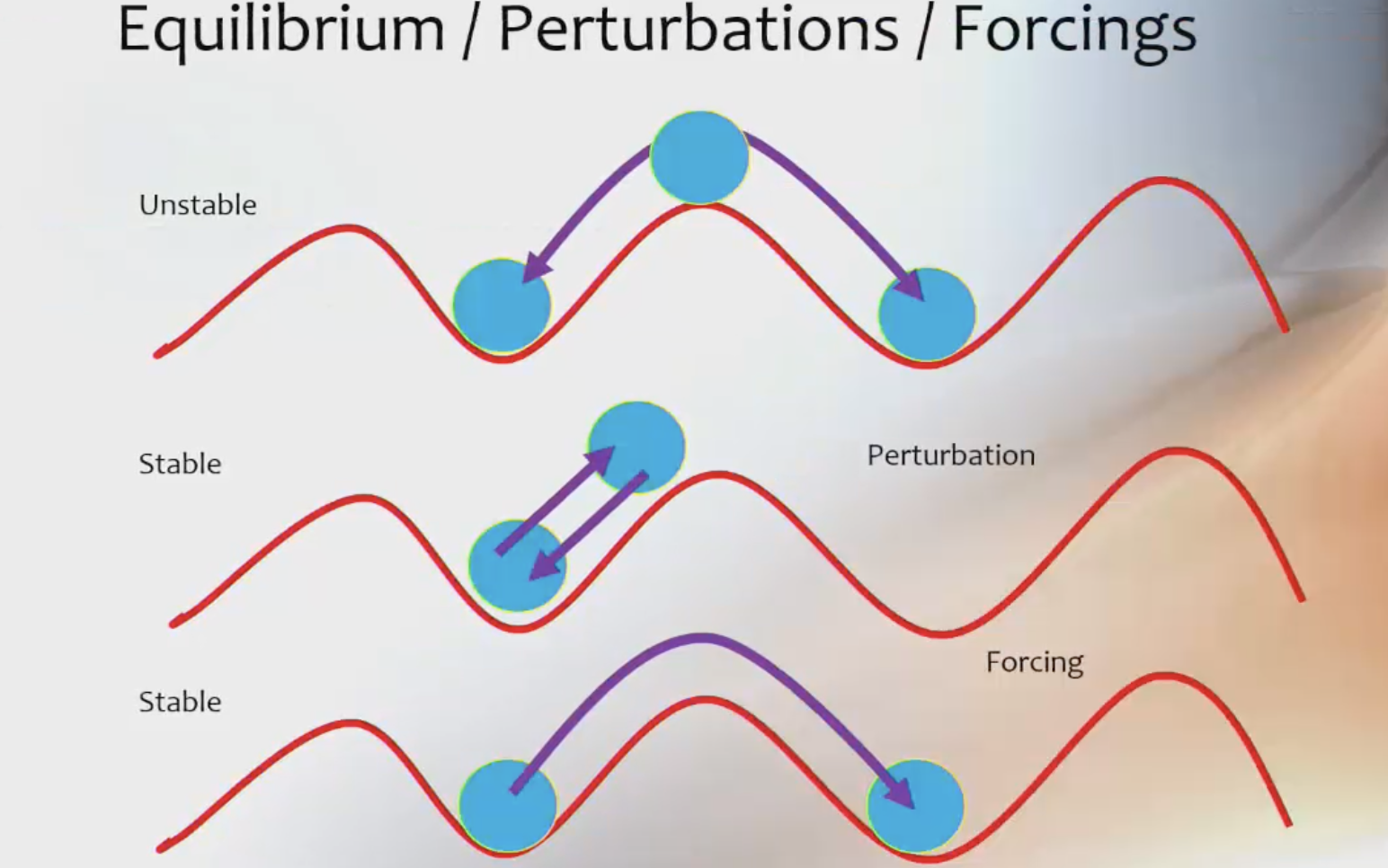
The planet has bounced around in an imperfect equilibrium
It is only varied within strict limits - dynamic and constrained
If we apple a big enough force it may fall out og equilibrium
What drives homeostatic processes
Feedbacks help to maintain stable conditions
Nitrogen cycle
Sulphar cycle
Life is central to earths system
Flux of different elements constantly
Important for operation of the climate
Pretty much everything in our world is needed for maintaining life - with life the average global temperature is 15 degrees c
Life is critical for maintaining a system that can sustain life
The earth moves through deep stable states
Oldest object found on earth is a zircon crystal that is 4.3 Ga
31 days to cound to 1,000,000
We move more dirt now than all of geographical rivers ever.
Lecture 3
Deep time
Supercontinent assembly sand break-up - slow time
Messinian salinity crisis - 5.7Ma
Came across a lot of salt - whole floor of the mediterranean covered of salt
Straights that separate spain amd africa - the whole sea evaporated, has happened many times
Straights of jamolta have re-flooded
End-cretaceous impact - extremely fast (instantaneously)
Ideas of rated of processes
What happened a long time ago can help plan for the future
Civilization exists by geological consent - we needto be aware of what geological process do so we can plan for the future
Europe should be cold but the gulf stream keeps the temperatures high
The origin of our planet
The big bang 14 billion years ago (14Ga)
You can still see the echos of the big bang (microradiation) in space
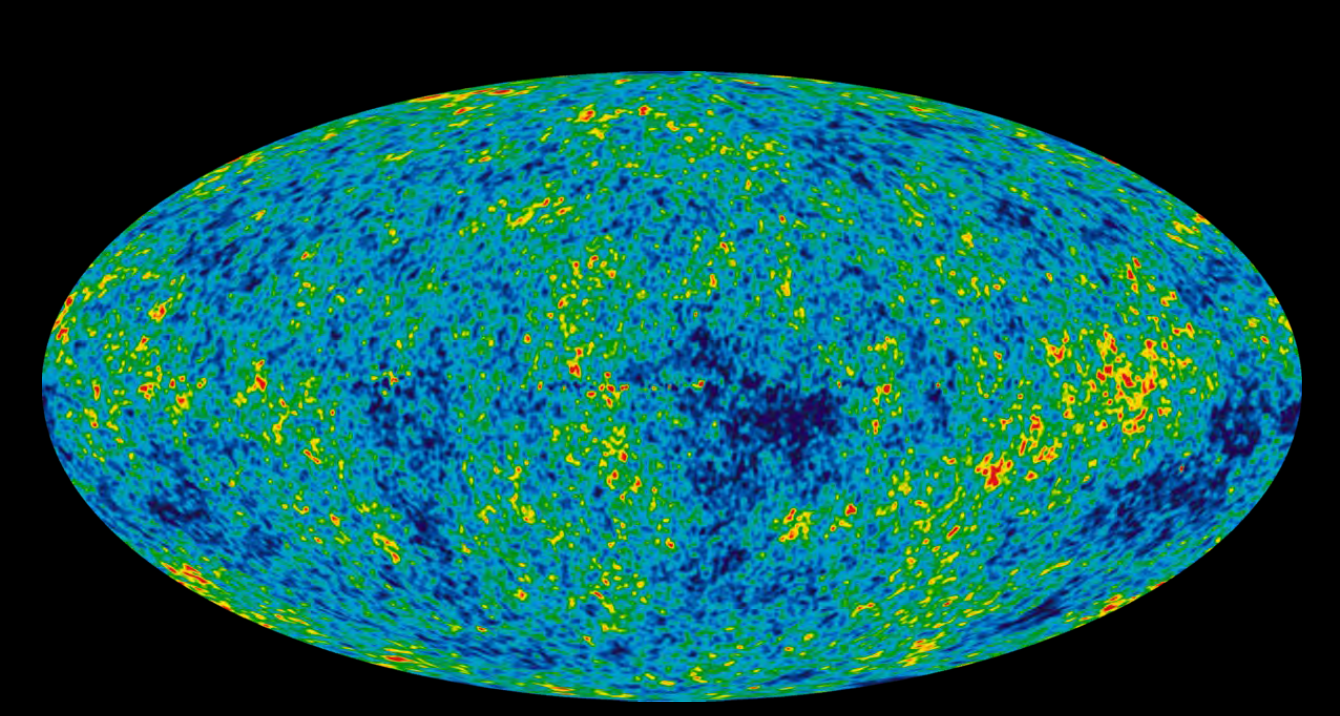
After the big bang you got a massive scale of inflation - universe expanded within seconds
Got two elements - hydrogen and helium
Gravity caused clumping
Some areas became extremely dense - got early stars
Super-nova release of elements
Gravity caused clumping
Spinning clouds of dust because of gravity - nebula
Planetesimal formation - what started to form the planets
Accretion of planetsimals to form planets
earth/mars size body impact
Formation of moon via synthesia
Earth was innitaly homologus - elements were distributed evenly
Iron stared to sink - lighter elements started to rise
Volatile elements formed the atmosphere
Popilating our planet
Palentology and fossil records
Initially the planet was inhabilal
Simple single celled life evolved relatively early on
A fossil is any trace of a organism that is preserved in rocks
- Body parts
- Tracks and trails - reminisce of interactions of living things with the earth
- Chemical signature - chemical fossils are often used now, organic molecules take a very long time to break down
- Excreta
Fossil in latin means “dug up”
Western science is only 2-4 hundred years old. Ancient greeks have recognised fossils for a long time but got lost through the dark ages
Nicolas Steno - first recogised in western science for understanding fossils - recognised they were remains of life
Most lings of living life are not fossilised
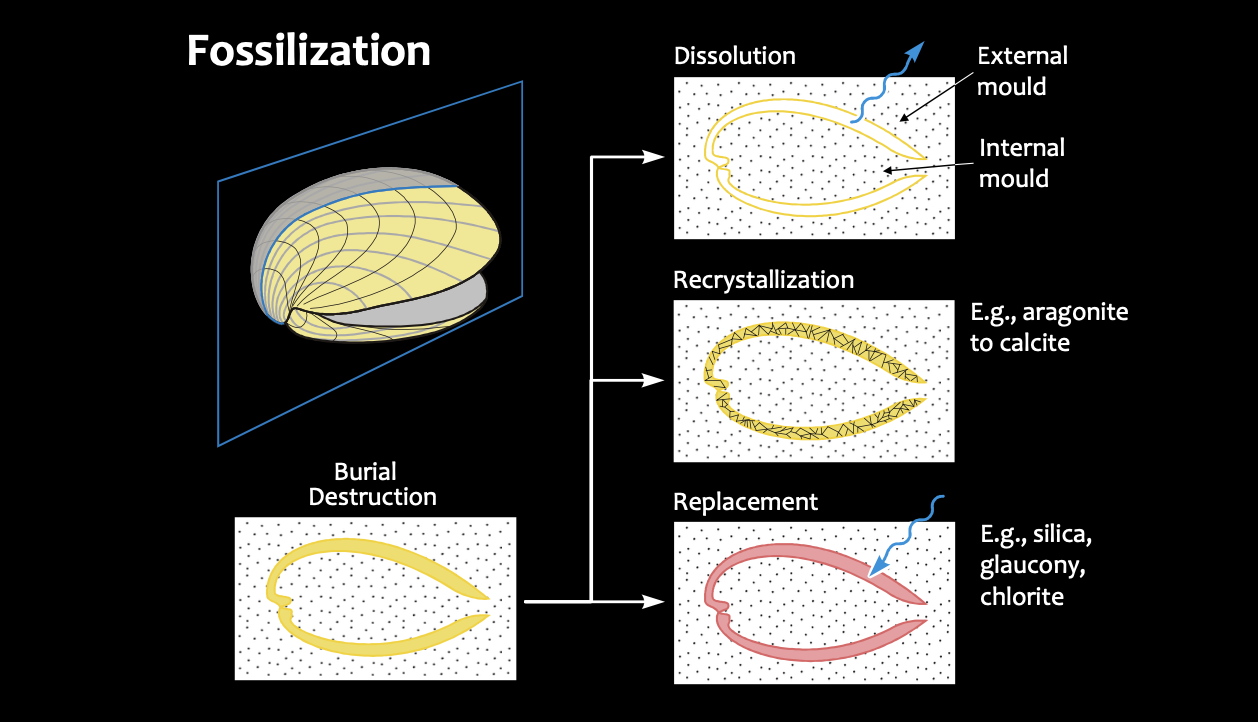
Other ways of being preserved
- Imcects amd lizards in amber
- Mamoths preserved in ice
- Carbon or mineral films
- Encased in tar
Fossils provide a lot of importan information eg. rock dating
Fossil record is the history of life as perserved in fossils
Reasons for hiles in the fossil records
- Fossil record is biased, in a predictable way
Not all organisms can be preserved
- Fossils are mainly preserved in the marine environment
Not all orhnasims are capable of being perswerved
- Most fossils afre hard parts eg. shell, bones
Low number of individuals / restricted geographic range reduces the likelihood of preservation
- Most fossils are common abundans species eg. sheep, rats
“The increasing ecosystem stability of the planet and its ability to support complex life and are largely a consequence of biological consequence of biological peosccesses that started in the cambrian” (Payne et al. 2020)
550 million years ago organisms were able to burrow - helped evolution become easier
Lecture 4
Studen rep
What are rocks?
- Solid earth component of the earth system
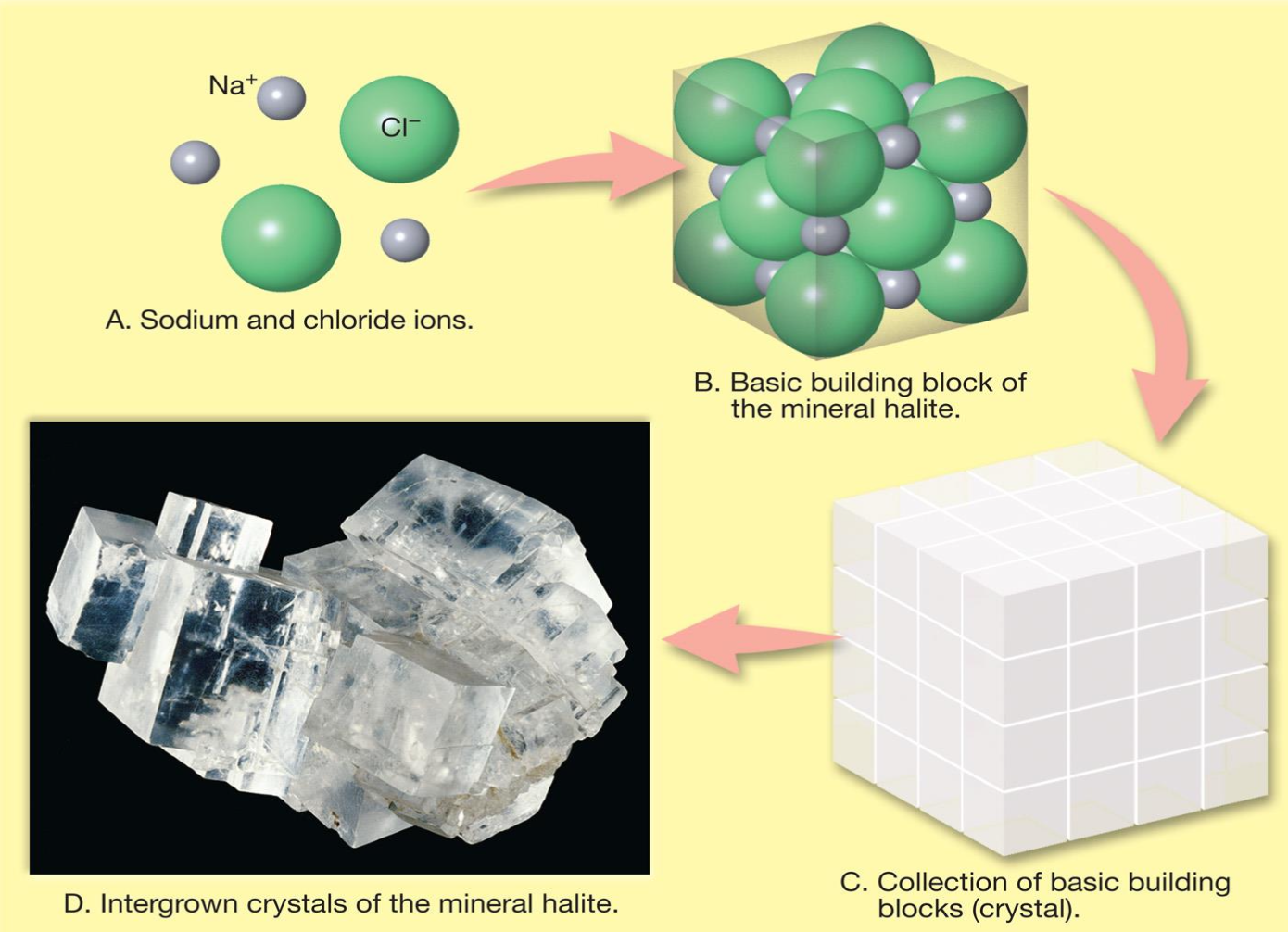
- Assemblages of elements forming minerals with specific crystal structures
- Aggregates of one or more minerals forms a rock fragment
- Sodium and chloride ions
- Basic building block of the mineral halite
- Collection of the basic building blocks (crystal)
- Intergrown crystals of the mineral halite eg. rock salt
Rock forming minerals
- Over 4000 minerals named…. Lots more to be found
- Only 8 elements make up 98% of the earths crust
- 74.3% of crust made up of silicon and oxygen
- Silicon and oxygen combine with other elements to form silicates making up 95% of earths crust
- The remaining are non silicates eg. oxides, sulfides, sulfates, carbonates
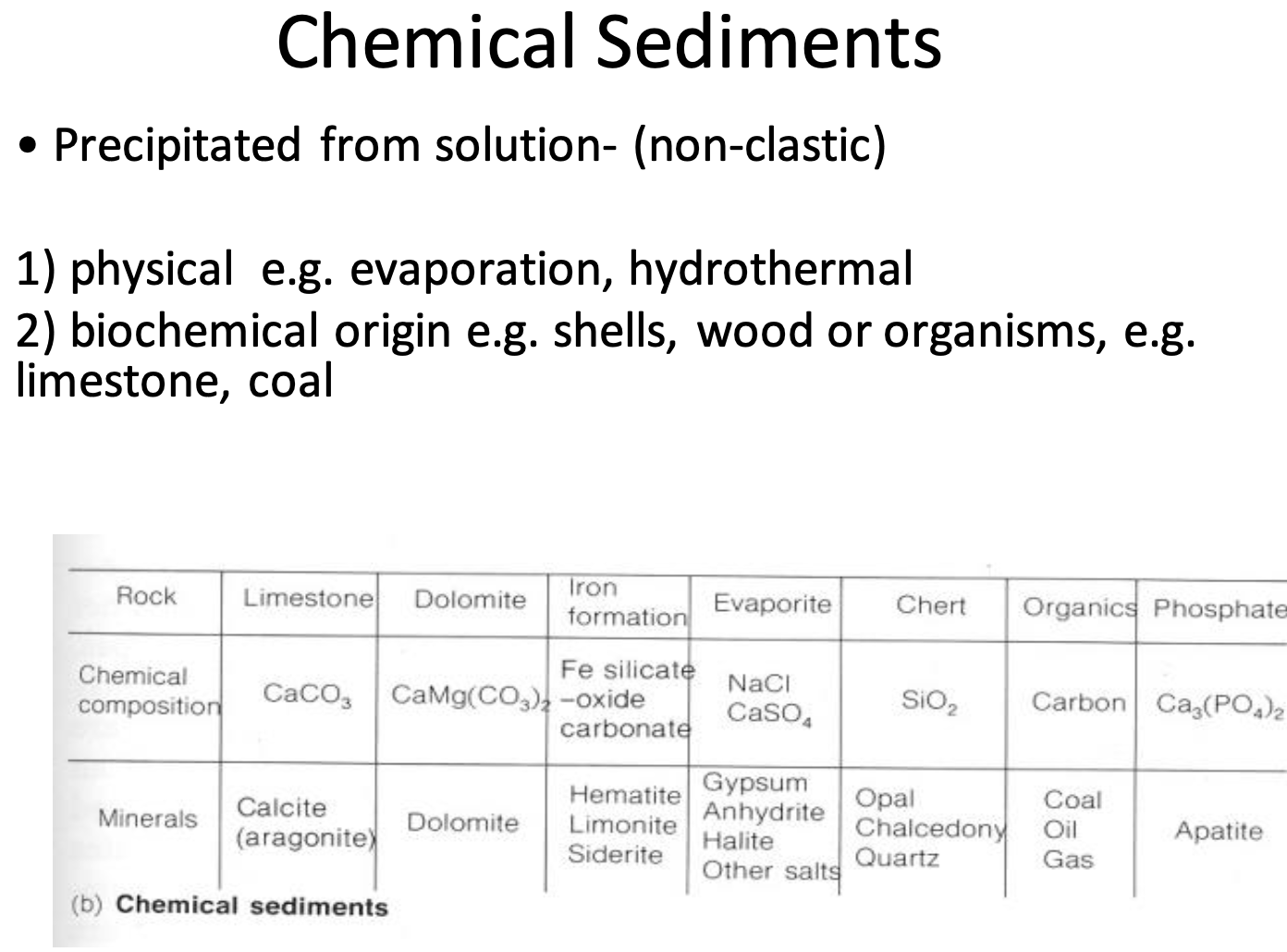
Rocks are divided onbasis of origin into 3 major groups
- Igneous - came from volcanos
- Sedimentary - transported somewhere else
- Metamorphic - have been changed because of heat
Grain size is the size of the particles that make up the rock
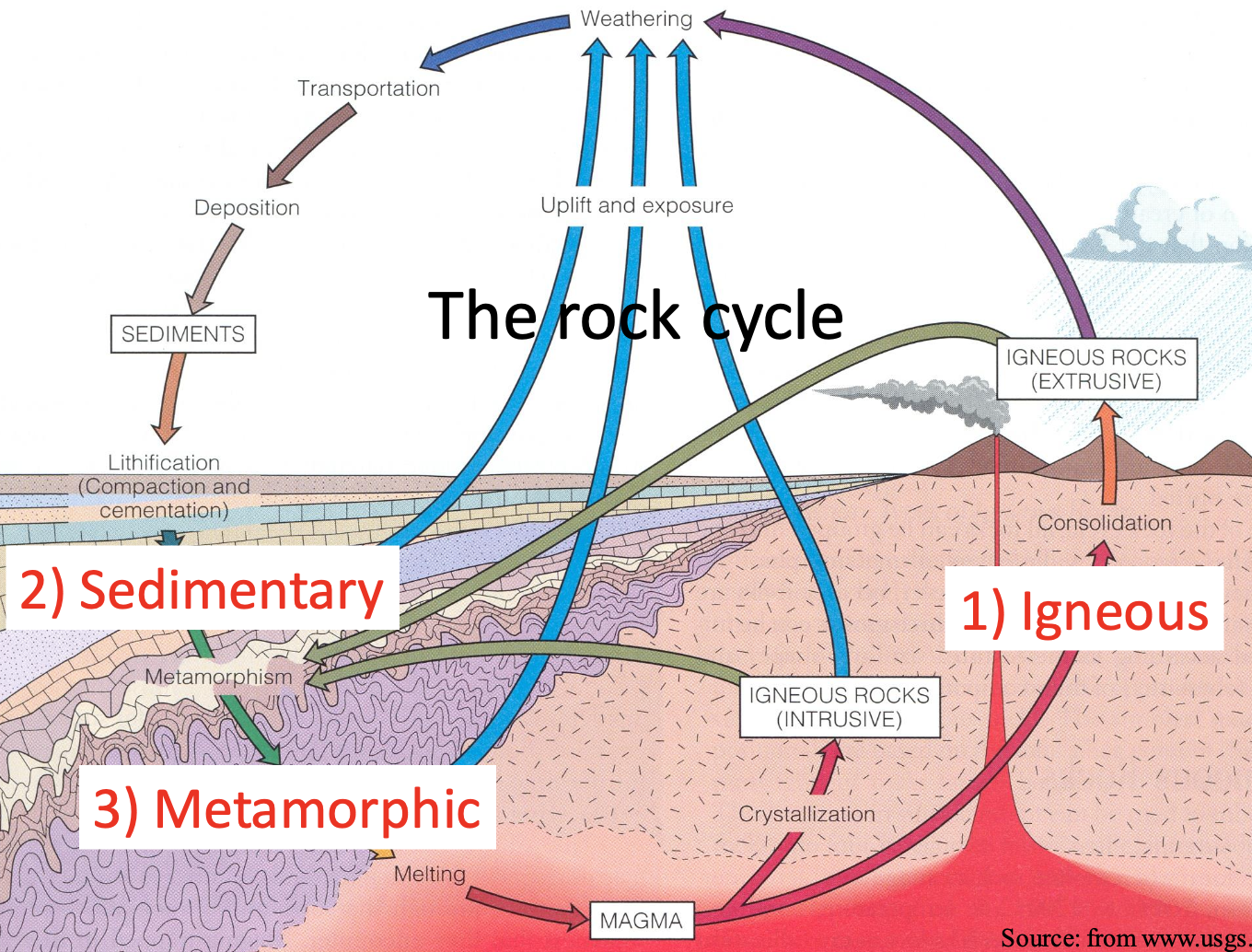 DIAGRAM IS IMPORTSNT
Rocks are our guide to the composition of the earth - how our planet is structured
Chemical composition tells us how things have happened
Everything around us has come out of the ground
Igneous rocks
Rocks that were once molten or liquid - magma has two types
- Intrusive, formed at depth
Cool down slowly underground - still in the crust of the earth - minerals get crystalised out eg. granite
- Extrusive, erupted at surface
Cool down fast above ground
Intrusive rocks
- Plutonic
- Only see then at the surfice when thy have been exposed to the surface
Extrusive igneous rocks
Called volcanic
Erupted at surface and usually finer grained than intrusive rocks eg. basalt
Rapid cooling maks the crystals very small
Composition
- Felsic, (light coloured and light weight)
Rich in feldspar and silica with low melting point
Eg. rhyolite and granite
- Mafic, (dark coloured and heavier)
Rich in magnesium and iron (ferric) with a high melting points
Eg. basalt or gabbro
Texture
- Crystalline granular, individual crystals are visible and interlocking (plutonic)
- Porphyitic, large crystals ( phenocrysts) embedded in fine grained matrix (volcanic)
- Glassy, nin crystalline like glass (obsidian)
- Vesicular, rock with holed in it (vesicles) from gas in the rock when it was liquid (pumice)
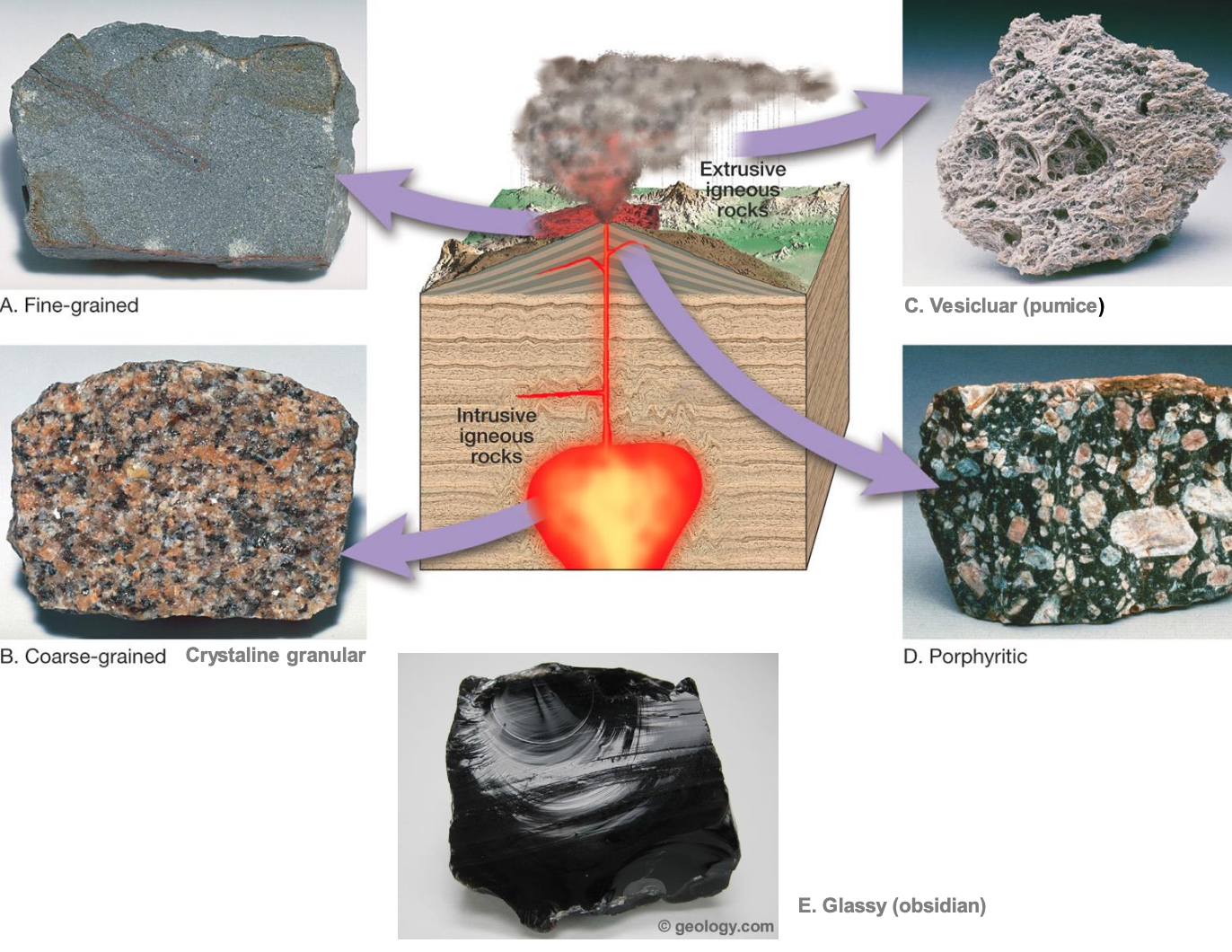
Percentage of silica can be used to divide up igneous rocks
Sedimentary rocks
Two types
- Detrital (clastic), were other rocks that have been eroded somehow and have been deposisted somewhere else (old rocks that make up new rocks)
- Chemical
Subdivided on badis of texture, mineralogy and what they're made up of
Lithification
Divide up based on grain size
Beach - hydrolic energy sorts out specific type of sand stone so is well sorted
Lecture 5
Earth Materials:
- Igneous
- Sedimentary
- Metamorphic
%silica to divide
Understanding sedimentary rocks
- Clastic
- Chemical
Sedimentary rocks form layers (strata) that contain vast majority of fossils and much of the information about earths history
The fossils are used to:
- Help determine past environments
- Time indicators
- Match strata in different places
The technique used to organise this information into geological stories is Stratigraphy - the study of rocks and their distribution in space and time with the object of reconstructing the history of earth
Nicholas steno made the link between the environment
- The principle od superposition
- Any layered sequence of rocks must be the oldest
- The principle of original Horizontality
- Layers resulting from particles deposited under the influence of gravity are originally parallel to the surface of the earth
- The principe of original lateral continuity
- Layers, when they were originally formed are laterally continuous unless they terminate against another solid substance
Sir Charles Lyle - uniformatrianism
The process that are going om now have always been going on
The power of a sedimentary proxy
Strata and fossils through time
- Using Steno’s principles we can correlate from one place to another, understanding the principles we can correlate ove 100s - 1000s of regions
Some of the images that have come back from mars show us that there once was water on mars - because we can seethe way sedimentation behaves on earth we can translate it to mars by adjusting the physics to account for gravity changes
Metamorphic rocks - temperature and pressure
- Have been heated and squashed
Contact - heat signal
Regional - region get buried under a mountain range
Heat 100 degrees up to 700 degrees
Rocks begin to melt and turn back into magma
Geothermal magnet
Immense pressure - pressure gradient 285bar per km
Chemically active fluids - crust of the earth
Circulate round - water comes in from surface and pump through crevices in rocks
New minerals at different temperatures and pressures
Contact metamorphism
- Heat alteration around an intrusion
- Localised effect and gradient texture
Dark rocks are igneous
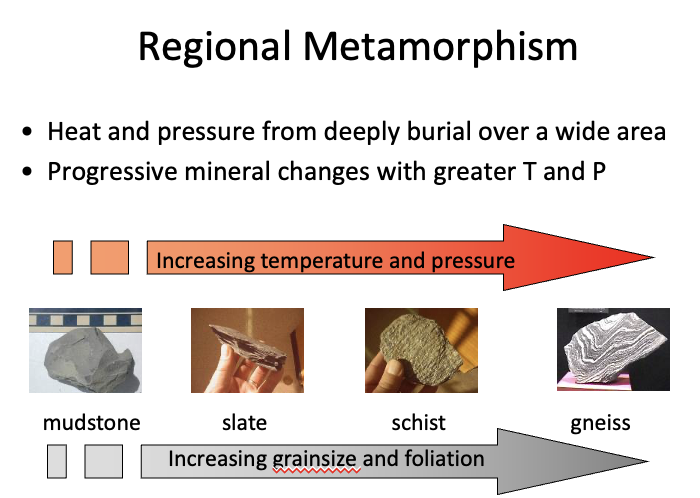
Regional metamorphosis
- Heat and pressure from deeply buried over a wide area (burial and building)
Heat and pressure - low pressure and low temperature turns sediment into rocks \
High temperature and high pressure
Increasing heat and pressure if you squash and heat it it turns into slate if you have mudstone
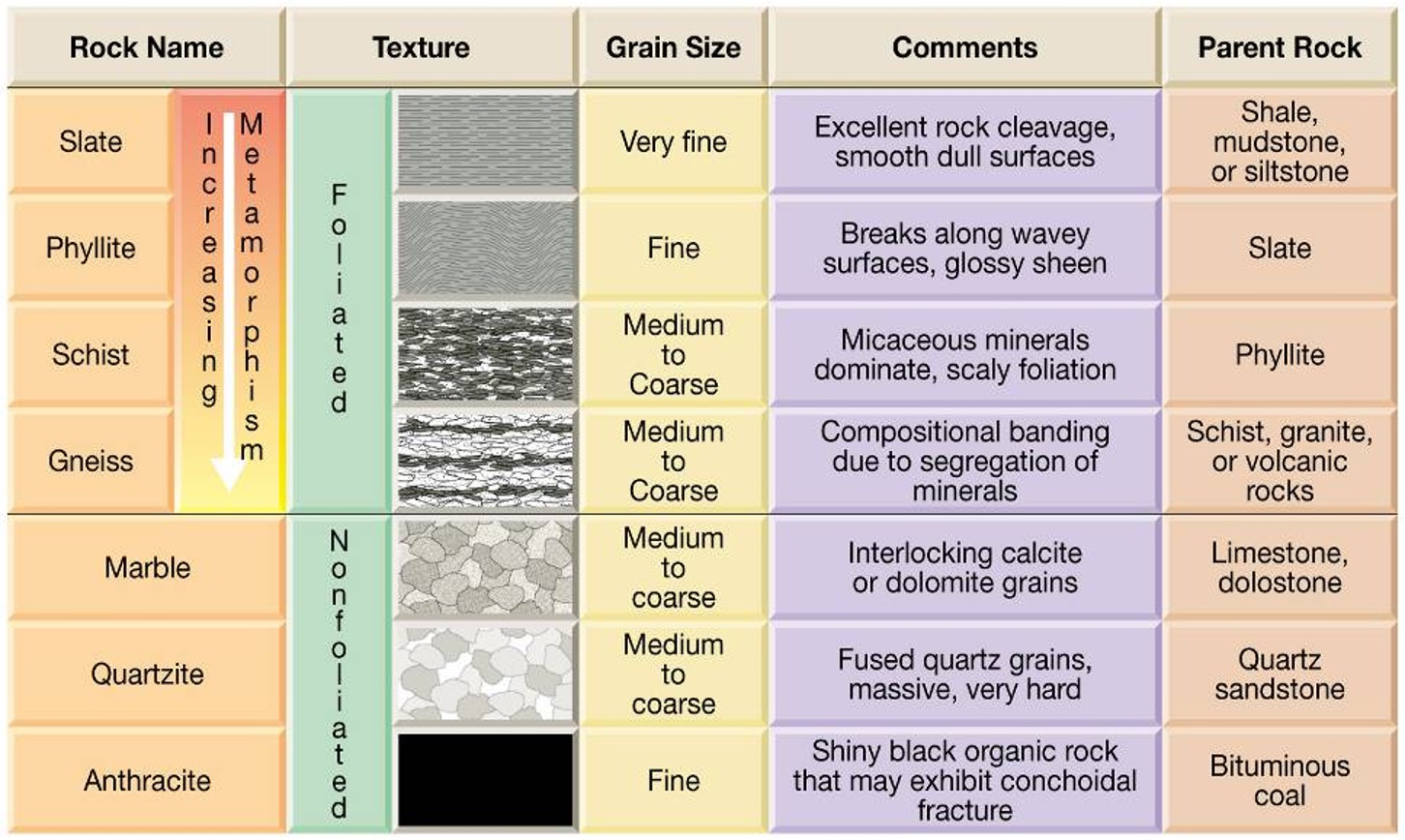
Foliated rocks
- Low grade = slaty cleavage
- Medium grade = schistosity
- High grade = porphyroblasts
Gemstones in metamorphic rocks
- Garnet
- Sapphire
- Ruby
- Greenstone / jade
- Labradorite
- Kyanite
Lecture 6
What shaped our landscape?
The bedrock, greywacke (220-200 million years ago)
- Layers of sediment deposited by the submarine avalanches (turbides) in the ocean off the coast of Gondwanaland
- Layers of the sandstone (light grey) and argillite/mud stone (dark grey)
- Literally means “sandstone”
- 200 million years ago NZ was just a bunch of sediment off the coast of what we now call australia
Greywackle story
Rare fossils:
- Hydrozoans
- Brachiopods
- Tube fossils foraminifera
- Vertebrae from lchthyossaurs
Graded layers
- Sediment layers scraped off the seafloor and “stacked up” in an “accretionary prism”
- Heat and pressure have slightly metamorphosed the sediments (low temp metamorphic minerals)
- Each couplet is the outcome of a big pressure in the deep ocean
- Rock that is close to the surface is able to be exposed to weathering goes “rusty” looks orange
Erosion
- Between 100 and 5 million years ago, the land was eroded down into a subdued low-lying plain (called a peneplain) and finally submerged beneath the ocean and marine sediments deposited over the plain
- The convergent plate bounty turned into a rifting boundary - beginning of Zelandia
- Eroded into a flat subdued landscape - no big mountains, volcanos
- Eventually the whole of Zelandia became submerged into the ocean
Uplift
- In the last 1 million years, tectonic forces initiated new uplift and the wellington region was lifted out of the sea
- The marine sediments on top of the peneplain was eroded away
- Zelandia is on a convergent boundary
NZ’s tectonic setting
- NZ sits on top of plate boundaries
- In the lower North Island, the pacific plate is being subducted beneath the Australian plate
- Uplift created major fault lines in the greywacke such as wellington fault and Wairarapa fault
- Strongly influence the shape of the landscape
- 100s of faults with a small major ones
- The pacific plate is subducting under the australia plate
- Plate is moving at 40 mm per year - same time as fingernails
- Earthquakes overtime as conforming for the 40 mm of movement every year
- Lots of volcanoes 200 km in from the subducting plate tectonics
- 1855 the Wairarapa fault moved with several m of plate uplift - over centuries this uplift causes mountain ranges
Wellington fault
- Horizontal offset = 3-10m everytime the fault moves
- Vertical offset 2-3m everytime the fault moves
- Recurrence = 500-770 years
- Last rupture = 335-485 years
- Wellington fault is just off from the motorway
Shaking hazard is different depending on what you're built on
River terraces
- Water flows downhill, water will erode into the landscape and cause a valley
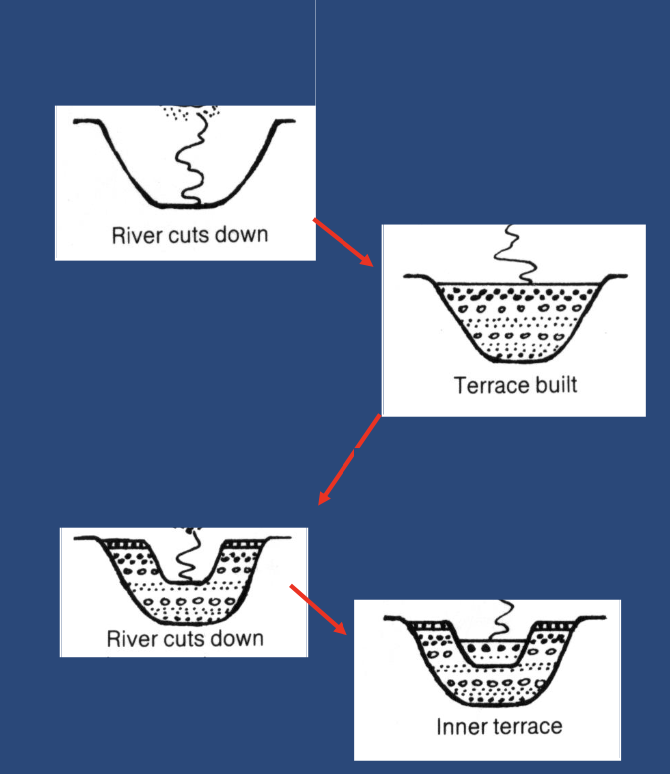
By using the terraces we can figure out the offset of the terrace and see how many times they have been offset to see how often the fault moves
Comate cycles
- 700,000 years 1000 year climate cycles
- The climate warms up, ice melts and sea level has risen
Hutt river used to flow out where the ferries leave from and where the airport is
Harbour used to be a river valley
- Benches cut during high sea level during interglacial periods
- Subsequently uplifted and preserved
- Sea Level at high points eroding in a bench, when sea level rises again it cant occupy the same bench
Petone foreshore “building out” into harbour
Over half of the hutt river flow is underground in “gravel”
Emerges in springs, near Somes island
Uplift in 1855 drained swamp area at Petone, stranded beach ridges and make river non-navigable
Costal Process at Kapiti coast
Coast is a dynamic environment