Tutorial - Induction
Dealing with structures not numbers now
To rpove a property P(xs) holds for all finite lists, we must prove:
Base case: Prove P([])
Induction step: prove (P(x:xs) on the assumption that P(xs)
 1.
1.
If both lists are empty, its trivial
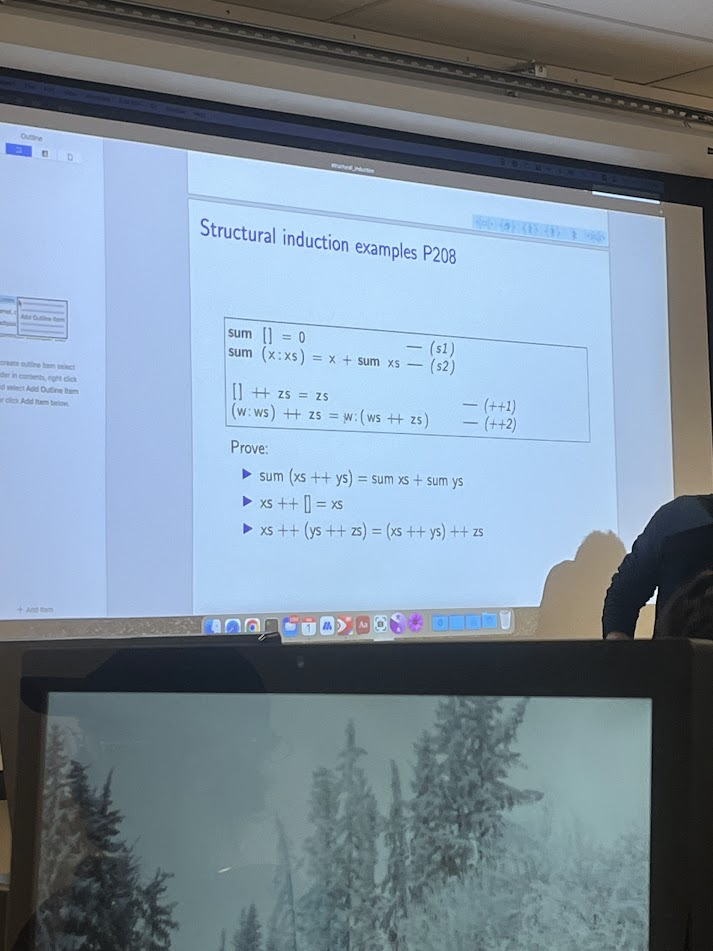
Given:
sum [] = 0 —s1
sum (x:xs) = x + sum xs — s2
[ ]++ zs = zs — ++1
(w:ws) ++ zs = w:(ws ++ za) == (++2)
Question: Prove sum (xs ++ ys) = sum xs + sum ys
We want to prove two goals of the induction process
(1). For base case, we have to prove:
sum ([] ++ ys) = sum [] + sum ys
(2) For induction step, we have to prove:
sum ((x:xs) ++ ys) = sum (x:xs) + sum (ys) on the assumption that
sum (xs ++ ys) = sum xs + sum ys is true (the Inductive hypothesis)
Base:
LHS:
sum ([] ++ ys)
= sum (ys) By rule ++1
RHS:
sum [] + sum ys = 0 + sum ys by (s1)
= sum ys by calculus
LHS = RHS
Inductive Case:
LHS: sum ((x:xs) ++ ys)
= sum (x(xs ++ ys)) by ++2
= x +sum (xs ++ ys) by s2
RHS: sum (x:xs) + sum (ys)
= x + sum xs + sum ys by s2
= x + sum (xs ++ ys) by Inductive Hypothesis
LHS = RHS
Question2: Prove xs ++ [] = xs
Base:
LHS: [] ++ []
= [] by ++1
RHS: []
LHS = RHS
Given:
sum [] = 0 —s1
sum (x:xs) = x + sum xs — s2
[ ]++ zs = zs — ++1
(w:ws) ++ zs = w:(ws ++ za) == (++2)
Inductive Step
Assume xs ++ [] = xs
LHS: (x:xs) ++ []
x:(xs ++ []) by ++2
(x:xs) by IH
RHS: (x:xs)
LHS = RHS