wk 8 - Services and Non-Profit Marketing
Lecture Overview: Services and Non-Profit Marketing
Today's focus is on services and non-profit marketing. This is relevant to the team assignment, which involves co-branding, sponsoring, or using a social enterprise business model.
The Importance of Services
Definition of Services
Services are the result of applying human or mechanical efforts to people or objects.Services involve a deed, a performance, or an effort that cannot be physically possessed (Lamb et al., 2023).
You cannot own a service, it is performative.
Demographic Shifts and Services
The prevalence of certain services often reflects demographic shifts in society.
Ageing population leads to increased healthcare services.
Two-income families increase demand for childcare, house cleaning, and lawn mowing services.
(Lamb et al., 2023)
Additional Definition of Services
Services are intangible activities or benefits (such as airline trips, finiancial advice, or automobline repair) that an organization provides to satisfy consumers' needs in exchange for money or something else of value. (Kerin & Hartley, 2021)
Often, the cost of services includes time (e.g., waiting in line).
Issues in Services Marketing
The services sector is becoming increasingly significant globally, as part of many world economies and key drivers of growth.
Economic activity is driven by services like telecommunications, banking, and logistics, which are often at the forefront of innovation.
Nature of companies core products and the marketing mix elements lead to the success of services sectors ing hte global marketplace
Austrilas service secotor represents about 70% of the gloabl GDP
Competitiion in services is increasing
Lower labour costs in developing countries can provide a competitiive advantage
Services are hard to compete with, as many offer similar things. Differentiation can be achieved through brand story, service delivery, or environment.
Starbucks Example
Starbucks succeeded by offering predictability in its service, regardless of location.
New Zealand's Service Sector
New Zealand's service sector now represents a significant portion of the GDP.
Historically, New Zealand was known for sheep farming, but the service sector has grown over time.
Competition in services is increasing, especially as services can be offered online.
Globalization of Services
Many services can be digitized and transported globally, unlike the past when they were constrained by time and place.
Some services, like boot camp fitness, remain place and time-constrained unless taken online.
Lower Labor Costs
Lower labor costs in developing countries can provide a competitive advantage through offshoring.
Example: customer service representatives located overseas.
Customer Service Innovations
Chatbots and live chat features are innovating customer service.
These features can solve negative reactions to offshore customer service by offering instant support.
Virtual chats can handle basic customer service tasks before handing off to a human.
Relationship Marketing in New Zealand
Relationship marketing (now often called customer engagement) involves attracting, developing and retaining satisfied customers.
Satisfied customers engage with others and say nice things, while dissatisfied customers say bad things.
Its more cost effective to hold into customers than having to find you customers
Air New Zealand Example
Air New Zealand uses relationship marketing effectively.
Airpoints: Points for behavioral loyalty. Loyalty program. Points for flights, partners purcahse and credit car usage
Tiers: (Silver, gold, elite) Escalating benefits with higher tiers.
Personalized communication: Data usage to tailor customer experience. Using customer data
Superior customer experience: Humorous safety videos, culturally inclusive service, and active social media engagement.
Active engagement on social media. Fostering two wat communicationi
Air New Zealand Safety Video Example
Discussion and viewing of a humorous Air New Zealand safety video to illustrate superior customer experience and cultural engagement.
Partnership with New Zealand Tourism.
AI icon and QR data to encourage the speaking of Te Reo.
Goods-Services Continuum
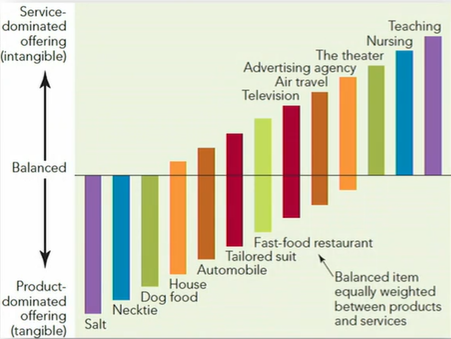
Developed by Len Shostak, it shows that all products have a degree of service and tangibility.
There is no pure service or pure tangibility.
Goods and services are not oppositional but exist on a continuum.
Classifying Services
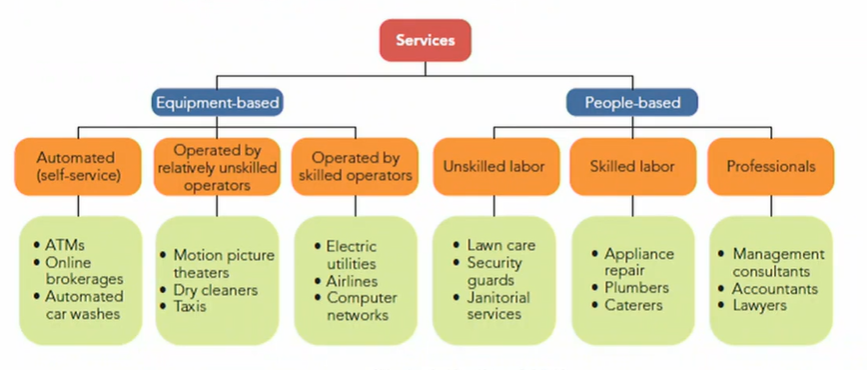
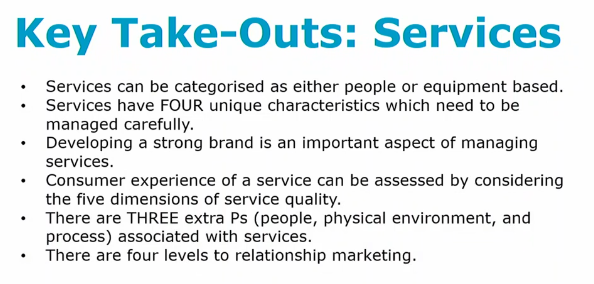
Services can be classified as equipment-based or people-based.
Equipment-based services include automated self-service (e.g., dog washing machines), unskilled operators using machinery (e.g., taxis), and skilled operators (e.g., airlines).
People-based services range from unskilled laborers to professionals
When answering a question in the exam, determine which of the categories it falls under to show an understanding of the topic.
The Four Is of Services
These are the unique characteristics of services:
Intangibility: Services cannot be touched, seen, tasted, heard, or felt like a good can.
Inseparability: Services are produced and consumed at the same time, requiring the customer to be present.
Heterogeneity: Services are never exactly the same;(inconsistency and variability )
Perishability: Services cannot be stored or warehoused. (not inventory). And Airplane
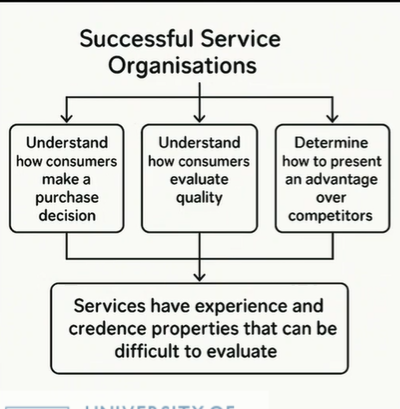
How Service Organizations Succeed
How can service organisations gain understanding
Customer journey mapping
Market Research
Behavioural Data analysis
Segmentation
Properties of Goods and Services
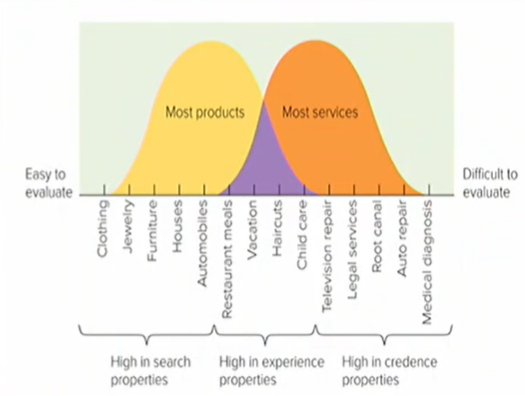
Search Properties: tangiable products that can be determined prior to purchase (e.g., color, style).
Experience Properties: Properties that can only be discerned after experiencing the product or service (e.g., taste, friendliness).
Credence Properties: Properties that consumers may never understand, requiring trust (e.g., surgery, car repair).
Provided by professionals. immpossiable to eval after, during or before consumption
Dimensions of Service Quality and Gap Analysis
Service quality is measured post-experience.
Customer expectations are shaped by previous experience and vicarious learning (e.g., reviews).
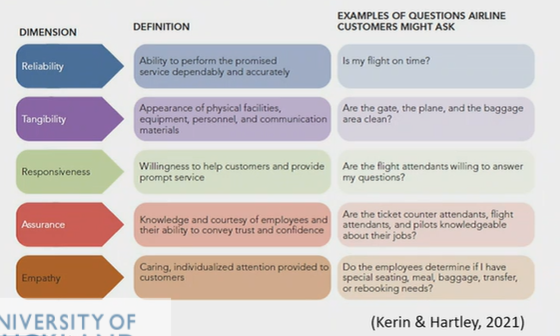
The 5 dimensions: RATER
The five dimension of service quality are:
Reliability: Ability to perform the promised service dependably and accurately.
Tangibility: Appearance of physical facilities, equipment, personnel, and communication materials.
Responsiveness: Willingness to help customers and provide prompt service.
Assurance: Knowledge and courtesy of employees and their ability to convey trust and confidence.
Empathy: Caring, individualized attention the firm provides its customers.
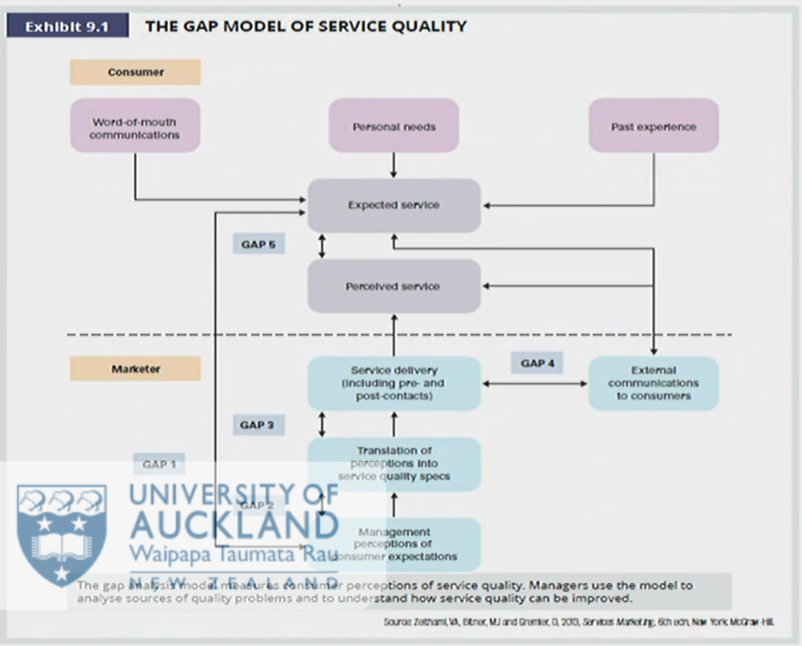
The 5 Gaps of Service Quality
The 5 gaps of service quality are:
Gap 1: The gap between what customers want and what management thinks customers want. (Not enough research by management)
Gap 2: The gap between what management thinks customers want and the quality specifications that management develops to provide that service. (Managerial Performance)
Gap 3: The gap between the service quality specifications and the service that's actually provided. (Lack of specifications)
Gap 4: The gap between what the company provides and what the customer is told it provides. (Communication. Overselling vs. underselling)
Gap 5: The gap between the service that the customers receive and the cuts and the service they want.
The Extended Marketing Mix (7 P's)
In addition to the standard product, price, place, and promotion (4 Ps), services marketing includes:
People: Includes employees and other customers.
Process: How processes can be sped up
Physical Evidence: Physical environment
Process
Automation of aspects of the custonmer journey
Involves getting customers to do things themselves (e.g., self-check-in kiosks).
The advantages of machinery and automation:
Reduce people-to-people contact.
Gets the customer to do the work (Lower Cost)
Yield management pricing (dynamic pricing) is used to manage demand and inventory.
Inseperability
Refers to the actual prpodcueers, mechanism and lfow of activites by whish the serice is created and delivers.
The provide customers with ability to assess a service aby experiences the delivers (co creation.)
People
Employees and other customers
Service dependent on peopel for the creation and those delivering the customer services and exp.
Customers judge the quality of a service based on interactions with staff and other customers.
If staff are involved, there should be correct attitude, skills, commitment.
Physical Place
The apperanc of the enviro/place that the service is deliver and interactions occur can also influence consumer perceptions of a service.
Creates a tangible environment consistent with the service offering(The Pullam Hotel). Can also be what you see on website and social media.
Addresses increased perceived risk and involvement with an intangible service.
The Moment of Truth
Occurs when the firm and customer come into contact.
Decides whether or not the service meets expected or desired outcome.
Influences reviews, word of mouth, and future decisions based on service quality.
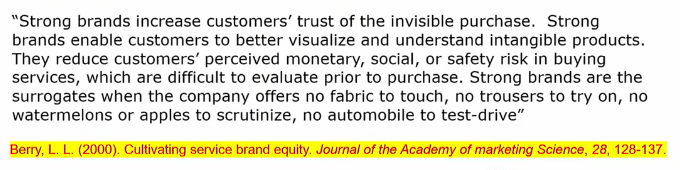
Brand Equity
The customer's experience with the company directly affects brand equity.
Strong brands increase trust in invisible purchases, enable better visualization of intangible products, and reduce perceived risk.
Relationship Marketing cont.
4 Levels of customer relationship management.
Levels of Relationship Marketing
Levels of relationship marketing:
Level 1: Pricing based on unseen terms to encourage customers (frequent flyer programs).
Level 2: Social signal to customers, staying in touch with customers (customer surveys).
Level 3: Financial and social bonds to create deeper connections (customization).
Level 4: Make it hard for people to leave. (structural relationship marketing- seamless check and boarding, loyalty tracking, meal and seat selection and upgrades, mobile app). Making an ecosystem in the process.
Smaller Companies and Relationship Marketing
Smaller companies may not be able to invest in systematic relationship marketing.
By observing websites you can determine how marketing influences customers.
Key areas to have are easy booking system, and pop-ups that can encourage data sharing.
Key Takeaways From Services Lecture
Non-Profit Organization Marketing
An org that exists to achieve some goal other than the usual business goals of profit, market share or return on investment.
hospitals, community groups, religious groups, environmental groups
Org that you pick should be within your target market
Alignment of Products to Endorsements
Be careful which celebrities you align your company with because things can go horribly wrong (Russell Brand and Amy Winehouse endorsement examples).
The charity selected should resonate with your target market.
Farooq (two AUC students) was a company that target market was largely students who need healthy energy, so they partnered with Yellow Brick Road, who deal with mental health and can relate to that group.
Simple $ goes to charity with sales.
Objectives of Non-Profits
Make enough money to survive and provide equitable or effective and efficient services.
Do no seek to make profit to redistribute to shareholders.
Focus on generating enough funds to cover costs expenses
Provide equitable and effective services
Example: Ronald McDonald House provides accommodations for families with sick children.
Decisions the Industry have to make
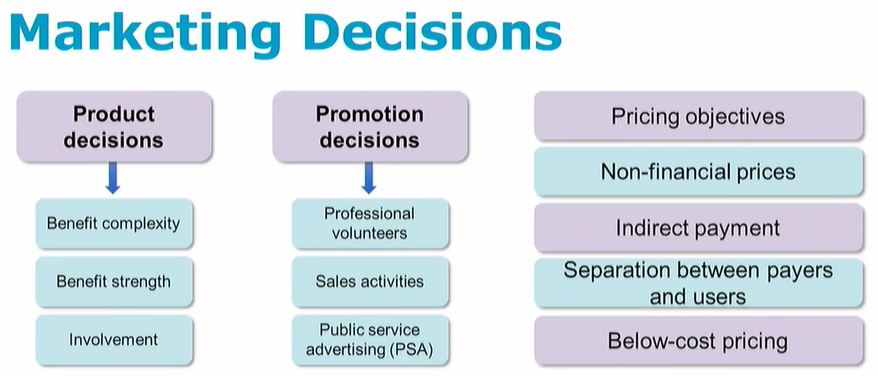
Decisions are more complex because difficult to know if people will understand benefit of charity.
Strength of Benefit
How much do I care about this thing (planting forest)?
Employment Decisions
Very few employment as often use volunteers.
Financing
How to obtain (token sales, giving money).
Advertising
Advertising expensive.
Pricing Objectives
What is it that you're pricing (are you selling a poppy)? Need to make sure you're covering costs and maybe make tiny bit on top to keep things going.
Non-Financial Prices, Indirect Payments, and Below Cost Pricing
Non-financial prices: cost of volunteering or relationships outside of financial aspect. Indirect Payment might include a fee which goes to a third party not the product being bought. (Shoes + Toms Shoes donation).
Below cost pricing is when charities like Ronald McDonald try to create more equitable prices.
Business Models
Business models such as donating to charities and hospice shops can use different methods to bring in money.
The Social Enterprise Model
Then we have what we call social enterprises. This is a really nice social enterprise that I purchase from. This is called Tahari, and they have an 800-acre living Ecolab up in the North Island, north of the North Island, to the north of us. And they connect connected to the University of Auckland. And they have scientists, they have ethical beekeeping. Um, they are regenerating the land. It employs people and costs lots of money to function
For Profit Donations
There is also for profit donation where the business donates portion of profit to various organization.
Social Marketing
It's using marketing to create a better society (drink & drive, exercise)

Peer to Peer Marketing
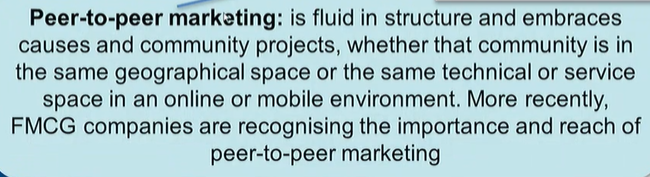
Peer-to-peer marketing Like Gibson Go (New Zealand equivalent). Where marketers stand out of way and let customers see take place.
Project Decision
The main decision you need to make as a team is what and who you will co-brand with (doesn't have to be a charity, might be ingredient brand only).
It's nice to think about making product ideation more than just about making money, um, and have a bit of a brand story.