Ionic Model
Overview:
Ionic bonds
Ionic structures and properties
Ionic bonds:
Ionic bonds are formed between a metal and a non-metal. It is a transfer of electrons, where the metal gives an electron and becomes a position ion called a cation, and the non-metal gains an electron and becomes an negative ion called an anion.
Electron transfers are explained by the concept of effective nuclear charge. Nuclear charge is the charge of the atom given by the atomic number (proton #), and increases between sucsessive elements in the periodic table as a proton is added to the nucleus. However the outer electrons (valence) which determine its reactivity do not experience the full attraction of this charge as they are shielded from the nucleus and repelled by the inner electrons. Therefore the effective nuclear charge exerienced by the outmost electrons is often weaker than the full nuclear charge. It increases across a period but remains the same downa group.
Ionization energy refers to the amount of energy required to rip an electron away from an atom. Ionization energies increase across a period which is due to increases nuclear charge. As effective nuclear charge increases, the nucleus’s attraction on its electron’s increases therefore a higher amount energy is required to remove its electrons. Since metals are on the left side of the periodic table they have both lower ionization energies and effective nuclear charges, meaning they are more likley to lose electrons and form positive ions. Non-metals have higher ionization energies and effective nuclear charges, so thet attract electrons to form negative ions.
An example of an ionic compound is the salt sodium chloride, NaCl. Sodium loses its electron in order to have a full valence shell as a sodium cation and chlorine gains an electron to also have a full value shell as a chlorine anion.
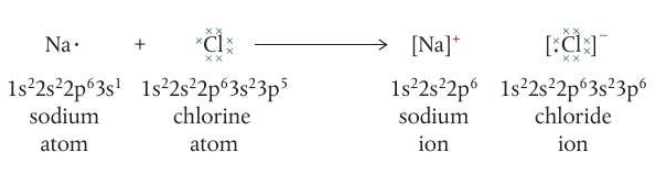
Similar reactions occur between other group 1 metals (alkali) and group 17 elements (halogens). The reactions are more vigorous the further away elements are on the periodic table.
Sometimes more than one electron will be transfered, this results in a greater charge of the ions and therefore increased force of attraction. However sucsessive ionization energies of an element increase, and there is a large jump in ionization energies when electrons are removed from an inner energy level.
Halogens attract electrons more strongly than group 16 elements because they only need one electron rather than two. Since noble gases have complete value shells they do not want to gain or lose electrons and are therefore very unreactive. The charge on an ion can be predicted by group number on the perodic table excluding transition metals which can form ions of different charges (multiple oxidation states). If a metal can form multiple ions (multivalent), it must be indicated in the nomenclature of the compound using roman numerals.
The formula of an ionic compound can be deduced from its component ions. The net charge is zero therefore writing the ionic compound involved balancing the positive and negative charges between the cation and anion.
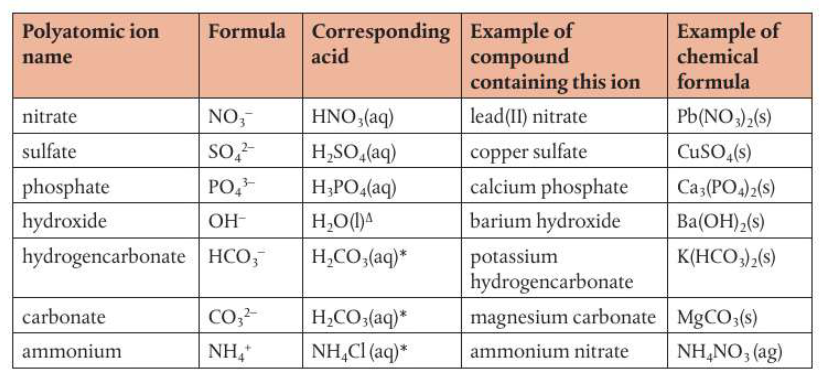
Polyatomic ions to know/memorize:
Ionic structues and properties:
Once ions are formed they are held together by an electroststic attraction called an ionic bond. Ionic compounds have a lattice structure involving a fixed arrangement of ions based on a repeating unit called a unit cell. Lattice consists of very large numbers of ions therefore the formula is representative of a ratio. The term coordination number is used to describe the number of ions which surround a given ion in the lattice.
Lattice enthalpy refers to the enthalpy change when seperating ions. A higher lattice enthalpy indicates a stronger ionic bond. The enthalpy of forming an ion releases energy and is therefore an exothermic process and negative. The enthapy of breaking an ion requires energy and is therefore an endothermic process and is positive.
Physical properties include:
High boiling points due to strong electrostatic attraction and low volatility
Soluble in polar solvents but not non-polar solvents
Conductive in a solution but not as a solid
Brittle due to crystal lattice structure, breaks apart when same charges align and repel
Some notable exceptions to the ionic model:
Period 3 chlorides are less ionic across a period
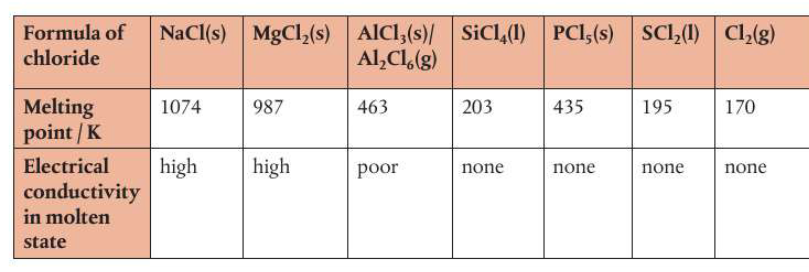
When comparing ionic and covalent bonds to electronegativity value, it should be noted that a compound/molecule is generally considered ionic if the electronegativity difference is larger than 1.8. If the difference is less than 1.8, the compound/molecule is covalent and will also be somewhat polar (unless diatomic).