Evolution Lab: Caribbean Anal Lizards, Phylogeny, and Ecological Adaptation
Lab Administration and Logistics
Lab Topic: Evolution (Week 2).
Deadlines: Both the Lab Report and the Lab Quiz for evolution are due by Sunday.
Requirements:
The Lockdown Browser must be downloaded and active before attempting the Lab Quiz.
Lab resources can be found under Week 2 in the lab resources section, which includes background, procedures, the lab report, and the lab quiz.
There is no lab simulation for this week (e.g., no virtual lab coat or gloves). Students must work through the provided procedures and record results manually from images and data provided in the background document.
Biological Classification and Morphology
Morphology: Defined as the study of the physical characteristics of an organism.
Morphology is used as a primary tool for scientists to classify new species.
It is often combined with DNA analysis and other specialized techniques for accurate classification.
Case Study: Anal Lizards:
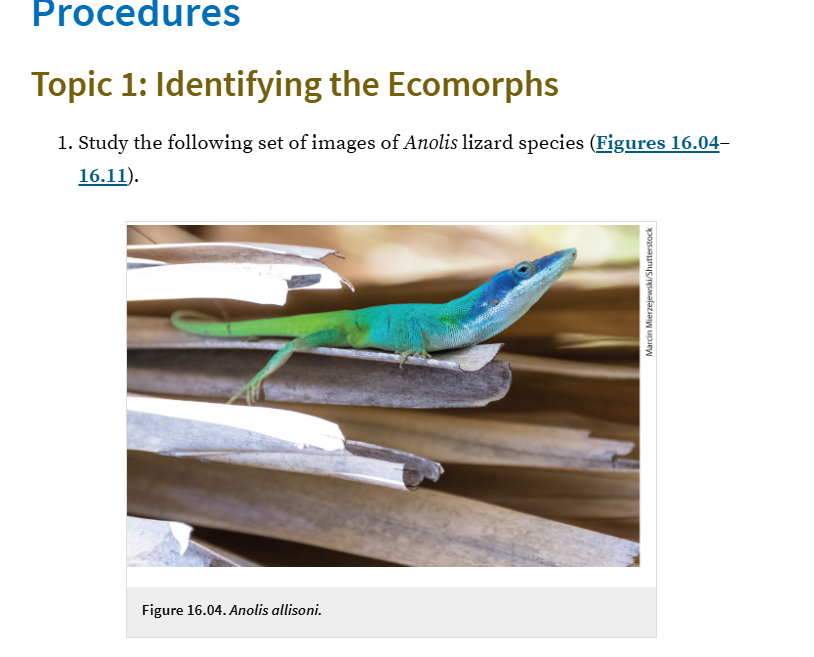
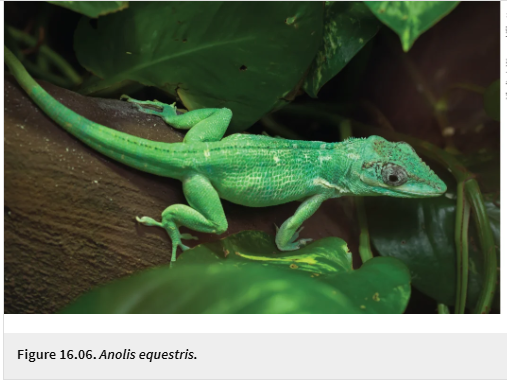
These lizards are found across various islands in the Caribbean.
Species vary significantly in physical traits, including:
Tail length (long vs. short).
Body thickness (thin vs. thick).
Leg length (short legs vs. long legs).
Coloration.
Phallogenetic Trees and Reading Phylogenies
Definition: Phallogenetic trees illustrate the evolutionary relationships between organisms and how new species evolved from common ancestors.
Principles of Interpretation:
Organisms branching from the same common ancestor are more closely related.
The last common ancestor is located at the base or node before a branching event.
Every time a line branches out, it represents a new evolutionary branch.
Structural Comparisons:
Phallogenetic trees can be drawn in various formats while representing identical data.
Example Tree Analysis (from transcript):
CG (Crown Giant): Represented as the first branch or oldest lineage.
TG (Trunk Ground): The second branch to emerge.
TC (Trunk Crown) and TW (Twig): These two are represented as the third branch, originating from the same common ancestor, making them the most closely related in that specific tree.
Ecological Niches and Ecomorphs
Ecological Niche: A specific area or habitat where an organism is found and lives.
A single tree can contain multiple niches:
Tree Canopy: Occupied by species like the Crown Giant.
Upper Tree Trunks/Lower Branches: Occupied by the Trunk Crown.
Trunk: Occupied by species that climb up and down like squirrels.
Ground/Roots: Distinct niches from the upper levels.
Ecomorph: An individual species whose morphology has adapted to a particular ecological niche.
Different ecomorphs hunt, court, and live differently based on their specific environments.
Evolutionary Driver: Competition within species is theorized to have forced this evolution. Rather than competing for the same resources in one area, lizards spread out and adapted to unoccupied niches to avoid conflict.
Evolutionary Mechanisms: Adaptive Radiation and Convergence
Adaptive Radiation: This occurs when an organism is introduced to a new environment without existing predators or competition.
The species spreads out and adapts to all available habitats/niches.
Example: The extinction of dinosaurs allowed mammals to undergo adaptive radiation to fill the vacated niches.
Convergent Evolution (Convergence): This occurs when two different species in different areas develop similar physical or behavioral characteristics independently because they face similar environmental pressures.
In the Caribbean, identical types of ecomorphs evolved on different islands independently.
Hypothesis Testing: Colonization vs. Joint Evolution
Hypothesis 1 (Single Colonization + Adaptive Radiation + Convergence): If this is correct, the phallogenetic trees for different islands should show lizards evolving in different orders on each island.
Hypothesis 2 (Joint Evolution): If lizards all evolved on a joint island and then spread to others, the phallogenetic trees for every island would be identical and show the same order of organisms.
Island Observations (Phallogeny Orders):
Cuba: Crown Giant (Oldest) Trunk Ground Trunk Crown Twig (Youngest).
Espanola: Trunk Crown appears first; Crown Giant did not come first here.
Jamaica: Twig emerged first.
Puerto Rico: Twig emerged first.
The observed differences in order across Cuba, Espanola, Jamaica, and Puerto Rico support the hypothesis of single colonization followed by independent adaptive radiation and convergence.
Sexual Selection and Dimorphism
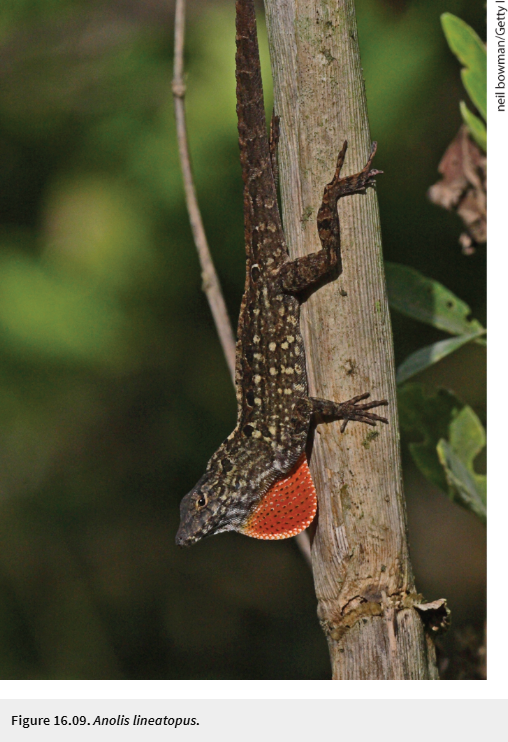
Sexual Dimorphism: Occurs when males and females of the same species are physically distinct.
Males: Often brightly colored and may possess a dualap (a flap of skin hanging from the neck used for display).
Advantage: Increases mating success.
Disadvantage: Makes them more visible to predators.
Females: Usually lack bright colors and are camouflaged to hide while protecting offspring.
Behavioral Evolution
Communication: Lizards communicate through behavioral displays such as head-bobbing.
Video Analysis Task: Students must use the link in the procedure to watch a video on lizard behavior, noting:
The direction of head moves.
The speed of the bobbing.
Variation in communication styles between different species.