Lesson 12
Lesson 12: Pacemaker Part 1
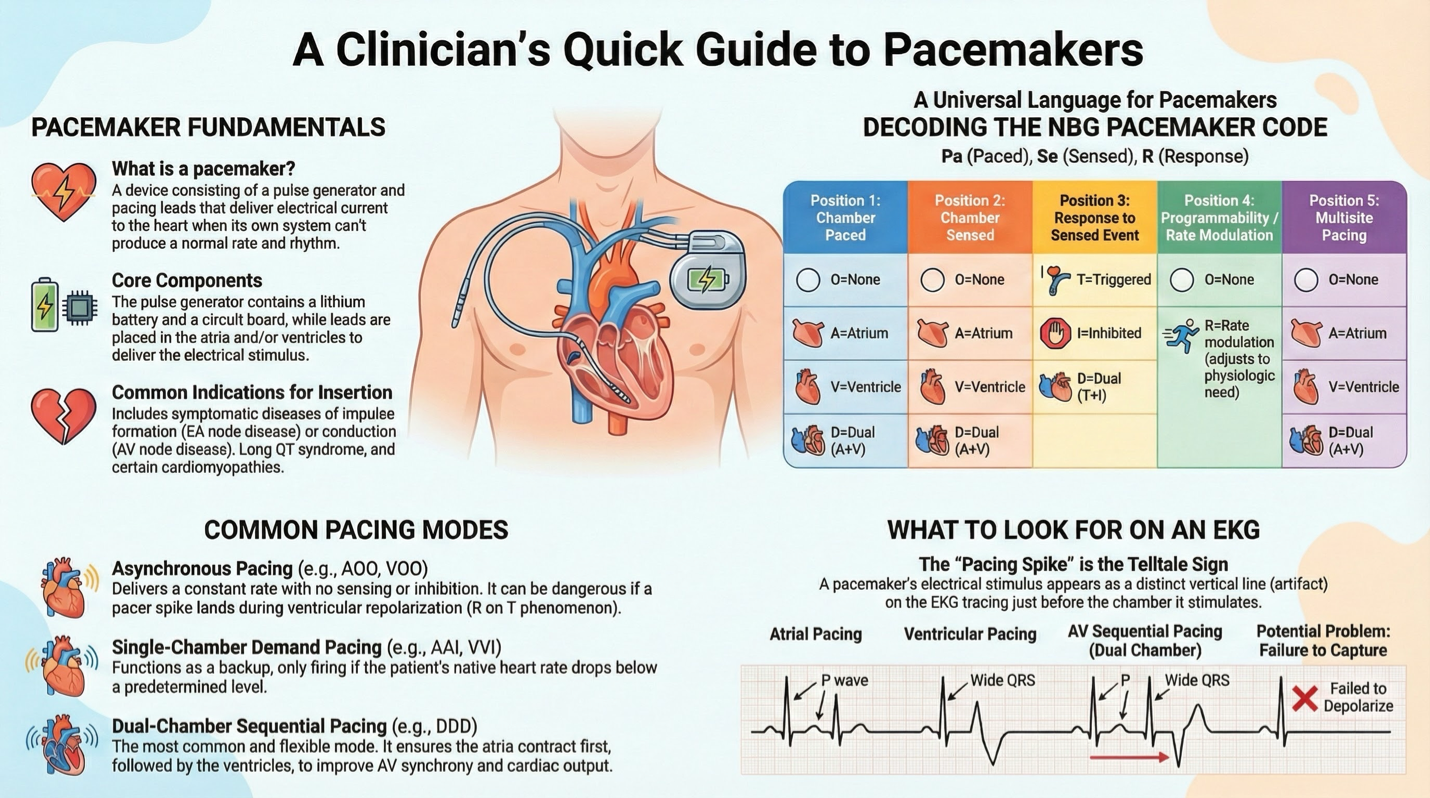
Consists of a pulse generator and pacing leads delivering electrical current to the heart.
NBG Classification
Pacemakers are identified using a 5-letter code:
Position 1 = Chamber paced
Position 2 = Chamber sensed
Position 3 = Response to sensed activity
Position 4 = Programmability options
Position 5 = Ability to pace multiple sites
Common Pacing Modes
Asynchronous: AOO, VOO, DOO
Single-chamber: AAI, VVI
Dual-chamber: DDD
Failure to Capture
Occurs when stimulus fails to trigger myocardial depolarization.
Cardiac Output
Dependent on normal heart rate and rhythm; pacemaker maintains this if the heart cannot.
Components of Pacemakers
Leads: Atrial lead (in right atrial appendage), Ventricular lead (in right ventricle apex)
Pulse Generator: Processes electrical signals from the heart, responds based on programming.
Battery: Often a lithium type.
Indications for Pacemaker Insertion
SA node disease, AV node disease, Long QT syndrome, Dilated cardiomyopathy, Hypertrophic obstructive cardiomyopathy.
EKG Morphology
Atrial pacing: Spike precedes P wave, QRS normal.
Ventricular pacing: Spike precedes wide QRS complex.
AV Sequential (dual chamber): Spikes for both atrial and ventricular pacing.
Key Mnemonic: PaSeR
Pa = Chamber Paced
Se = Chamber Sensed
R = Response