Week 13: Humanistic theories , Behavioural & Cognitive Theories of Counselling
Humanistic theories (under week 9)
People are essentially good
People naturally strive for growth and development
Helping people is best achieved by facilitating self-understanding by exploration of emotions
3 major humanistic theories
Person-centred
Existential
Gestalt
Carl Rogers
Person-centered counselling
human nature → People will thrive and strive to grow, human beings innately have this
intrinsic motivating drive for our existence to be a total and whole person
Qualitative experience of a person → their lived experience guides the work with them
The Self Concept
Self-Actualization
Congruence between ideal and real selves
Need for unconditional positive regard
Driven by helper
Model it to help the client do it for themselves (being loving, accepting, non-judgemental) so they can learn to have unconditional positive regard for themselves
Role of counsellor (person centred approach)
A facilitator (nondirective); create a safe and supportive environment for clients to explore feelings (no need to apply defence mechanisms); therapeutic relationship is central (attitudes and personal characteristics of therapist)
Techniques
Empathic understanding
Unconditional positive regard
Congruence/Genuineness
Person centred counselling Goals
Client as a person - focus on the inherent potential for growth, the process of becoming self actualized
Assists client with coping
Acceptance of self/others
Increase decision making
Identify and use personal resources and potential
Rollo May & Viktor Frankl - Existential counselling
View of Human Nature – Phenomenological, Existential, people are responsible for their choices
We define ourselves by our choices (how a person behaves)
Outside factors can restrict our choices, we are ultimately the authors of our lives
The world is meaningless, yet we can create a meaningful existence (unique to each person → What do their core values root in?)
Our capacity for awareness gives us freedom and with it the responsibility for the choices we make
Free will of choice & action (anti-deterministic → painful experiences happen, how do we create meaning despite that), emphasis on meaning (of life) through action, experience and suffering
6 major themes
Searching for the meaning of life
By doing a deed
By experiencing a value e.g. nature, culture, love
By suffering
The capacity of self-awareness
Freedom and responsibility
Striving for identity and relationship to others
Anxiety as a condition of living
Awareness of death and nonbeing
Role of counsellor
Being authentic and entering into deep and personal relationships with clients, model of how to achieve individual potential and make decisions
Goals
Help clients realize the importance of meaning, responsibility, awareness, freedom, and potential
Challenge clients to recognize and accept freedom, find meaning and purpose in suffering, work, love
Techniques
Very few (Focus is on understand clients current experience rather than using techniques)
Relationship is viewed as most important technique (authenticity, honesty & spontaneity), confrontation - emphasis on taking responsibility, address 4 “ultimate concerns” (death, freedom, isolation, meaninglessness)
Gestalt therapy (Fritz Perls)
Major concepts
“Whole is more than the sum of its parts”
Overdependency on intellectual experience
Unfinished business
Experiential – focus on the here and now
Disconnection: Loosing touch with environment; with self; unfinished business; fragmentation; conflict between top and underdog; conflict with dichotomies of life
Healing as opposed to internal conflicts
top dog → what one thinks “I should do” (external expectations)
underdog → what i actually want to do (knowing of the self)
Role of counsellor
create an atmosphere that promotes self-exploration of what is needed to grow; active and directive – use of exercises and experiments
Honesty is important
Goals
Integrating disowned parts of self, full experience of the present (here and now), help client recognize patterns in their life, become more aware
Eg. someone career focused, successful → Are there other values or other aspects of yourself that you have been quieting?
Making space for “neglected parts of yourself”
Gestalt therapy techniques
“Enactment” and “Confrontation”
Reversal technique
Staying with the feeling
Making the rounds
E.g., “I can’t trust anyone”
“I take responsibility” - focus on language
E.g., I am a smoker and I take responsibility for it
“May I feed you a sentence” – implicit attitudes
E.g., “I feel angry at my father because he was never home when I was growing up”
Exaggeration of actions
E.g., Tapping foot in an exaggerated manner
Exercises vs experiments
Empty chair
client talks to various parts of their personality (e.g. part that is confident and part that is insecure – helps bring forth rational and irrational parts of the client)
2 chair technique
used to discuss either differential parts of a problem or deal with conflicting issues of self – client moves between chairs representing different voices
Behavioural & Cognitive Theories of Counselling
Behavioural counselling
John Watson, BF Skinner
Psychology as a natural science (i.e., empirical)
Focus on the prediction and control of behaviour
Rationale
All behaviours are learned (operant conditioning)
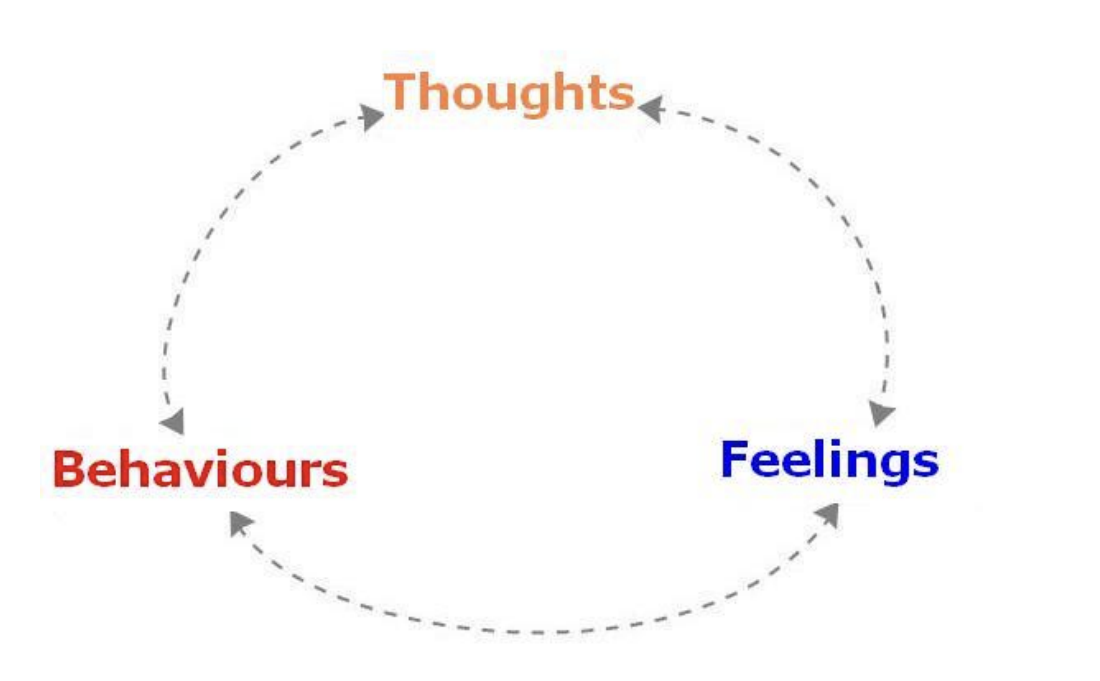
Change behaviour; thoughts and feelings will follow
Goals
Replace maladaptive behaviours with adaptive behaviours (behaviour modification)
Role of counsellor
Teacher, advisor, reinforcer, consultant, and facilitator
Techniques
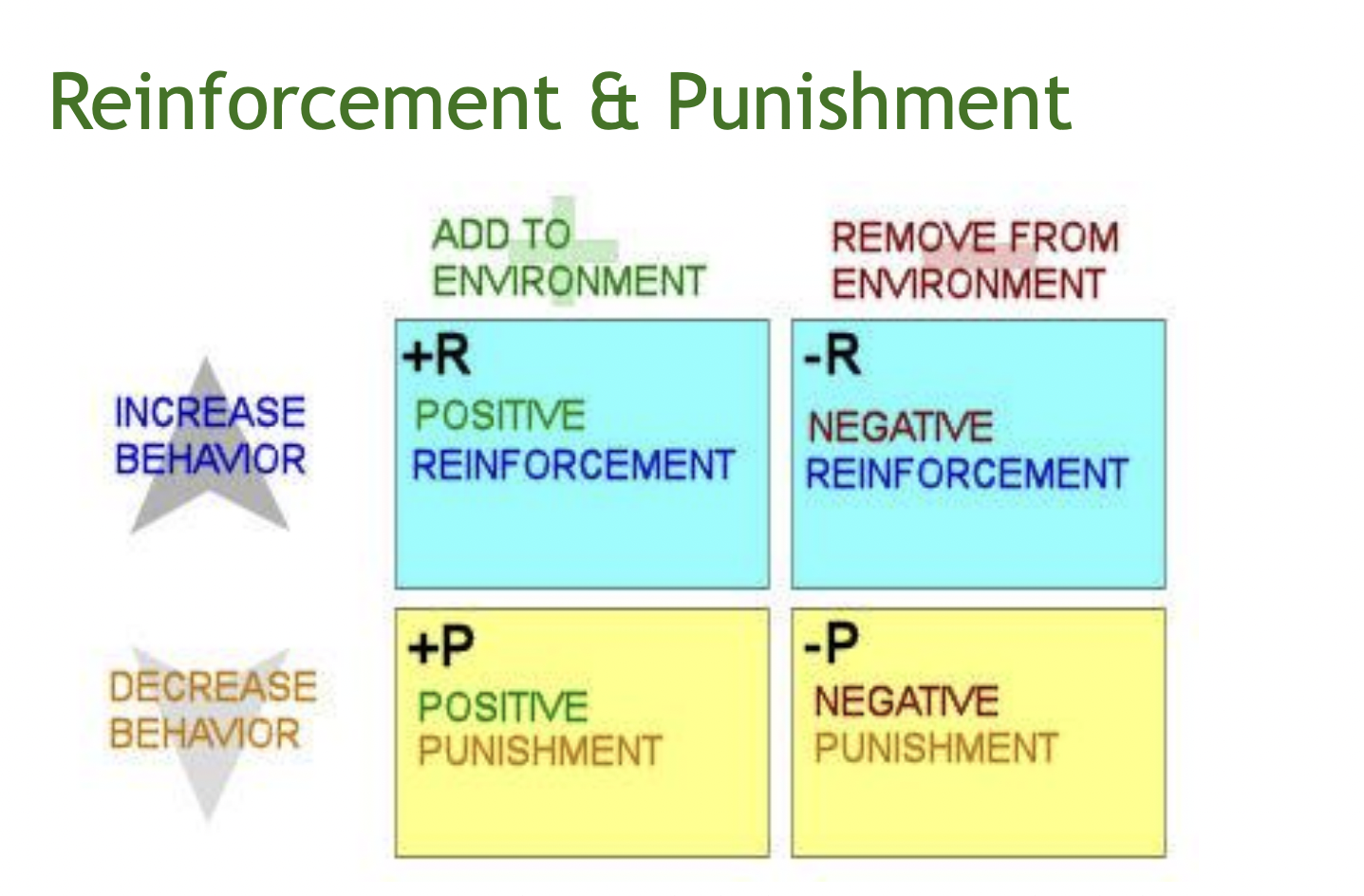
Reinforcement and Punishment: positive and negative
Systematic desensitization (graduated exposure)
Flooding (not gradual, throwing someone full in)
“Time-out”/Magic 1-2-3
Shaping
Reinforcement and punishment
Positive reinforcement
Presenting a motivating/reinforcing stimulus to the person after the desired behavior is exhibited, making the behavior more likely to happen in the future.
Little boy gets $5 for every A → To influence behaviour to be continued
Negative reinforcement
A certain stimulus (usually an aversive stimulus) is removed after a particular behavior is exhibited. The likelihood of the particular behavior occurring again in the future is increased because of removing/avoiding the negative consequence.
Child who eats all vegetables at dinner does not have to do dishes
Positive punishment
A certain desired stimulus is removed after a particular undesired behavior is exhibited, resulting in the behavior happening less often in the future.
If a child does not follow direction or acts inappropriately, he loses a token for good behaviour that can later be cashed in for a prize
Negative punishment
Presenting a negative consequence after an undesired behavior is exhibited, making the behavior less likely to happen in the future.
Child grabs toy from another child and the toy is taken away as a result
Limitations to Behavioural Therapy
Only deals with explicit behaviours (not whole person) – overly focused on symptoms
Sometimes too systematic & simplistic
Best used under experimental conditions
Ignores past, history & unconscious
Ignores higher level needs – self-worth, self-actualization & sense of fulfillment
Cannot explain observational learning without including cognitions
Cognitive & Cognitive-Behavioural Counselling (CBT)
Rational Emotive Behavioural Therapy (REBT)
Albert Ellis
View of human nature
People have both rational and irrational beliefs, humans are gullible, humans are fallible
To realize that individuals are irrational, they must have the ability for “self talk” to gain command of their lives → Conscious mind
Role of the counsellor
Teacher (active, direct), correct cognitions, challenge irrational beliefs
Listen for illogical statements and be very analytical
Goal
Restructuring thoughts (core beliefs) to live more productive and rational lives through practice
Major Concept
ABCDE model of REBT
A (Activating experience)
B (Belief)
C (Emotional Consequences)
D (Disputing irrational thought)
E (Effective thoughts, new personal philosophy)
F (New feelings)?
Techniques
Cognitive disputation
Imaginal disputation (imagining a situation, analyzing irrational thoughts)
Behavioural disputation (e.g., role playing)
Confrontation, encouragement
Bibliotherapy & homework
Strengths
Easily learned
Can be combined with other techniques
Can be short term
Empirical evidence
Limitations
Not effective with severe cognitive challenges (schizophrenia)
Mechanical
Does not emphasize working alliance (directive and argumentative/adversarial)
may not be simplest way of changing emotions
Can be overly focused on deficit/symptom reduction (medical model)
Cognitive therapy (CT) - Aaron Beck
View of Human Nature
Dysfunctional behaviour is caused by dysfunctional thinking
Role of counsellor
Active
Make covert thoughts overt
Gain awareness of automatic thoughts
Help client evaluate the evidence for thoughts, test through behavioural experiments
Goals
Change negative thoughts and cognitive distortions (ex: all-or-nothing thinking, overgeneralization)
Techniques
Challenge the way info is processed
Counter mistaken beliefs (poor reasoning)
Self-monitoring exercises – to stop ATs (catching thoughts → preventing spiral)
Improve communication skills
Increase positive self-statements (affirmations, positive thinking)
Homework
Strengths
Applicable in a number of cultural settings
Evidence-based (empirical evidence)
Lead to useful assessment tools (i.e., BDI)
Limitations
Clients need to be active - Homework
Highly structured
Not useful for low cognitive functioning individuals
Can be overly focused on deficit/symptom reduction (medical model)
Reality therapy
William Glasser (1925–2013)
View of human nature
Human beings operate on a conscious level; they are not driven by unconscious forces or instincts. Everyone has a health/growth force: physical & psychological Major Concepts:
Four primary psychological needs are the following:
Belonging —the need for friends, family, and love
Power—the need for self-esteem, recognition, and competition
Freedom —the need to make choices and decisions
Fun—the need for play, laughter, learning, and recreation
need for Identity —the development of a psychologically healthy sense of self •
human learning is a life-long process based on choice
Goal
1) help clients become psychologically strong and rational and realize they have choices in the ways they treat themselves and others
2) to help clients clarify what they want in life
3) to help the client formulate a realistic plan to achieve personal needs and wishes
4) meaningful relationship between client and therapist
5) to focus on behaviour and the present
Role of counsellor
teacher, model, warm and involved environment. Special attention is paid to metaphors and themes clients verbalize
Reality therapy
Techniques
action-oriented techniques; teaching, employing humor, confronting, role-playing, offering feedback, formulating specific plans, and composing contracts
WDEP System to make progress and employ techniques
W – want
D – direction
E- evaluation
P- plan
Strengths
Versatile populations
Concrete
Can be short-term
International training centres
Promotes responsibility and freedom
Challenges medical model- refreshing alternative to pathologizing models
Addresses conflict resolution
Focus on the control we have in the present
Limitations
Ignored concepts- unconscious, personal history developmental stages
All mental illness result of external events
Requires clear two-way communication
Could become overly moralistic