Tree Thinking and Dichotomous Branching The Three Domains of Life
Overview
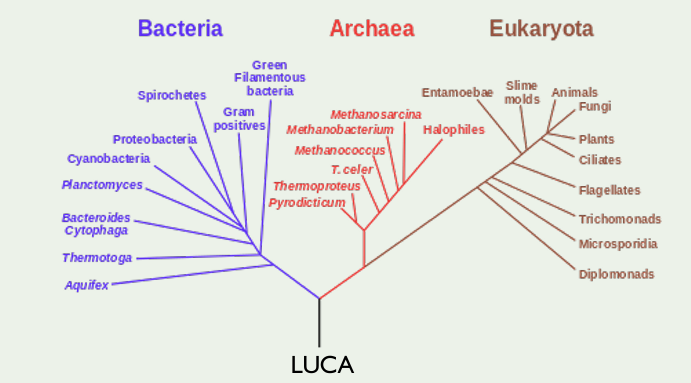
Three recognized domains:
Bacteria
Archaea
Eukaryota
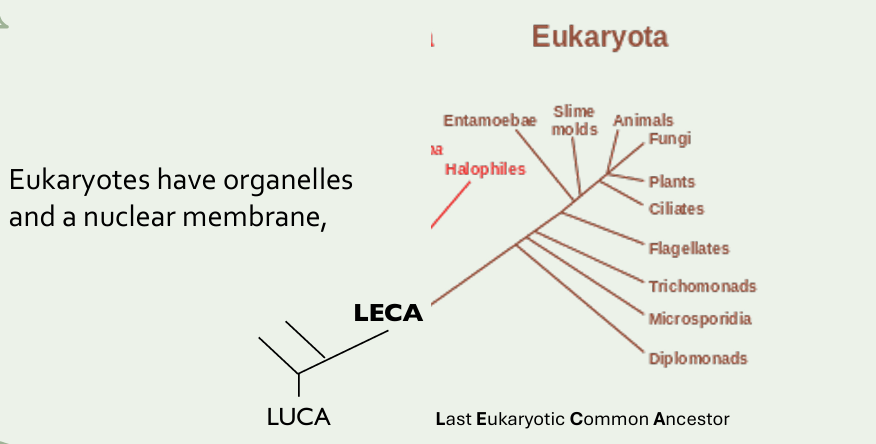
Key concepts include the Last Universal Common Ancestor (LUCA) and the Last Eukaryotic Common Ancestor (LECA).
The Tree of Life
Cultural Significance
The Tree of Life:
An archetype in various world mythologies and religions.
Symbolizes the origin and continuity of life.
Biological Importance
Model and Research Tool:
Essential for exploring the evolution of life.
Highlights relationships among organisms.
Assumption in Biology:
All organisms are related, tracing back to LUCA.
Phylogenetic Tree of Life Structure
Overview of Tree Composition
Branches of Life:
Bacteria:
Sub-divisions include:
Spirochetes
Proteobacteria
Cyanobacteria
Planctomyces
Bacteroides
Cytophaga
Thermotoga
Aquifex
Archaea:
Examples include:
Methanosarcina
Methanobacterium
Halophiles
Methanococcus
Thermoproteus
Pyrodicticum
Eukaryota:
Includes:
Animals
Fungi
Plants
Protists (Ciliates, Flagellates, Trichomonads, Microsporidia, Diplomonads)
LUCA (Last Universal Common Ancestor):
Common ancestor for all current and past organisms.
Eukaryotic Specifics
Eukaryotes:
Have organelles and a nuclear membrane.
LECA (Last Eukaryotic Common Ancestor):
Represents the common ancestor of all eukaryotic organisms.
Differences Between Prokaryotes and Eukaryotes
Prokaryotes (Bacteria and Archaea):
Lack cell organelles.
Many biochemical and rRNA markers separate Archaea from Bacteria.
Dichotomous Trees and Keys
Definition and Origin
Dichotomous Trees:
The term derives from Greek:
Di- = two
-tomia = cutting
Represents the division of organisms into groups through a stepwise approach.
Biological Implications
Illustrates an evolutionary assumption: Organisms split into groups one at a time.
Emphasizes the sequence of evolutionary events, with proximity to the base/root signifying earlier origins.
Stepwise Approach to Sorting
Utilized in dichotomous keys, valuable for identification or diagnosis.
Reflects evolutionary relationships among organisms.
Examples of Dichotomous Keys (Plant Identification)
Basic Structure of a Dichotomous Key
Example Inquiry:
Is the plant woody?
Yes → Proceed to step 1.
No → Proceed to step 1’. (herbaceous plants)
Further Example Steps for Classification
If woody:
Does the woody plant have flat and broad leaves?
Yes → Go to step 2.
No → Go to step 2’.
If flat and broad leaves:
Is the plant taller than 3 m?
Yes → (identifies as trees).
No → (identifies as shrubs).
If not flat and broad:
Are the leaves waxy and needle-like?
Yes → (identifies as conifers).
No → End classification based on other attributes.
Full Classification Example in Steps
Plant Types Identified:
Herbaceous plants
Broadleaf trees
Broadleaf shrubs
Conifers
Key Takeaways
Three Domains of Life:
Bacteria, Archaea, Eukaryota.
LUCA:
A shared ancestor for all current and extinct organisms.
LECA:
Represents the common ancestor to all eukaryotes.
Importance of Tree Diagrams & Dichotomous Keys:
Illustrate sequential changes in evolutionary history.
Crucial tools for identifying and classifying organisms.